President of Kazakhstan Delivers Lecture at United Nations University
20.12.2025 08:00:57 3813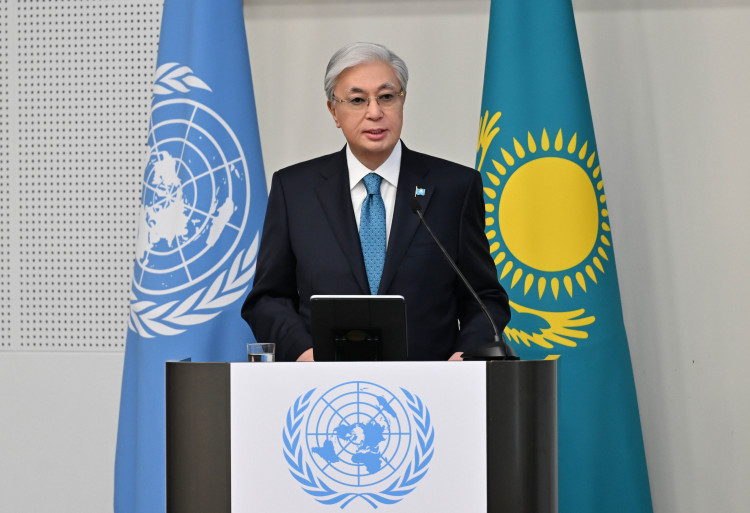
President Kassym-Jomart Tokayev visited the United Nations University in Tokyo, where he delivered a lecture titled “Rebuilding Strategic Trust in an Era of Turbulence: Kazakhstan’s Vision for a More Just and Stable World”.
– I am proud to stand here as the first Head of State from our part of the world to address this distinguished institution. I regard this as a sign of genuine trust in Kazakhstan’s growing international role and as recognition of our continued efforts to advance multilateralism and uphold global stability. The United Nations is of special significance for me, as I had the privilege of serving as Under-Secretary-General and Director-General of its Office at Geneva, as well as Secretary-General at the Conference on Disarmament, – said the President.
The Head of State congratulated the university’s staff on the anniversary marking 50 years since the start of its activities and highlighted the United Nations University’s contribution to developing practical solutions for the benefit of the entire international community.
Kassym-Jomart Tokayev also noted that the principles of Japanese ethics resonate with his own convictions, according to which true strength rests in harmony, wisdom and responsible leadership.
– As Prince Shotoku wrote in the 7th century – “harmony is to be valued above all.” Today, the same principle remains central to statecraft and international relations, and it is strongly reflected in Kazakhstan’s foreign policy, – noted the President.
The Head of State went on to outline his vision for building a more just and stable world amid escalating crises and the significant weakening of mechanisms of multilateral cooperation.
– The number and intensity of armed conflicts worldwide has reached its highest level in decades, while global military spending last year hit a record 2.7 trillion dollars. At the same time, rivalry between major countries is gaining its highest extent of tension that has already made the Security Council of the United Nations unable to tackle any of large-scale international conflicts, – Kassym-Jomart Tokayev stated.
In his view, for international institutions to function effectively, the global community urgently needs to restore mutual trust and predictability.
– A renewed culture of strategic trust must therefore anchor international cooperation and collective decision-making. In this spirit, Kazakhstan has been consistently advancing these pillars through initiatives such as the Conference on Interaction and Confidence-Building Measures in Asia and the Congress of the Leaders of World and Traditional Religions. It is clear that no state can meet today’s challenges alone. Only principled and effective collective action can deliver lasting results. In this context, the United Nations must continue to play a central role in the multilateral system as the universal and indispensable organization, – the President of Kazakhstan emphasized.
At the same time, he drew attention to the fact that the United Nations’ capabilities are increasingly constrained by growing geopolitical polarization and declining trust among major powers. He went on to note that, as a result, comprehensive UN reform is no longer a matter of rhetoric, but a shared priority and a strategic necessity.
– Any meaningful reform must begin with a renewed commitment to the UN Charter. Its core principles – sovereignty, territorial integrity, and peaceful settlement of disputes must be upheld universally and without exception. Yet, some provisions of the Charter no longer reflect the realities of the 21st century, including those that unfair to Japan and other countries greatly supporting the UN. The world has changed, while the Charter has not kept pace. I believe the time has come for a responsible dialogue on how to ensure that it remains credible and relevant for the future, – Kassym-Jomart Tokayev said.
The Head of State considers reform of the UN Security Council to be an extremely important and urgent task. He called for broader participation in this body by middle powers representing Asia, Africa and Latin America.
– Therefore, the voices of responsible Middle Powers must be significantly amplified in the Security Council, where they can serve as constructive mediators and help advance solutions when larger actors are divided. Kazakhstan sees its foreign policy mission precisely in this role. We pursue a principled, balanced, constructive multi-vector diplomacy that reflects our national interests and identity as an emerging Middle Power while strictly upholding the Charter of UN, – stated the President.
Taking the opportunity, Kassym-Jomart Tokayev expressed his sincere appreciation to former Minister for Foreign Affairs of Japan Yoriko Kawaguchi for her significant contribution to strengthening ties between the two countries. The President recalled that it was she who initiated the Central Asia–Japan summit format.
The Head of State emphasized that Kazakhstan enjoys broad recognition as a credible and reliable partner.
– Kazakhstan maintains comprehensive strategic cooperation with our immediate neighbours – Russia, China and Central Asian countries. We regard this neighborhood as a strategic advantage that enables us to promote confidence and connectivity across Eurasia. We also deepen long-term engagement with the United States, the European Union and expand our ties across the Middle East, Asia and the Global South. Japan is a country of huge importance for Kazakhstan and we will be doing our best to further promote friendship and cooperation to foster new still untapped opportunities of trade and investments. This balanced and unbiased approach strengthens Kazakhstan’s constructive diplomacy in an increasingly geopolitical fragmented world, – the Head of State continued.
A special focus of the address was placed on the growing nuclear threat. Kassym-Jomart Tokayev recalled that few countries can understand as deeply as Kazakhstan and Japan the price humanity has paid for nuclear weapons.
– Hiroshima, Nagasaki and Semipalatinsk are reminders of the high cost of nuclear responsibility and restraint. After gaining independence, Kazakhstan took a historic and principled decision to close the Semipalatinsk Nuclear Test Site and to renounce the world’s fourth-largest nuclear arsenal. This was not a sign of weakness, but an expression of strategic foresight and strong commitment to peace and human security. Three decades later, our position remains unchanged: global security architecture cannot rely on nuclear deterrence. The international community must intensify efforts toward complete nuclear disarmament and ensure the universal entry into force of the Comprehensive Nuclear-Test-Ban Treaty. Kazakhstan calls for renewed high-level dialogue among nuclear powers and stronger multilateral action to eliminate the threat of nuclear weapons and testing. In this global effort, Kazakhstan and Japan have a unique moral authority. Together, Astana and Tokyo could help smooth out divides and provide pragmatic leadership when nuclear powers struggle to reach consensus, – noted the President.
Continuing this theme, the Head of State recalled Kazakhstan’s initiative to establish an International Water Organization under the auspices of the United Nations. He invited the United Nations University to take an active part in conducting research in support of these efforts.
Looking to the future, Kassym-Jomart Tokayev described artificial intelligence as one of the decisive forces shaping the modern world. At the same time, he noted the emerging risks associated with unequal access to AI and its misuse, including for military purposes.
– The United Nations should play the central coordinating role – just as it once shaped universal norms on nuclear safety or civil aviation. As a global university located in one of the world’s leading technological centres, the UN University is uniquely positioned to advance international research on AI’s opportunities, risks and governance, – said the President.
The Head of State emphasized that Kazakhstan’s standing on the international stage is directly underpinned by the progress achieved at home. In his view, it is responsible domestic policy that forms the foundation of effective diplomacy.
– I attach particular importance to developing education and international academic collaboration, especially in areas where global transformation is accelerating. These priorities are fully aligned with the mission of the United Nations University. This year, Kazakhstan became a home for the UN Regional Centre for Sustainable Development Goals for Central Asia and Afghanistan. Building on this foundation, Kazakhstan would be honored to host a regional branch of the United Nations University in Almaty. Its activities could focus primarily on water and climate security, conflict prevention and peacebuilding, sustainable development and AI governance, – Kassym-Jomart Tokayev proposed.
In conclusion, the Head of State stated Kazakhstan’s interest in further strengthening institutional partnership between the United Nations University and leading Kazakh universities in the areas of joint research, academic exchanges and graduate training programs.
The United Nations University is a global research and educational center headquartered in Tokyo, established by the UN General Assembly. It brings together 13 institutes located in 12 countries worldwide.
Source : https://www.gov.kz/memleket/entities/mfa-geneva/press/news/details/1129353?lang=kk