Manufacturing industry will be the driver of GDP growth in 2026
14.01.2026 08:00:47 2458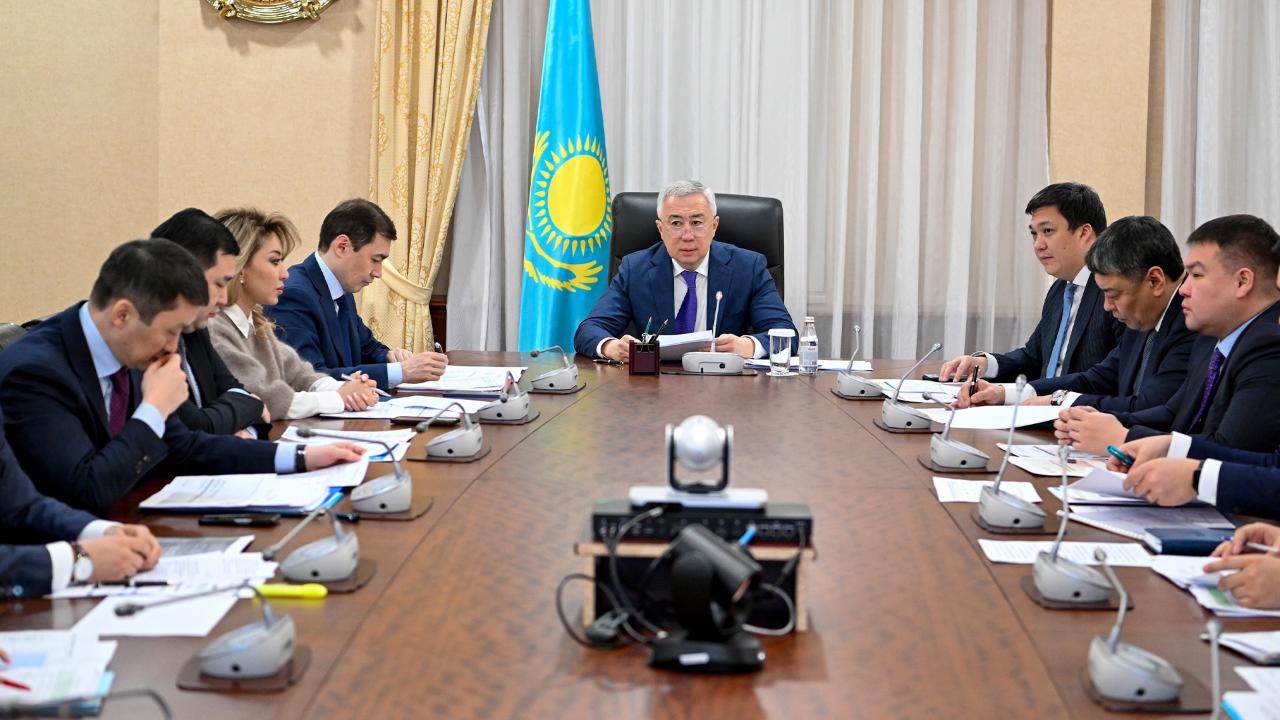
The first meeting of the Economic growth headquarters this year was held in the Government under the chairmanship of Deputy Prime Minister - Minister of National Economy Serik Zhumangarin. The main topic of discussion was the tools for maintaining high rates of economic development in 2026.
The key focus of 2026 is the development of the manufacturing industry as one of the sources of GDP growth. On behalf of the Deputy Prime Minister, the Ministry of Industry and Construction has developed a roadmap for the development of the manufacturing industry with detailed measures for each sector.
Taking into account the systemic role of the industry in the economy, it was decided to consider each sub–sector separately at the meetings of the economic headquarters - with an analysis of weaknesses, limitations and barriers to growth.
Industry associations and major market participants will be involved in the work of the economic headquarters to comprehensively discuss the problems and development potential.
Metallurgy, which forms about 40% of the manufacturing industry, remains under special attention. In 2026, the physical volume index in metallurgy is projected at 103% due to the development of both non-ferrous and ferrous metallurgy. A significant share of metallurgy remains in the structure of trade – about 5%, which provides an additional contribution to the growth of trade turnover by increasing physical production volumes.
Steady growth is expected in the mechanical engineering industry – 13.4% in 2026. It will be provided, in particular, by an increase in the production of passenger cars, trucks and special equipment, self-propelled agricultural machinery, gondola trucks, railway platforms and household appliances.
The chemical industry is expected to grow by 7% due to the implementation of existing and new investment projects.
In the production of building materials, growth of 6% is planned to be achieved by increasing the production of Portland cement, ceramic slabs, reinforced concrete products and ready-mixed concrete.
By the end of 2025, the construction industry reached record levels – 20.1 million m2 of housing were commissioned. The Deputy Prime Minister set the task for the Ministry of Internal Affairs and the regions to maintain the set pace in 2026.
In trade, the goal for the current year is to ensure an increase in physical volume of at least +6.5%. To achieve this goal, the focus is shifting to the structural factors of expanding turnover and exports. This is an increase in wholesale supplies of agricultural products to foreign markets, including grain, and an increase in the production of food and non-food products within the country.
The key driver of IFO growth in trade will be the development of an organized wholesale link. Since this year, wholesale B2B electronic trading platforms have been fully launched, providing direct supplies between manufacturers and domestic trade entities. Sales markets for domestic goods are expanding. This year, wholesale procurement standards will be introduced, aimed at increasing pricing transparency, reducing excessive intermediaries and creating predictable business conditions.
An additional incentive for domestic producers was the updated rules of domestic trade, which provide for the mandatory allocation of at least 30% of the retail space for Kazakhstani products. Licensing and streamlining of markets as a key source of shadow trade, digitalization and traceability of supply chains will also make a significant contribution.
High growth rates will continue in the field of transport and warehousing. Growth of 6.1% is forecast in the first quarter, while a comparable contribution will be provided by freight transportation – 305.3 million tons (+13.3%) and passenger transportation – 496.6 million people (+12.2%). By the end of the year, growth in the industry is projected at +9.6%. The achievement of the indicators is planned due to the repair of 11 thousand. km of highways, the completion of the construction of the Kyzylzhar–Moynty and Darbaza–Maktaaral railway lines, the commissioning of Zaisan, Katon-Karagai and Kenderli airports, the modernization of railway and airport terminals, as well as the renovation of the transport fleet.
Following the meeting, Serik Zhumangarin instructed the regions not to slow down the growth rates in key sectors of the economy in the context of tight budget consolidation. It was also emphasized that in the context of the announced Year of Digitalization and Artificial Intelligence, special attention will be paid to the economic development of the relevant sector of the economy.
https://www.gov.kz/memleket/entities/economy/press/news/details/1140686?lang=ru