Tokayev Outlines Foreign Policy, Reform Agenda for 2026
14.01.2026 08:40:36 3321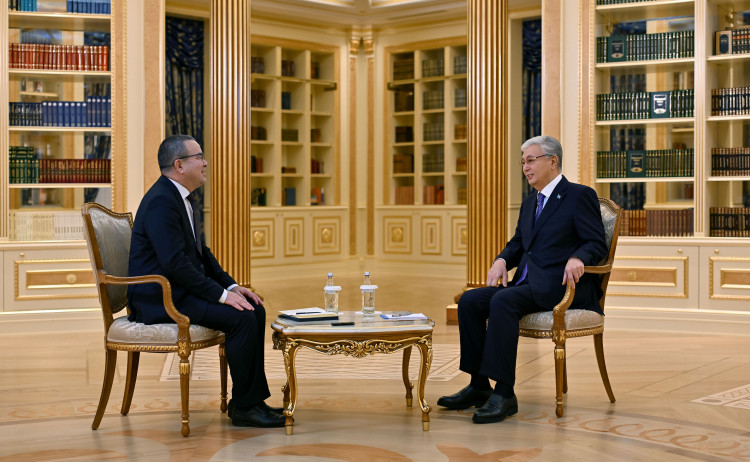
In an interview with the national newspaper Turkistan, Kazakh President Kassym-Jomart Tokayev summed up the results of 2025 for Kazakhstan's foreign policy and outlined priorities for 2026. According to him, in the second half of 2025, Kazakhstan’s foreign policy gained particular momentum, marked by President Kassym-Jomart Tokayev’s intensive schedule of high-level international engagements across Asia, Europe, the Middle East, and the United States. Tokayev said the pace and geography of these contacts reflect Kazakhstan’s growing international standing and demand as a responsible actor in global affairs.
“I have no desire whatsoever to act as a mediator in international disputes, nor do I have any aspiration to return to work at the UN, despite approaches from several countries. However, I do take part in closed consultations and discussions, especially since heads of a number of states are interested in my opinion. I do not need media coverage of this important work, I am far from populism. It seems that for participants in behind-the-scenes consultations, this point is also important,” President Tokayev said.
Tokayev stressed that Kazakhstan’s geographic position obliges the country to pursue a balanced, independent, and principled foreign policy, including active participation in shaping global discussions.
Transit and logistics as a strategic priority
Tokayev described transit and logistics as a cornerstone of Kazakhstan’s long-term strategy, emphasizing the country’s unique position at the crossroads of major continental routes.
“For our country, strengthening its transit and logistics potential is a task of strategic importance. Despite having no direct access to the sea, Kazakhstan is located at the center of the Eurasian continent at the intersection of most transit corridors. This is a major advantage that we must skillfully use for the benefit of the country,” he said.
According to him, Kazakhstan aims to transform itself into a major transport hub of Eurasia, supported by large-scale rail and road infrastructure projects, including new railway lines and the Center–West highway, which will significantly shorten travel distances between regions.
Kazakhstan has also developed a transport system that extends beyond its borders, forming a network of cargo terminals stretching from the Yellow Sea to the Black Sea. Tokayev also emphasized that 12 international transport corridors pass through the country, handling the majority of land freight between China and Europe.
“Of course, all this does not mean that we can count on easy revenues. Competition in this sector is intensifying, since transport and logistics have become an integral part of geopolitics,” he said.
Tokayev highlighted that Kazakhstan remains actively engaged in developing the Belt and Road Initiative, the North–South corridor, and the Trans-Caspian International Transport Route, while welcoming China’s participation in the Middle Corridor.
Political continuity and reforms
Tokayev rejected claims that parliamentary reform is designed to elevate the speaker’s role for personal political purposes, calling such assertions unfounded.
“The discussion of all reforms most important for the country is put to a nationwide referendum. There are no hidden meanings here. My position is well known – political reforms will continue. Some long-term plans, as always, will be announced soon,” he said.
Looking forward, Tokayev described the coming year as decisive, with major political developments expected to shape Kazakhstan’s trajectory for decades. He confirmed that a constitutional reform referendum has already been announced and that work is underway on extensive amendments on a scale comparable to adopting a new constitution.
Reflecting on Kazakhstan’s 35 years of independence, Tokayev said the country has overcome skepticism and external doubts through sustained state-building and reform.
“Reality has refuted those forecasts. Kazakhstan has emerged as a successful state with a dynamically developing economy and authoritative international positions. But ahead lies a colossal volume of work that must be carried out by both experienced professionals and young people,” he said.
Source : https://www.gov.kz/memleket/entities/mfa-roma/press/news/details/1140700?lang=kk