CONSTITUTION: COMPARATIVE CHARACTERISTICS OF THE OLD AND NEW VERSIONS
23.02.2026 12:30:48 3444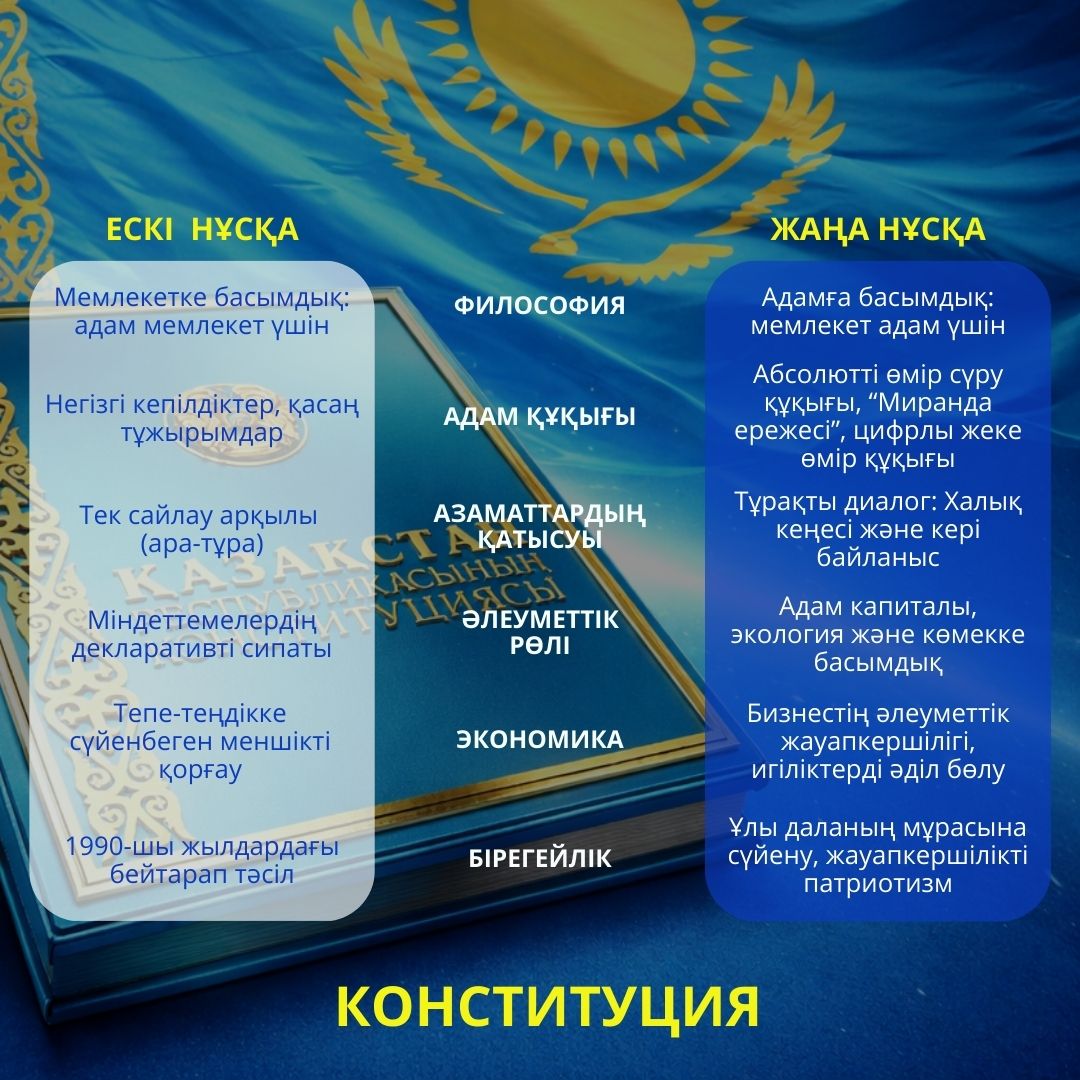
The new Constitution of the Republic of Kazakhstan aims to redefine the content and priorities of state policy and reconsider the philosophical foundations of the legal system. The content of the document clearly reflects the differences between the old and new principles.
In the old version, the state was given priority, and the principle of "man for the state" was promoted. The main guarantees were often limited to vague statements, and the obligations were declarative in nature. Citizen participation was limited only to electoral mechanisms, implemented occasionally. The principle of balance was not fully observed in the issue of property protection. The general approach was formed in a neutral manner, typical of the 1990s.
In the new version, the priority has changed radically, and the principle of "the state is for the person" has been taken as the basis. Human rights have been supplemented by the absolute right to life, and norms such as the "Miranda Rule" and the right to digital privacy have been introduced. This is aimed at strengthening the level of legal protection of citizens through specific mechanisms.
In addition, mechanisms for citizen participation have been expanded and the principle of permanent dialogue has been established. In this direction, the People's Council and feedback tools play an important role. In social policy, priority is given to the development of human capital, ecology, and assistance to those in need.
In the economic sphere, the principles of social responsibility of business and fair distribution of benefits were defined. In the issue of identity, the principles of relying on the heritage of the Great Steppe and responsible patriotism were taken as the basis.
Thus, the philosophy of the new Constitution establishes the protection of human rights, active participation of citizens, social justice, and the strengthening of national values as its main orientations.