
Central Asia Discusses University Transformation in the Era of AI and Sustainable Development
17.04.2026 19:15:51 2858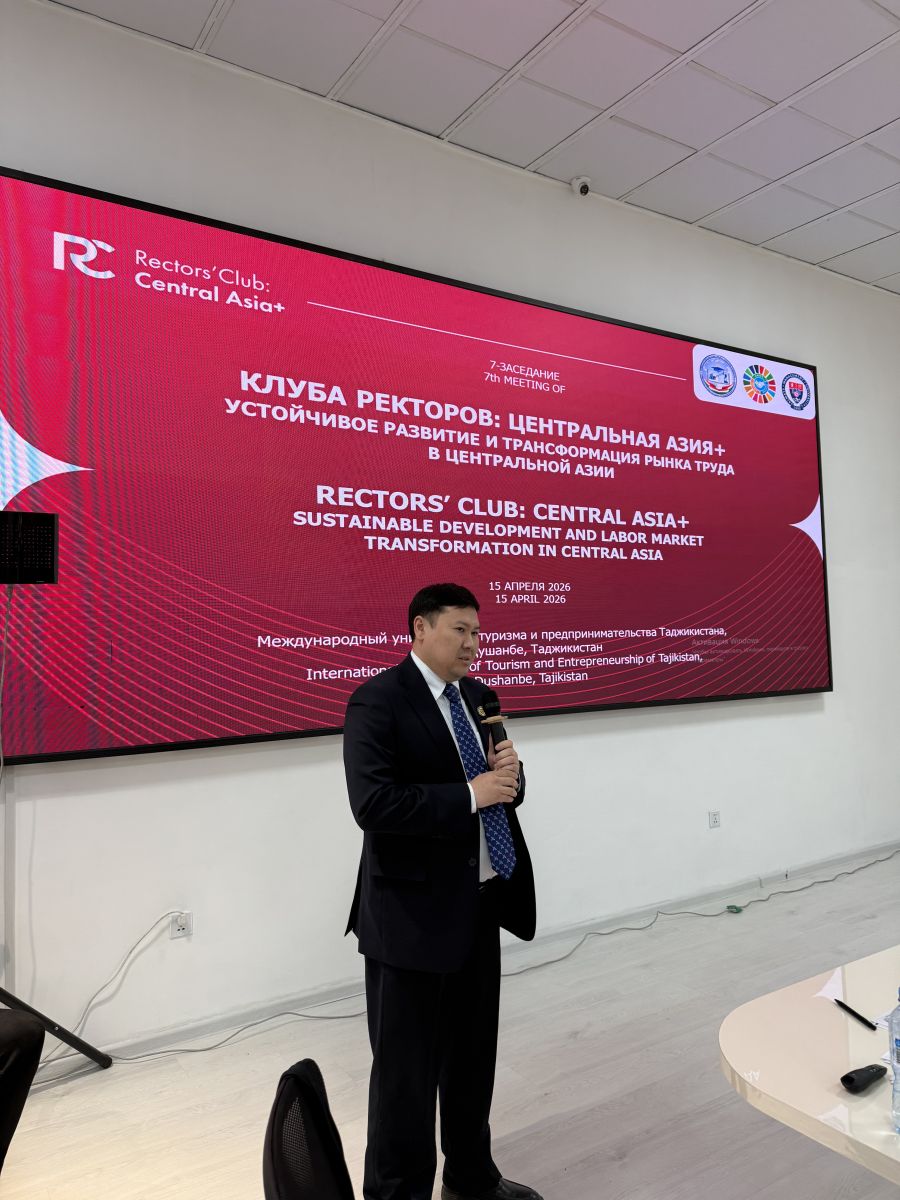
On April 15, 2026, the 7th meeting of the Rectors’ Club “Rectors’ Club: Central Asia+” was held in Dushanbe. The event brought together university leaders, government representatives, international experts, and practitioners to discuss the future of higher education in the context of global challenges. The meeting took place within the framework of the International Forum “Partnership for Sustainable Development: Green. Digital. Smart,” organized by the International University of Tourism and Entrepreneurship of Tajikistan.
The event was attended by presidents, rectors, vice-rectors, and professors from universities in Azerbaijan, Kazakhstan, Malaysia, Russia, Uzbekistan, Tajikistan, Kyrgyzstan, the United Kingdom, Burkina Faso, Indonesia, and India. The total number of participants exceeded 80.
Welcome remarks were delivered by Ubaydullo Sattor Asrorzoda, Rector of the International University of Tourism and Entrepreneurship of Tajikistan; Lutfia Abdukholik Abduholikzoda, Deputy Minister of Education and Science of the Republic of Tajikistan; Zulfiya Mahmadnabi Kurbonzoda, Vice-Rector for Strategic Development and Quality Management of the same university; Asylbek Kozhakhmetov, President of Almaty Management University and founder of the “Rectors’ Club: Central Asia+” (video message); and Timur Buldybayev, Rector of Almaty Management University (Kazakhstan).
Representatives of the academic community and education authorities emphasized the importance of strengthening regional cooperation and highlighted the role of universities in addressing pressing socio-economic and environmental challenges.
The theme of the 7th meeting was “Sustainable Development and Labor Market Transformation in Central Asia.” The session continued with keynote speeches by three main speakers.
Professor Tristan McCowan, Deputy Dean (International) at the UCL Institute of Education (University College London, UK), presented an approach to the internationalization of the “green university,” emphasizing the need to integrate international cooperation with sustainable development goals. He noted that universities must rethink their impact, focusing not only on academic performance but also on their real contribution to society and the environment. Professor McCowan highlighted the dual nature of internationalization: on the one hand, international mobility generates a significant carbon footprint; on the other hand, it enables the dissemination of knowledge and solutions necessary to address the climate crisis. He stressed that universities’ greatest impact comes through their graduates, who transform industries and societies. In this regard, he called for a rethinking of existing evaluation systems, noting that traditional rankings do not reflect universities’ real contribution to sustainable development and social change.
The practical dimension of universities’ role was presented by Elmira Karmanova, Chief Project Manager at the Almaty City Development Center, co-founder of the “COMMUNITYPLUS” Foundation, and CEO of “Community” LLP (Almaty, Kazakhstan). She shared cases of collaboration between universities and urban communities. Attention was given to project-based learning focused on solving real regional challenges and building sustainable partnerships between universities, government, and society. According to Karmanova, educational projects become truly effective only when there is a real client and a clearly defined task; otherwise, they remain formal academic exercises. She also emphasized the importance of trust within communities as a key factor for the successful implementation of joint initiatives and sustainable local change.
Pavel Luksha, an expert in the future of education, founder of Global Education Futures, associate researcher at the Learning Planet Institute (France), and member of the World Academy of Art and Science (USA), outlined systemic challenges associated with the development of artificial intelligence. He emphasized that the traditional model of higher education is rapidly losing relevance, and universities must shift toward developing practical competencies, flexible thinking, and the ability to operate in conditions of uncertainty. He also highlighted the growing role of universities as spaces for shaping new models of interaction between humans and technology.
Luksha noted that 40–80% of professional tasks are already within the potential scope of automation, especially for entry-level specialists and office-based roles. In this context, traditional higher education faces a crisis: educational programs become outdated faster than they can be updated, as new technological solutions emerge every few months. According to the expert, there is a fundamental shift from knowledge accumulation to the demonstration of practical competencies. Employers are increasingly less concerned with diplomas and more focused on the ability to solve real-world problems. Therefore, universities must transition to new educational models based on project-based learning, interdisciplinarity, and the development of adaptability skills in a rapidly changing environment. He also emphasized that amid global challenges—including underfunding sustainable development goals and growing geopolitical uncertainty—universities are becoming key centers for generating solutions and preparing future professionals.
The speakers’ presentations demonstrated that universities in Central Asia are at a point of major transformation—from traditional educational institutions to active drivers of technological, social, and environmental change.
During the foresight session, rectors of Central Asian universities discussed the prospects of integrating artificial intelligence into educational processes and its potential for achieving sustainable development goals. Participants agreed on the need to strengthen inter-university cooperation, exchange experience, and develop joint initiatives.
The meeting concluded with the recognition that universities in the region must become active participants in societal transformation, combining educational, research, and social missions. Key priorities include developing international partnerships, implementing innovative educational models, and strengthening universities’ contribution to sustainable development.
Almaty Management University expresses sincere gratitude to the organizers of the International Forum “Partnership for Sustainable Development: Green. Digital. Smart,” particularly the International University of Tourism and Entrepreneurship of Tajikistan and the team of the Research Institute for Sustainable Development and Green Economy, for the high level of organization, meaningful agenda, and the creation of an open platform for professional dialogue. The forum made a significant contribution to the development of international academic cooperation and the strengthening of partnerships aimed at promoting sustainable development principles in the region.
The “Rectors’ Club: Central Asia+” is a regional platform for strategic dialogue that brings together university presidents, rectors, vice-rectors, and experts to shape the future of higher education in Central Asia and partner countries. The Club promotes partnerships, open dialogue, and the global positioning of universities in the region, based on the principles of equality, trust, and cooperation. Since June 2023, six meetings of the Rectors’ Club have been held in Central Asia: in Kazakhstan (Almaty), Uzbekistan (Bukhara, Tashkent), Kyrgyzstan (Bishkek), and Azerbaijan (Baku).