AlmaU Management Conference: Future Management: from Artificial Intelligence to sustainable ecosystems
06.05.2026 17:49:40 2060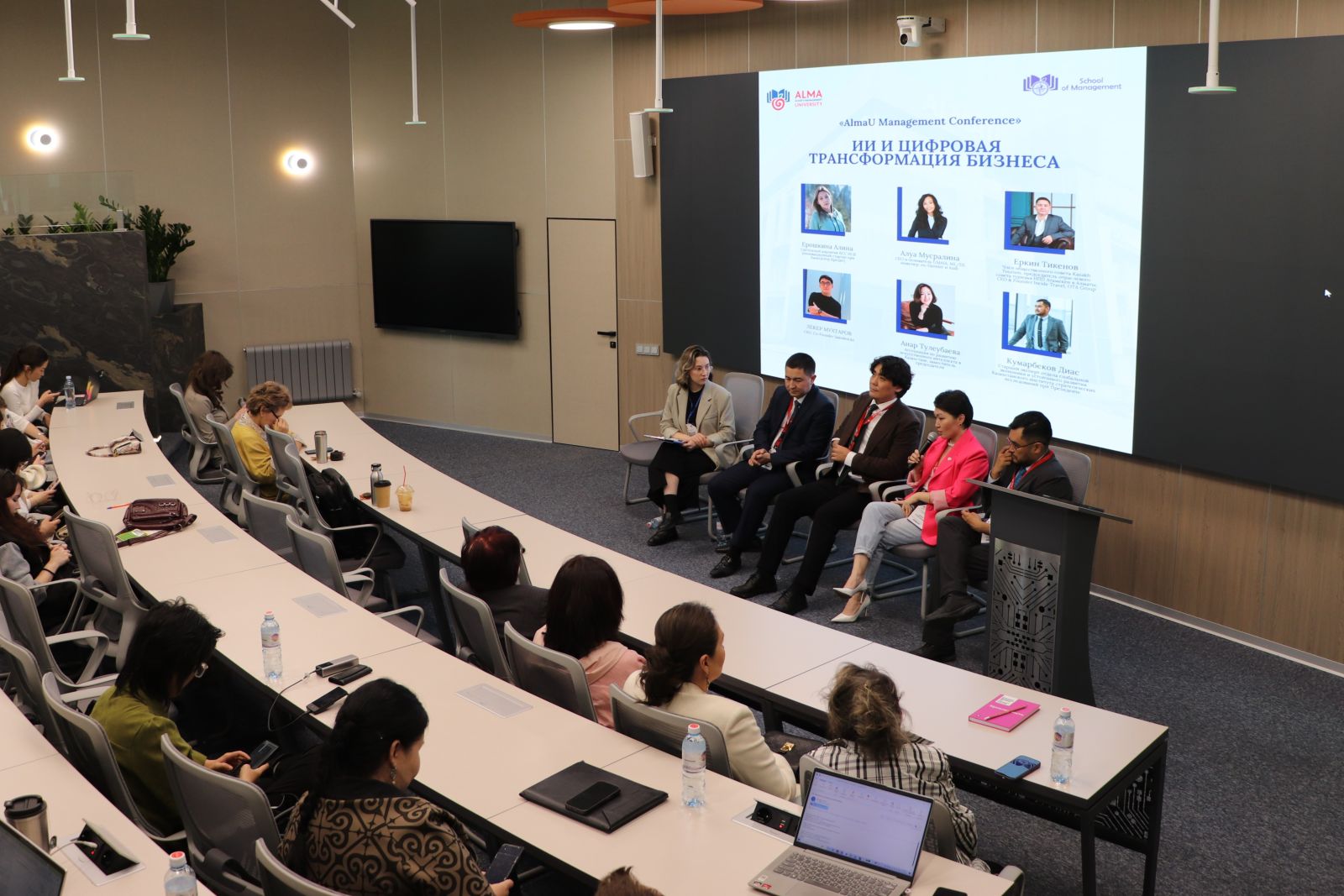
On May 5, 2026, Almaty Management University (AlmaU) hosted the First International AlmaU Management Conference, bringing together representatives of the academic community, business and opinion leaders to discuss the transformation of modern management.
The conference brought together experts to discuss key challenges - the introduction of artificial intelligence, the development of the ESG agenda and the formation of new leadership models in the BANI environment. The participants reviewed the transformation of management approaches and key competencies of future leaders.
Timur Buldybaev, Rector of AlmaU, addressed the guests with a welcoming speech.:
«For AlmaU, hosting this conference is a reflection of our mission to transform society through the synergy of education, research and entrepreneurial spirit. We strive to create not just an educational space, but an intellectual ecosystem in which new ideas, solutions and meanings are formed» he said.
The conference continued with a plenary session moderated by Azamat Toimbetov, President of PMI Kazakhstan Chapter. The session presented various conceptual approaches to understanding the role of technology, values and human capital in modern management.
María Stefanie Vasquez Peñafiel, Associate Professor at the International University of Ecuador, Quito, EU, PhD in Business Administration and Management, Master of Applied Artificial Intelligence, noted in her speech:
«We must take ethics and responsibility into account when making every decision, especially when relying on artificial intelligence. Today, this is confirmed by numerous studies: when using tools such as ChatGPT, DeepSeek or Gemini, there is a high probability of so-called “hallucinations”. In some cases, their level can reach up to 40%. Therefore, it is critically important to constantly check and recheck the results obtained with the help of AI."
Norbert Csizmadia, a geopolitical thinker, best-selling author, and ex-president of the University, continued to reveal the topic. John von Neumann, AUAP Ambassador. He introduced the concept of "turquoise zones" as learning ecosystems focused on long-term development.:
«Today we are looking for a kind of formula for the future. Each country has its own intellectual source of development. The first element is vision. The second is strong values that support this vision. The third is a “smart mix” of traditional and modern. The fourth element is adaptation and compensation through new technologies. The fifth is education. The sixth is the future, which is shaped by the development of talents. To simplify, the focus of tomorrow can be expressed in three words: nature, culture, and the future. And the future is talent, knowledge, technology and an effective combination of capital. I am convinced that Central Asia will become the next important stage of global development. In this context, Kazakhstan has unique advantages: rich culture, strong natural base, talented people and universities capable of working together. The future is created by talents, and Kazakhstan is already moving in this direction.»
In turn, Anar Tuleubayeva, Deputy Chairman of the Association for the Development of Artificial Intelligence in Kazakhstan (Qaz.AI ), told how the leaders of the future transform data into business value.
«The managers of the future are those who keep an eye on data, values, and living people behind the numbers at the same time. For such managers, AI is not a competitor or a magic box. This is a reflection partner with whom you can argue and clarify decisions.»
The panelists at this plenary session were Aurora Diaz-Soloaga, Senior Lecturer at the School of Management, Vice Chairman for Education and i5, PRME Chapter Eurasia, Kadyrzhan Damitov, PhD, Advisor to the President of AlmaU, ex-Chairman of the National Bank of the Republic of Kazakhstan, Kairzhan Abdykhalykov, Chairman of the Civil Alliance of Almaty, PhD, Professor at KBTU, Aynur Tulegenova, Executive Director of ESG at Freedom Holding Corp., Alexandra Bekisheva, CEO of Kazgiproneftetrans Engineering Company, Master of Business Informatics, graduate of Harvard Business School and University of Oxford.
The first discussion section on artificial intelligence and digital business transformation was moderated by Alina Eroshkina, system analyst at BCC HUB. In the section, participants discussed the impact of AI on development and business processes, the transformation of professions and the use of technology in public administration.
The discussion was attended by:
Dias Kumarbekov, expert at the KISI under the President of the Republic of Kazakhstan, senior lecturer at KBTU, highlighting the role of AI in strategic analysis and decision-making;
Anar Tuleubayeva, Deputy Chairman of the Association for the Development of Artificial Intelligence in Kazakhstan;
Alua Musralina, CEO of UMAIA, ML/DL Engineer, ex-Daimler and Audi;
Yerkin Tikenov, CEO of Incide Travel, travel industry expert;
Mukhtar Leker, co-founder of Ezapp Logistic Technologies.
The second discussion section was devoted to ESG and corporate governance. The participants reviewed the transition from corporate social responsibility to ESG models, as well as the integration of sustainable development principles into business processes.
To participate:
Irina Gorbacheva, Director of Sustainability Solutions, spoke about business transformation through ESG;
Zikria Nursultan, Senior ESG Manager, Freedom Holding Corp., shared the practices of integrating ESG into the risk management system;
Rafis Abazov, Director of the International Institute of Green and Sustainable Development, Vice Rector of KazNAIU;
Larisa Kogutenko, UNESCO Representative;
Zhania Khaibullina, Director of the AlmaU Center for Sustainable Development.
The third discussion section discussed approaches to management in conditions of instability and new requirements for leaders. The speakers were Valikhan Ten, CEO of the KRIDA fitness club, who shared his experience of managing teams in an unstable environment, and Gulshat Sadykova, HR Director of Starbucks, who spoke about the evolution of management models from VUCA to BANI and SHIVA.
Practical workshops were also held at the conference. The participants took part in the Urban Data Workshop led by Ivan Ryaposov, Professor of Practice at the Institute of Urban Studies, where both AI and video analytics are used to analyze urban mobility and design the urban environment.
In addition, a Neuro-Tools Workshop was held with Akdana Abuzhalitova, Head of the AlmaU Neuromarketing Laboratory, and Alexandra Pankratova, Senior Lecturer at the School of Management, dedicated to modern neuromarketing tools.
The conference has become an important platform for discussing the transformation of modern management, combining academic research, practical business experience and technological approaches. The presented discussions and workshops allowed the participants not only to exchange expertise, but also to form a holistic understanding of new management models based on the synthesis of technology, sustainable development and human capital.
The event resulted in strengthening the dialogue between science and practice, as well as identifying key areas for the development of management thinking in the context of global uncertainty and technological change.