
Proactive economic policy and new investment opportunities of Kazakhstan discussed in the Senate
18.05.2026 19:55:31 2548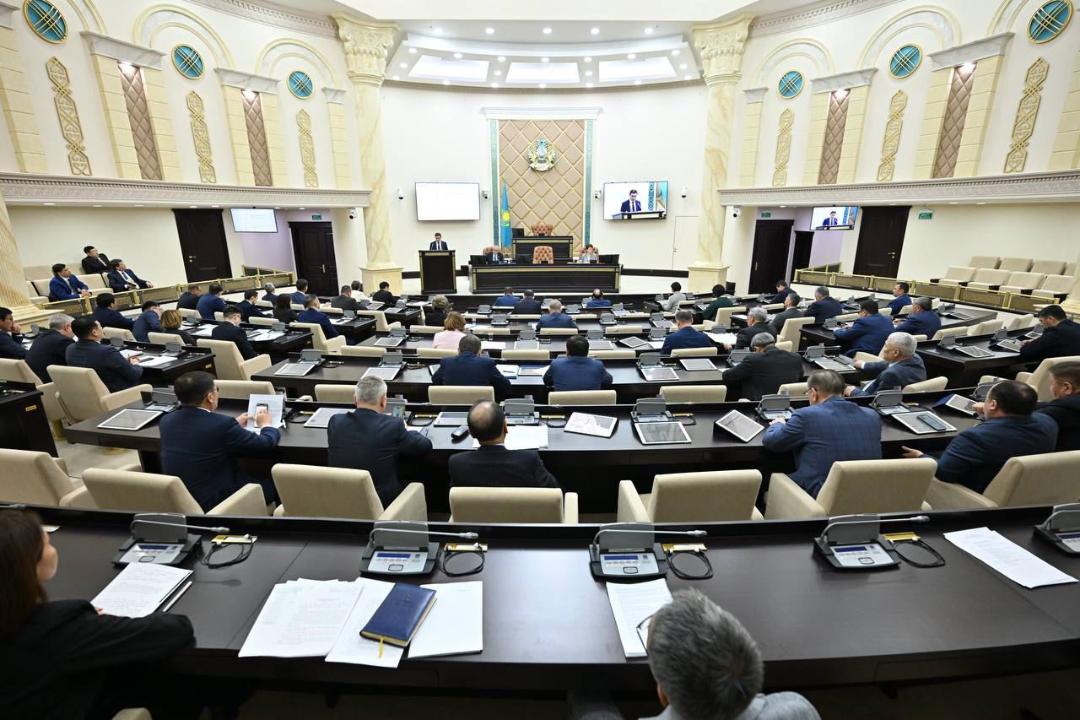
A Government hour on "Financing economic growth in 2026" was held today in the Senate of the Parliament of the Republic of Kazakhstan.
The main report was delivered by Vice Minister of National Economy Arman Kasenov, who presented a report on the current economic situation and proactive economic policy approaches aimed at achieving a GDP of 450 billion US dollars by 2029.
During his speech, the Vice Minister noted that over the past three years, Kazakhstan's real GDP growth has consistently exceeded 5%, outstripping the global average by more than 1.5 times.
"In order to maintain the momentum gained, the main driver should be accelerated investment attraction. According to the World Bank, Kazakhstan is already ahead of most countries in terms of investment activity, but for a qualitative breakthrough, we aim to increase the share of investments in fixed assets from the current 14% to 23% by 2029, generating an additional inflow of about $ 85 billion," Arman Kasenov added.
A vision was presented for the implementation of a proactive economic strategy based on three key "pillars": a point analysis and identification of highly productive niches, targeted involvement of leading global companies and the willingness of the state to provide large-scale financing.
The Ministry noted the priority of implementing clusters with high export potential, including the copper and aluminum industries, where the volume of new promising projects is estimated at more than 10-12 billion dollars. Along with metallurgy, a huge multiplier effect is expected from the deep processing of agricultural products (potential over $ 5 billion), the striking examples of which are the launch of the Dalian Hesheng investor plant in the Akmola region, the company's project
Fufeng in Zhambyl region.
In parallel with the development of exports, pools of projects in the field of import substitution have been formed, including projects in agriculture worth more than 4 trillion tenge, as well as niches in sugar production, meat products and the construction of greenhouses. In order to actively involve businesses in these areas, official invitations and ready-made cases have already been sent to several hundred of the world's leading corporations since March of this year.
The implementation of these industrial projects is designed to accelerate the diversification of the economy, as a result of which the share of oil production in the country's GDP has already more than doubled, from 16.5% in 2010 to 8.1% in 2024.
Given the scale of the challenges, the Government has already taken a set of measures to increase the availability of financing for businesses, including a differentiated reduction in the CPI rate for banks, reducing the requirements for borrowers' own participation to 20%, as well as launching mechanisms to guarantee large loans and expand support for SMEs through the Damu Fund.
To ensure the liquidity of the development institutions themselves, a three-year program of annual capitalization of the Baiterek holding was launched for 1 trillion tenge, which, due to market leverage, will allow up to 8 trillion tenge to be allocated to the economy annually (about 40 trillion tenge over 5 years). Additionally, the ministry expects a mirror activation from commercial banks, whose business lending potential is estimated at another 15-20 trillion tenge.
At the end of the report, it was noted that this whole set of synergetic measures is designed to ensure the emergence of promising projects in priority sectors, increased investment activity, increased availability of loans and further high rates of economic growth.