
Leaders of Turkic states discussed expanding economic and technological partnership at a summit in Turkestan.
26.05.2026 19:00:04 1919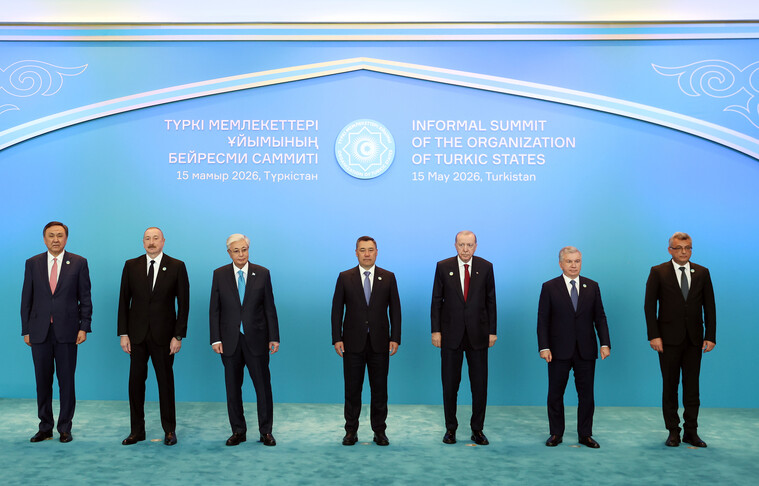
On May 15, 2026, a summit of the Organization of Turkic States was held in Turkestan. The leaders of Kazakhstan, Turkey, Azerbaijan, Kyrgyzstan, and Uzbekistan, as well as representatives of observer countries and the leadership of the amalgamated territorial communities, participated. During the meeting, participants discussed the development of trade and economic cooperation, transport corridors, digitalization, energy, and cultural and humanitarian ties.
The summit was chaired by Kazakh President Kassym-Jomart Tokayev. The central theme of the meeting was "Artificial Intelligence and Digital Development."
Turkic integration is consistently recognized as a significant factor in expanding economic horizons and unlocking mutual potential.
Its dynamics are also indicative: by the end of 2025, mutual trade between the ATC states reached $12.9 billion, demonstrating sustainable growth and increasing economic interconnectedness. The combined population of the ATC member and observer states is approximately 175 million.
Astana views the economic dimension as one of the key areas of Turkic integration, consistently advocating for the further elimination of trade and infrastructure barriers, the expansion of non-resource exports, support for small and medium-sized businesses, and the creation of a modern and predictable business environment.
During the meeting, President of the Republic of Kazakhstan Kassym-Jomart Tokayev delivered a keynote speech, emphasizing the importance of further strengthening cooperation within the Organization of Turkic States.
The head of state noted that the OTG is not a political or military bloc, but a unique platform for developing mutually beneficial partnerships between fraternal countries. He stated that expanding trade and economic cooperation, developing transport and logistics corridors, and deepening cooperation in high technology and digital transformation are currently a priority.
The leaders also emphasized the importance of expanding mutual trade, developing the Trans-Caspian route, and joint technology projects. Following the summit, the parties reaffirmed their commitment to deepening integration and coordination in key areas of cooperation.
The President emphasized that the organization's sustainable development must be based on practical results and specific joint projects that contribute to the economic growth of member countries and the well-being of their citizens.
The heads of state of the Organization of Turkic States laid a time capsule and launched the construction of a new facility – the Center of Turkic Civilization.
The center's main idea is to present the Turkic peoples as the creators of a great civilization with a unique place in world history, a profound philosophy, and centuries-old traditions of statehood. The Center will focus on scientific research, systematizing their shared historical heritage, developing cultural tourism, and international cooperation.
The architectural design will be imbued with profound symbolism. The complex is planned to reflect key concepts of the Turkic worldview, such as Tengri, Ergenekon, Kokbörі, Zherüyük, the Great Steppe, and the Tree of Life.
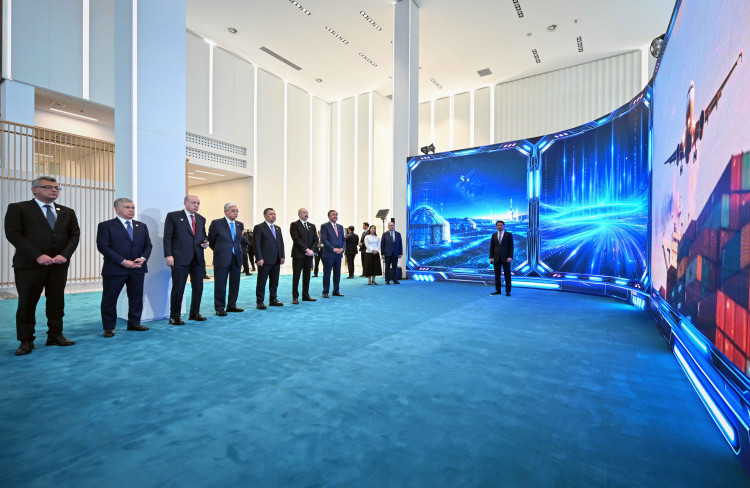
The presidents of the amalgamated territorial communities (ATCs) were briefed on key initiatives to develop Kazakhstan's digital economy and strengthen technological partnerships in the region.
Kazakhstan views AI as a strategic priority, building a fully-fledged ecosystem through the development of infrastructure, human capital, and innovative products.
Kazakhstan consistently promotes digital transformation as a priority area for the development of the ATCs, viewing the implementation of advanced technologies as key to creating a new architecture for economic growth. Priority attention is given to artificial intelligence and digital solutions, which act as drivers for increased productivity, industrial modernization, and deeper cooperation between the participating states.
Kazakhstan is actively implementing satellite communication technologies from Starlink and OneWeb, and the construction of the Trans-Caspian fiber-optic communication line promises to take the country's transit potential to a new level.
Cooperation between the United Territories of Central Asia (UTC) countries is already bearing fruit in the space industry. In partnership with Uzbekistan, Turkey, and Azerbaijan, Kazakhstan is developing a CubeSat scientific satellite, scheduled for launch next year.
Artificial intelligence is being actively integrated into public administration. Solutions such as the eGov AI assistant and the AlemGPT platform are making government services more intelligent and proactive.
Kazakhstan is also developing a continuous educational chain, from school initiatives and TUMO centers to a specialized AI Research University.
The Alem.ai international center, providing a full cycle of support from research to the implementation of finished products, is intended to become a hub for specialists and startups.
The presidents were also briefed on the digitalization of the transport and logistics sector. The main goals of implementing artificial intelligence in the industry were identified as simplifying processes, reducing costs, and increasing the transit potential of the region's countries.
In conclusion, it was noted that the countries of the United Territories of the Central Asian region unanimously supported Kazakhstan's initiative to establish an Asia-Pacific Digital Solutions Center. Kazakhstan expressed its sincere gratitude to its partners for their support, which contributed to the adoption of a resolution establishing this center in Almaty at the 82nd session of the UN ESCAP in Bangkok.
For reference: The Organization of Turkic States is a unique regional organization designed to expand trade, economic, cultural, and humanitarian ties among its member countries.
Kazakhstan is one of the founders and driving forces of Turkic integration. Our country was at the forefront of the creation of the OTG and consistently promotes the deepening of political dialogue and institutional development within the organization.
Kazakhstan has played an important role in the institutional strengthening of the OTG. Thus, the Cooperation Council of Turkic-Speaking States, established in 2009, was transformed into the OTG in 2021 as a full-fledged international organization.
Currently, the members of the OTG are Kazakhstan, Azerbaijan, Kyrgyzstan, Turkey, and Uzbekistan.
Following the informal OTG summit in Turkestan, the leaders of the member states signed the Turkestan Declaration
Source : https://www.gov.kz/memleket/entities/mfa-bucharest/press/news/details/1228828?lang=ru