
Knowledge Economy – a New Driver of Partnership between Kazakhstan and the European Union
30.06.2026 19:09:29 579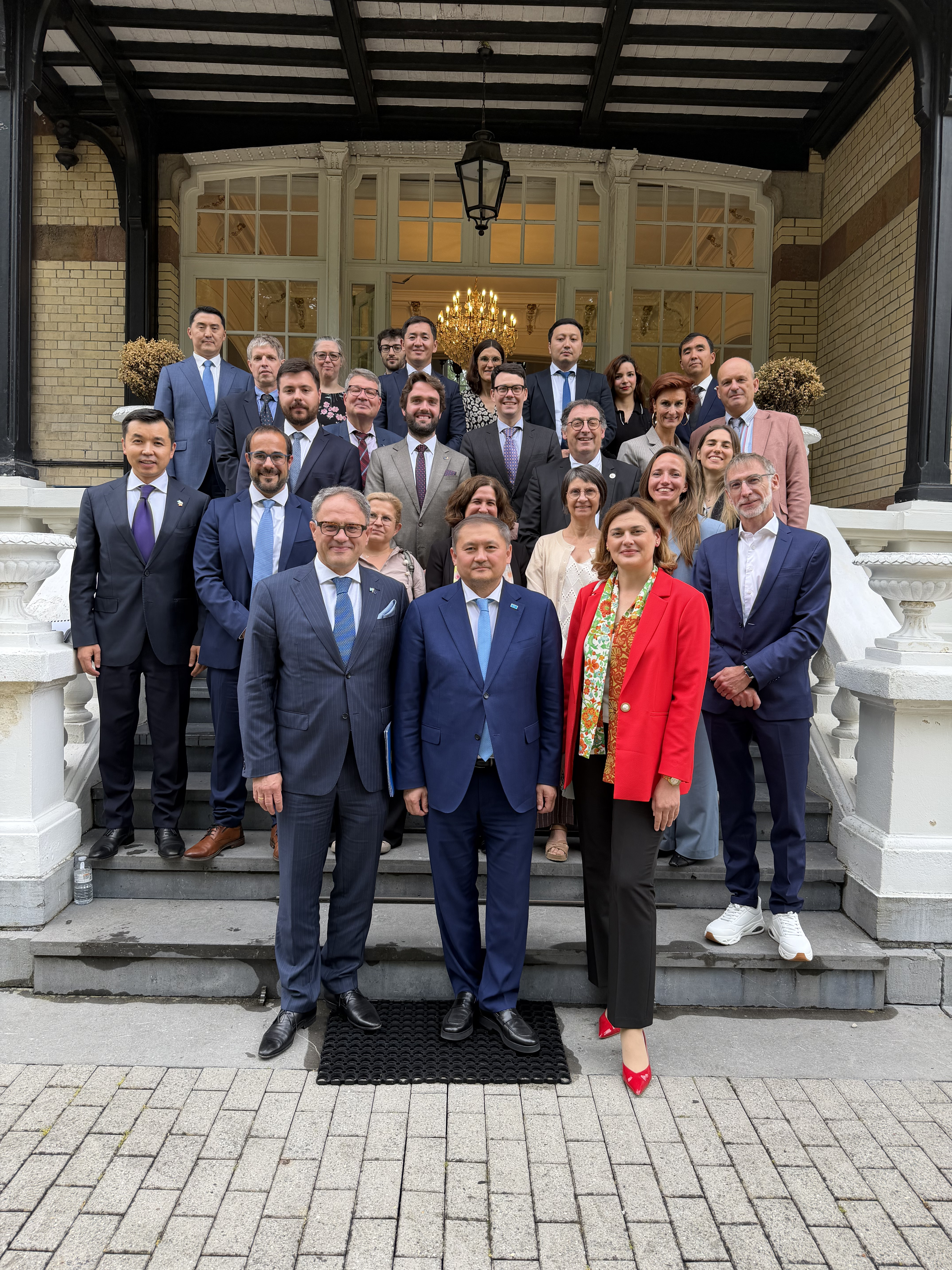
Brussels, June 2nd, 2026 – As part of the “Shanyraq Dialogue” discussion platform, the Embassy of the Republic of Kazakhstan to Belgium hosted a roundtable entitled “Kazakhstan’s Knowledge Economy: New Horizons for Partnership with the European Union”. The event brought together Kazakhstan’s Minister of Science and Higher Education Sayasat Nurbek, representatives of Belgian universities and research centres, members of the expert and diplomatic communities, and representatives of the European External Action Service.
The discussion was moderated by Karina Anguelieva, Executive Director of the International Science and Technology Center (ISTC). In her opening remarks, she highlighted the dynamic development of Kazakhstan’s solid scientific and technological potential, which was one of the key factors behind the ISTC’s decision to relocate its headquarters to Astana in 2015. She emphasized that Kazakhstan currently occupies a leading position in the implementation of several flagship ISTC projects.
Welcoming participants, Kazakhstan’s Ambassador to Belgium Roman Vassilenko noted the significant qualitative progress in Kazakhstan – EU relations over the 33 years since diplomatic relations were established between Astana and Brussels, and 10 years since the signing of the Enhanced Partnership and Cooperation Agreement between Kazakhstan and the European Union.
The Ambassador recalled that the European Union remains Kazakhstan’s largest trade and investment partner. Cooperation between the two sides continues expanding in the strategic areas such as transport connectivity, critical raw materials, green transformation, digitalization, and innovation.
Mr. Vassilenko particularly emphasized the cooperation in education, science, and technology. He noted that investment in human capital is one of Kazakhstan’s key priorities, and that deeper engagement with European universities and research centres creates new opportunities for joint research, academic exchanges, and the training of specialists for the economy of the future.
As the keynote speaker, Minister of Science and Higher Education Sayasat Nurbek presented the main priorities of Kazakhstan’s state policy in science and higher education. These include the modernization of research infrastructure, the development of research universities, the internationalization of higher education, support for young scientists, the commercialization of scientific research, and expanded participation in international research programs.
Particular attention was paid to Kazakhstan’s efforts to strengthen cooperation with the European scientific and educational community, including participation in international initiatives such as the European Union’s "Horizon Europe" program, which supports research and innovation.
In particular, Minister Nurbek stated: “The knowledge economy is built on trust, open universities, strong science, and international cooperation. Kazakhstan is interested in ensuring that cooperation with European universities is systematic and long-term, based on joint research, the exchange of experience, and the training of specialists for the economy of the future”.
During the event, participants discussed the development of the knowledge economy in Kazakhstan, international cooperation in higher education, the implementation of joint research projects, academic mobility, workforce development for emerging industries, and prospects for expanding cooperation with Belgian and European universities.
On the sidelines of the roundtable, Minister Nurbek held bilateral meetings with the leadership of several leading Belgian higher education institutions, including the Universities of Mons, Liège, and Namur, as well as the Brussels Diplomatic Academy. Following the discussions, the parties agreed to promote joint projects aimed at expanding academic mobility, student exchanges, and split doctoral (PhD) programs.
Overall, the roundtable served as an effective platform for open dialogue among government officials, academic institutions, experts, and members of the diplomatic corps on the future development of scientific and educational cooperation between Kazakhstan and the European Union.
Source : https://www.gov.kz/memleket/entities/mfa-brussels/press/news/details/1233104?lang=ru