
Implementation of the 2025 Address: How Kazakhstan’s Investment Model Is Changing
18.09.2026 15:16:22 143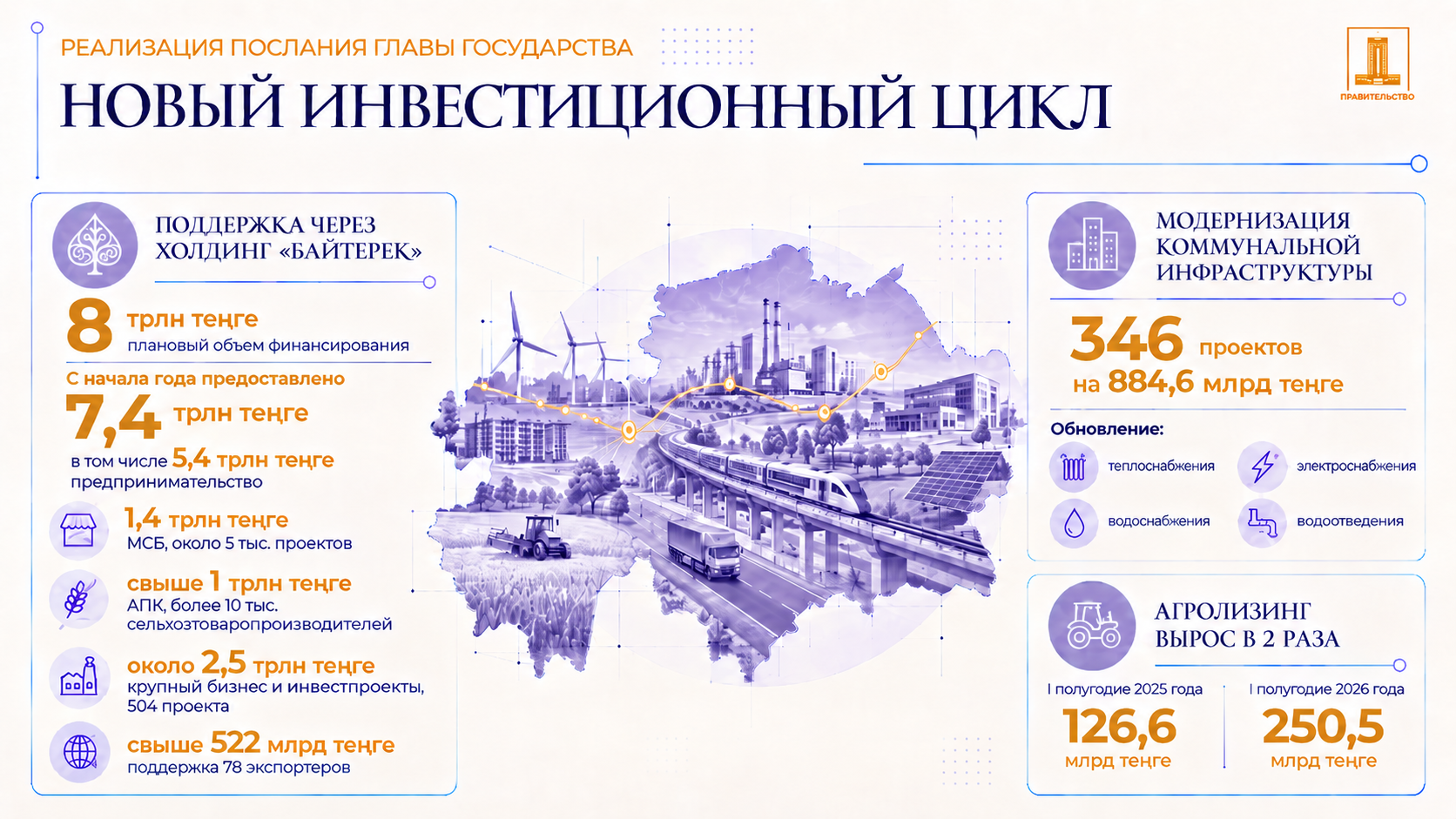
As part of the implementation of the Address by Head of State Kassym-Jomart Tokayev to the people of Kazakhstan, “Kazakhstan in the Age of Artificial Intelligence: Current Challenges and Solutions through Digital Transformation,” the country is undertaking a comprehensive overhaul of its investment policy.
In December 2025, the Investment Policy Concept through 2030 was adopted, and Baiterek Holding was transformed into a national investment holding company. The new model is focused on attracting private and foreign capital and developing domestic production, infrastructure, technology, and non-resource exports. By 2029, an additional USD 150 billion in investment is planned to be attracted through the Holding’s instruments.
The approach to attracting capital is also being improved: the state is shifting toward proactive investor outreach and targeting. For example, the regions identify priority sectoral niches and prepare investment proposals that have undergone preliminary development.
The investor support system is being restructured and now operates at the external, central, and regional levels. A Fast Track mechanism is used to expedite project implementation, while the powers of the Investment Headquarters under the Government are being expanded. Investor protection has been strengthened: a “prosecutorial filter” is in place, a unified register of problematic issues and complaints is being established, and mechanisms for the pre-trial settlement of investment disputes are being improved. In 2025, 30 Investment Agreements were concluded; in 2026, 26 agreements have already been concluded for approximately KZT 5.2 trillion.
In addition, a task force working-group mechanism is being established to support key foreign partners, and a “green corridor” is being applied to expedite the necessary procedures. The digital component of the new model provides for the development of the National Digital Investment Platform and the creation of an Integrated Analytical System for Monitoring Investment Projects, incorporating data analytics tools and artificial intelligence elements.
Fixed capital investment grew by 16.7% in 2025
Investment activity in Kazakhstan continues to show positive momentum. In 2024, fixed capital investment exceeded KZT 19.4 trillion, with real growth of 8%. In 2025, the figure increased to approximately KZT 23.5 trillion, while the real growth rate accelerated to 16.7%.
Between January and August 2026, more than KZT 13.5 trillion was invested in fixed capital, 8.1% more than in the same period of the previous year. The share of fixed capital investment in GDP increased from 14.2% in 2024 to 14.7% in 2025. In the first half of 2026, it stood at 13.4%.
At the same time, a new investment portfolio is being developed. A unified information center, Kazakhstan Investment House, is planned to be established in Astana on the basis of Kazakh Invest and to operate as a “one-stop shop.” To date, 667 specific projects with a total investment volume of USD 162.5 billion have been selected, along with an additional pipeline of projects aimed at developing the raw-material base worth USD 42.6 billion.
New projects attracted in 2024–2025 include facilities in advanced processing, industry, the agro-industrial complex, and transport infrastructure. In the Zhambyl Region, Fufeng Group is implementing a USD 350 million deep corn-processing project: construction and installation works began in 2025, and the first phase is expected to be launched in 2026. In the Akmola Region, Dalian Hesheng Holding Group is building a USD 500 million deep wheat-processing complex. Spain’s Roca Group is implementing a USD 70 million project in the Kyzylorda Region to establish a plant for the manufacture and assembly of sanitary ware.
In the Almaty Region, Solico Group has begun construction of a USD 58.8 million cheese production facility with a capacity of 155 tonnes of products per day; commissioning of the facility, which is expected to create approximately 400 jobs, is scheduled for 2027. Guoyou Materials Group is developing a USD 1.1 billion project for a new port on Kazakhstan’s Caspian coast with a throughput capacity of up to 15 million tonnes. Switzerland’s Harvest Group SA has commenced implementation of a USD 700 million agro-industrial cluster providing for the phased conversion of 300,000 hectares of land into irrigated agricultural land.
The share of budget funds fell to 14%, while the share of non-budgetary sources rose to 86%
One of the notable changes concerns the structure of investment financing. In 2024, state budget funds accounted for 21.6% of total fixed capital investment; in 2025, the share was 21.5%. Between January and August 2026, it declined to 14%.
Non-budgetary sources already accounted for 86% of investment during this period. Enterprises’ own funds remain the principal source, at 66.7%. Bank loans accounted for 5.6%, while other borrowed funds accounted for 13.7%.
Current trends indicate a declining role for direct budget financing and a growing share of businesses’ own and borrowed funds. This model is consistent with the objective of using state instruments not as the sole source of capital, but as a mechanism for mobilizing additional private resources.
The share of manufacturing in investment increased to 14.1%
In 2025, some of the highest real growth rates in investment were recorded in the energy sector at 61.8%, the agro-industrial complex at 51.8%, manufacturing at 39%, and information and communications at 32%.
The trend continued in 2026. Between January and August, real investment increased by 49.3% in the energy sector, 45.3% in information and communications, 39.9% in manufacturing, and 17.6% in the agro-industrial complex.
Particularly notable is the change in the shares of individual sectors in total investment. In manufacturing, the share increased from 10.7% in 2024 to 12.7% in 2025 and to 14.1% between January and August 2026. In the agro-industrial complex, it increased from 3.8% to 5.6%; in energy, from 6.9% to 9.7%; and in information and communications, from 1.8% to 2.3%.
Against this backdrop, the share of the mining industry declined from 18.7% in 2024 to 13.9% in the first eight months of 2026.
These changes are also reflected in the structure of the economy. Manufacturing’s share of GDP increased from 12.4% in 2024 to 12.8% in 2025 and reached 14% in the first half of 2026. At the same time, the oil and gas sector’s share declined from 8.1% to 7.8% of GDP, while the share of the mining industry as a whole decreased from 12% to 11.7%.
KZT 8 trillion for the real sector: Baiterek restructures its financing system
A key role in the new investment architecture is assigned to Baiterek Holding. In 2026, financing for the real sector through its instruments is planned to remain at KZT 8 trillion, including KZT 1 trillion through the capitalization of the Holding.
Financing parameters are also changing. The Development Bank of Kazakhstan has raised the minimum financing threshold for investment projects to KZT 15 billion and for export transactions to KZT 3 billion, thereby focusing on major strategic initiatives. The Industrial Development Fund is placing greater emphasis on mechanical engineering: the minimum financing amount for such projects has been set at KZT 1 billion, whereas for projects outside mechanical engineering, the minimum total investment project value is KZT 15 billion.
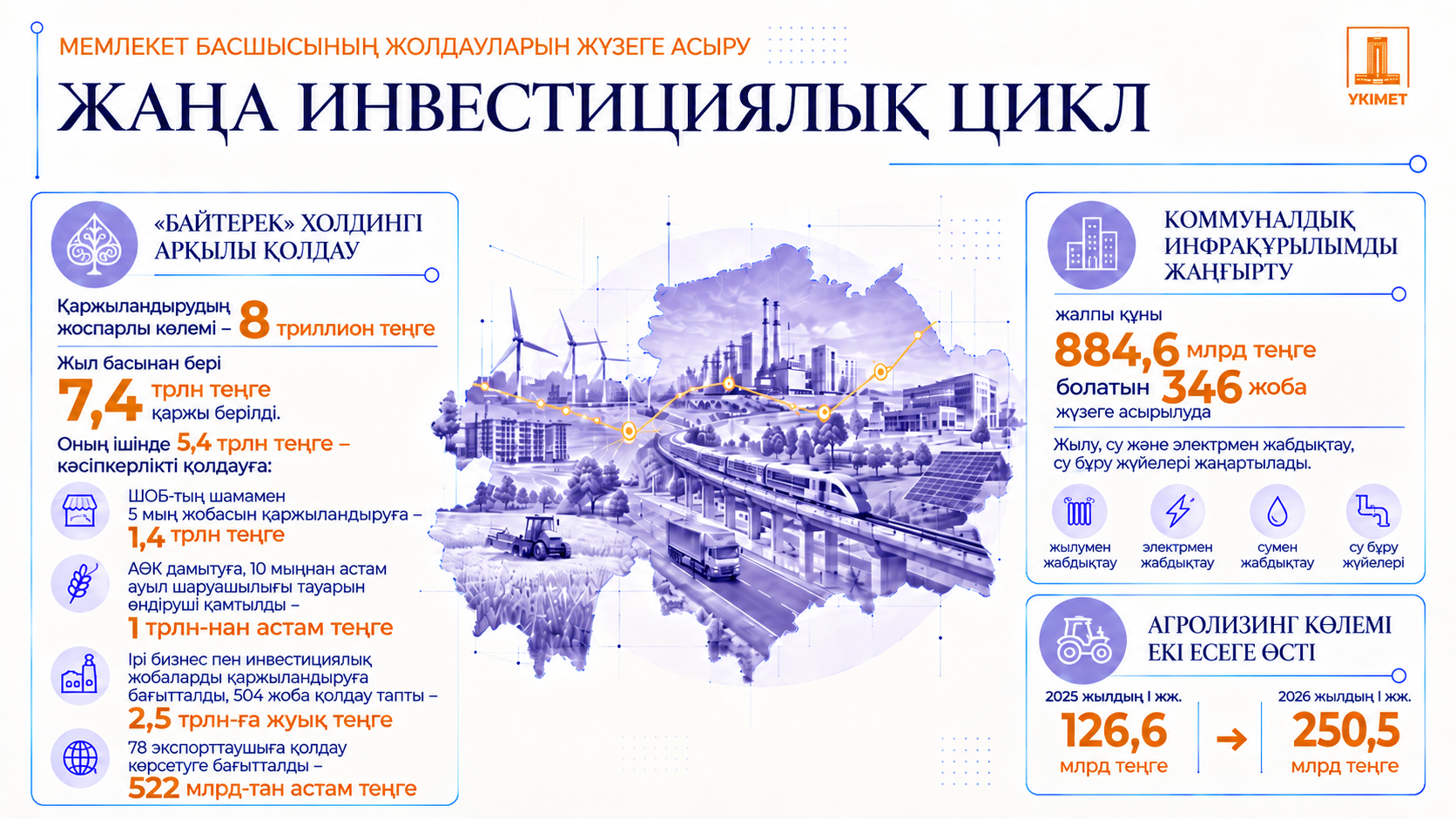
Since the beginning of the year, the total volume of support, including the housing sector, has reached KZT 7.4 trillion, of which KZT 5.4 trillion has been allocated to entrepreneurship. Through the Damu Fund, approximately 5,000 SME projects worth KZT 1.4 trillion have been supported. More than KZT 1 trillion has been allocated to the agro-industrial complex through the Agrarian Credit Corporation and KazAgroFinance for more than 10,000 agricultural producers. Approximately KZT 2.5 trillion has been channeled through the Development Bank of Kazakhstan, the Industrial Development Fund, and Qazaqstan Investment Corporation to finance 504 large-business projects and investment initiatives. The Export Credit Agency provided support to 78 exporters totaling more than KZT 522 billion.
Up to KZT 7 billion per project and a guarantee of up to 85%: support for small businesses expanded
For small and medium-sized businesses, expanding access to financing remains the principal area of support. For loans of up to KZT 7 billion under the Guarantee Fund, the guarantee may cover up to 85% of the financing amount, but no more than KZT 3.5 billion. The mechanism may be used for investment purposes, working capital replenishment, and refinancing.
The preferential lending program “Orleu” continues: financing of up to KZT 7 billion is provided at a final interest rate of 12.6% per annum for a term of up to 10 years. Priority sectors include manufacturing, tourism, IT, and creative industries. To modernize production capacity, “Orleu Leasing” provides financing of up to KZT 500 million per borrower.
A separate instrument is the Unified Small Business Support Program “Isker Aimaq.” The maximum loan amount under the program is KZT 200 million. Funds may be used both for investment purposes and for working capital. The subsidy amounts to 40% of the nominal interest rate and 50% for social entrepreneurship entities; the subsidy period is up to three years. Processing and manufacturing have been designated as the program’s core focus.
At the same time, interaction between businesses and development institutions is being streamlined. A unified front office has been established, the 1408 contact center, a CRM system, and a unified AI assistant have been launched, and integration with the National Digital Investment Platform has been completed.
346 projects worth KZT 884.6 billion allocated to modernization of public utility infrastructure
The Holding’s investment mechanisms also extend to infrastructure modernization. Under the National Project for the Modernization of the Energy and Utilities Sectors (NPMEUS), Baiterek acts as the financial operator, arranging and coordinating financing through subsidiaries, second-tier banks, and international financial institutions.
To date, 346 projects with a total value of KZT 884.6 billion have been approved under this mechanism. They are aimed at upgrading utility networks, reducing accident rates, and improving the quality of heat, electricity and water supply, as well as wastewater services.
KZT 250.5 billion in six months: agricultural leasing volume nearly doubled year-on-year
Another area of focus is the renewal of agricultural machinery. In 2025, KazAgroFinance concluded leasing agreements totaling KZT 268.9 billion for the acquisition of 10,393 units of machinery. In the first half of 2026, financing had already reached KZT 250.5 billion, compared with KZT 126.6 billion in the corresponding period of the previous year. The company’s services were used by 3,931 agricultural producers.
A range of leasing programs is available to renew the machinery and tractor fleet. Preferential leasing of agricultural machinery is provided at an annual interest rate of 6% for up to 10 years; a separate program offers a 5% annual rate for up to 7 years with a down payment of at least 10%. Under the “Made in Kazakhstan” program, domestically produced machinery and vehicles are available at 6% per annum for up to 10 years; the “Own Feed” program, on the same terms, covers forage-harvesting machinery and mobile irrigation systems. For agricultural producers that do not qualify for preferential programs, “Agroleasing” is available at 12.6% per annum for up to 10 years.
The leasing application process is fully available online: an agricultural producer may submit an application remotely, while an AI-powered service analyzes the documents and issues a decision on the application within 10 minutes. An electronic queue for preferential programs via a Telegram bot and an AI-based online monitoring system for leased assets have also been launched.
At the end of 2025, the total volume of support provided through Baiterek Holding’s instruments across all areas amounted to KZT 10.4 trillion. In 2026, the focus remains on financing the real sector, launching production facilities, infrastructure projects, supporting entrepreneurship, the agro-industrial complex, and exports.
#ZiP
Source : https://www.gov.kz/memleket/entities/economy/press/news/details/1294087?lang=ru