
T.Ospankulov informed about the work of state inspectors of social protection
11.12.2024 18:10:45 4015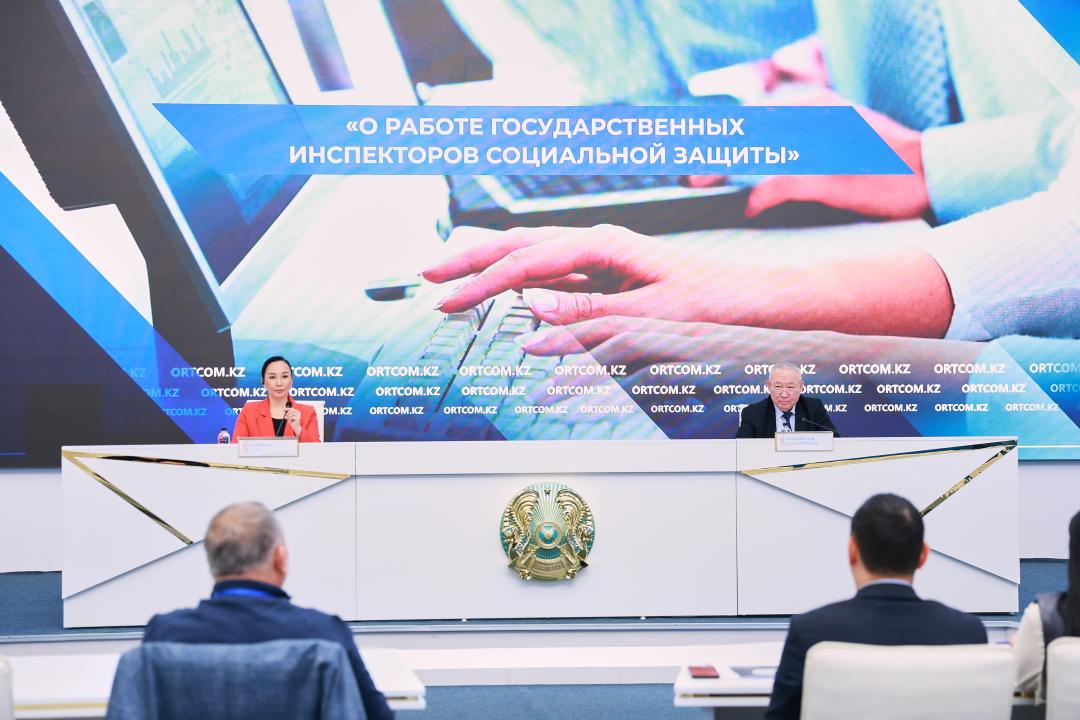
Chairman of the Committee for Regulation and Control in the Field of Social Protection (hereinafter referred to as the Committee) Tolegen Ospankulov, the Ministry of Labor and Social Protection of the Population of the Republic of Kazakhstan, spoke at a press conference at the Central Communications Service under the President of the Republic of Kazakhstan about the work of state inspectors of social protection in 2024.
At the beginning of his speech, he noted that institutions of social inspectors exist in many countries and play an important role in improving the quality of social support for citizens, as well as allow for the formation of an effective and transparent social protection system with strict control over compliance with standards in this area.
In Kazakhstan, the Institute of Social Inspectors has been introduced since the entry into force of the Social Code on July 1, 2023 to strengthen control over compliance by service providers with legislation in the field of social protection and improve the quality of services provided. To date, 111 state inspectors are working in the field of social protection of the population.
"The main activity of social protection inspectors is to monitor compliance with legislation in the field of social protection of persons with disabilities (hereinafter – LSI), the provision of special social services and social security.
The functions of social inspectors also include conducting explanatory work on issues within their competence, interacting with government agencies, individuals and legal entities on issues of ensuring compliance with the requirements of legislation on social protection," Tolegen Ospankulov said.
Social inspectors, based on the results of the inspection, make mandatory instructions to the subject of control for the elimination, prevention, prevention and prevention of detected violations and impose administrative fines for gross violations.
"Today, more than 730 thousand people live in the country. LSI, their share of the total population is 3.6%.
In 11 months of 2024, social inspectors conducted 2,474 inspections, of which 2,307 were on accessibility for people with disabilities and 167 on the provision of special social services (hereinafter referred to as SSS). 629 inspections were carried out as part of preventive control, 655 – unscheduled and 1,190 – at the request of the prosecutor's office. According to the results of inspections, 949 prescriptions were issued to service providers and 961 fines were imposed in the amount of more than 215 million tenge. The inspections covered: 174 akimats, 167 SSU centers, 88 polyclinics and hospitals, 11 rehabilitation centers, 468 kindergartens, 802 schools, 144 lyceums and colleges, 110 departments and departments of local executive bodies, 39 trading houses, 12 banks, etc." – Tolegen Ospankulov informed.
The Chairman of the Committee noted that the main violations of accessibility for LSI are: the absence of a ramp; the incongruity of the ramp angle, as well as the width of the doorway to the standards; the absence of handrails on the entrance group; inadequate sanitary facilities; lack of special parking spaces for LSI, signs, contrast guides for persons with visual impairment.
In some organizations providing SSU, the need for ongoing or major repairs has been identified, as well as the discrepancy between the area of residential premises and the required standards. In addition, violations were found in terms of compliance with the norms and requirements of nutrition, prescribing and dispensing medicines, installing video surveillance cameras, maintaining personal files of service recipients, filling in staff, the need to replace furniture, equipment, hard and soft inventory, clothing and shoes, vehicles.
Ospankulov stressed that the main focus on protecting the rights of LSI is the adaptation of facilities. Currently, the National Plan to Ensure the Rights and Improve the Quality of Life of Persons with Disabilities in the Republic of Kazakhstan until 2025, the Roadmap of the Amanat Party for 2023-2027 and the Halykpen Birge project, developed on behalf of the Head of State, are being implemented.
The Roadmap of the Amanat party in the period from 2023 to 2027 provides for the adaptation of more than 40 thousand objects included in the Interactive Accessibility Map (hereinafter referred to as the Map). 20% of the facilities are subject to adaptation annually. By 2024, it is planned to adapt 40%, or 17,325 facilities, to 2025 – 60%, 2026 – 80%, in 2027, 100%.
"Today, according to local executive bodies, 22,166 objects have been fully adapted, or 51.8% (with a plan of 40%) of the number included in the Accessibility Map. Among them are almost 3.4 thousand healthcare facilities, more than 7.5 thousand educational facilities, 3.3 thousand institutions and organizations, more than 1.8 thousand cultural facilities, more than 4 thousand objects of trade, services, entertainment, etc.
At the same time, in the regional aspect, indicators below the planned level were noted in Mangystau (36%) and Ulytau (28%) regions," the chairman of the Committee said.
Tolegen Ospankulov added that in August this year, the criteria for assessing the degree of risk and a checklist in the field of social security, including compulsory social insurance, were approved. Inspections in these areas will begin from the beginning of 2025.
"The inspections will cover the sphere of social security of the population in terms of timely and correct appointment and transfer of social benefits to recipients. The subjects of control will be the NAO State Corporation Government for Citizens, JSC State Social Insurance Fund, as well as their branches, whose activities will be evaluated according to 12 criteria," he informed.
At the end of his speech, Ospankulov said that another area of work of the Committee from January 1, 2025 will be the licensing of organizations providing SSU.
"The introduction of licensing is aimed at improving the quality of services provided to socially vulnerable segments of the population. When issuing a license, the availability of a material and technical base and equipment, a medical license, a fire safety license, the availability of an adapted building, a full staff, etc. will be taken into account. Thanks to the ongoing work, organizations that are not interested in providing high-quality services will be filtered out.
Currently, social inspectors, together with local executive bodies, are working to analyze the readiness for licensing of organizations providing SSU. Applications for licensing will be accepted from December 26," Tolegen Ospankulov summed up.
Source : https://www.gov.kz/memleket/entities/enbek/press/news/details/900720