THE NEW CONSTITUTION OF THE REPUBLIC OF KAZAKHSTAN: KEY CHANGES AND PRIORITIES
08.02.2026 14:24:56 7882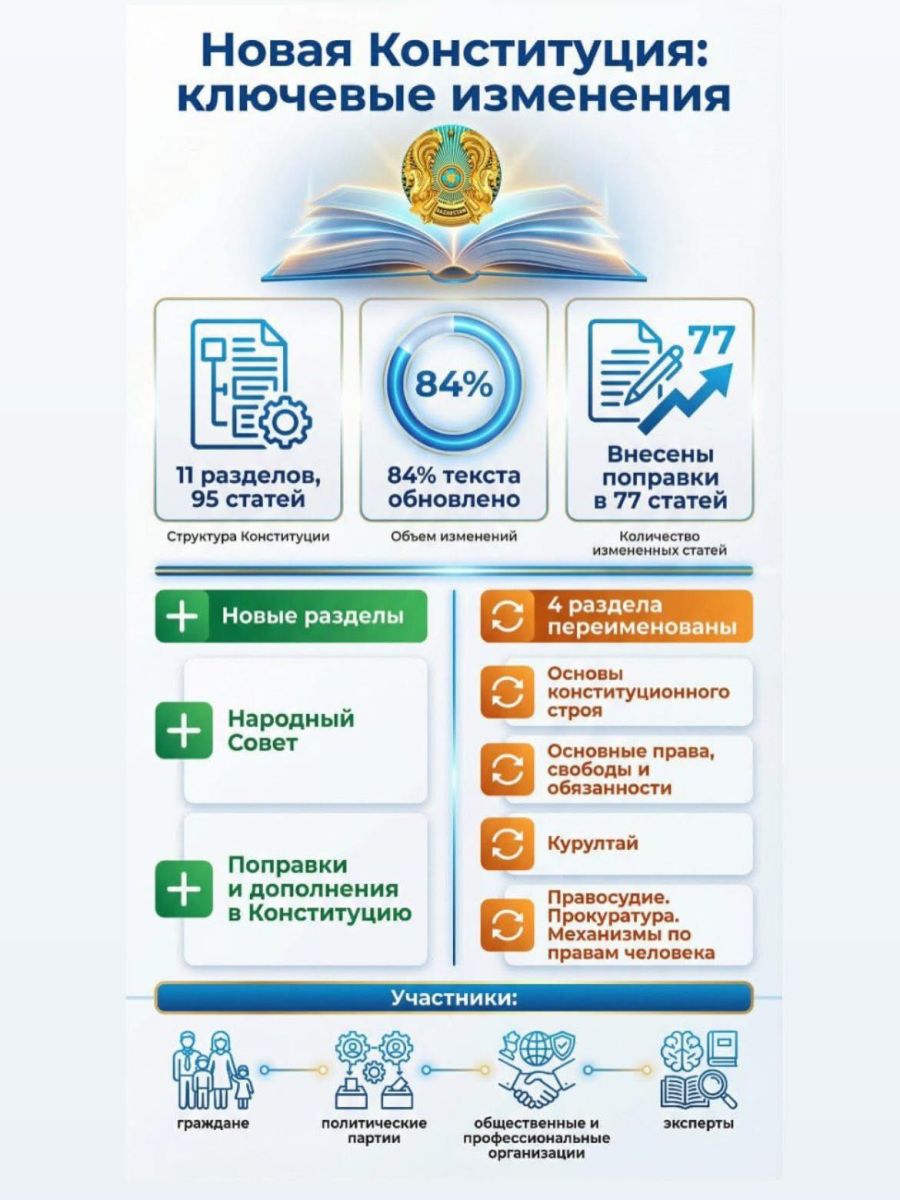
In Kazakhstan, the first draft of the new edition of the Constitution, prepared as part of the large-scale constitutional reform, was presented. The document was the result of a broad public discussion with the participation of citizens, political parties, public and professional organizations, as well as the expert community. The project of the new Constitution envisages a systematic renewal of the Basic Law of the country. In particular, it is proposed to consolidate the Preamble, 11 sections and 95 articles. At the same time, 84 percent of the text of the Constitution was updated, and amendments were made to 77 articles, which indicates the depth and complexity of the changes being made.
New sections appeared in the structure of the Constitution, among which is the "People's Council", as well as a section devoted to amendments and additions to the Constitution. At the same time, four sections received new names. It is about the foundations of the constitutional system, basic rights, freedoms and obligations of a person and a citizen, the institution of the Kurultaya, as well as the system of justice, the prosecutor's office and mechanisms for the protection of human rights.
Special attention is paid to the Preamble in the project. For the first time in the country's history, human rights and freedom are declared the main priority of the state. It is emphasized that the unity and solidarity of society, interethnic and interconfessional harmony are the foundations of Kazakhstan's statehood.
The sovereignty and independence of the country, the unitary nature of the state, as well as its territorial integrity are among the immutable values of the new Constitution. These provisions are defined as basic and subject to revision. In addition, at the level of the Constitution for the first time, such principles as Justice, Law and Order, as well as a careful attitude towards nature, are enshrined for the first time. These norms reflect the state's desire to build a stable, legal and socially oriented society.
The project also confirms the secular nature of the state. In the Constitution, religion and state power are clearly distinguished, and the secular character of the education system is confirmed. A separate position is introduced in the institution of marriage.