
A reminder on Anthrax.
27.07.2026 13:01:36 1265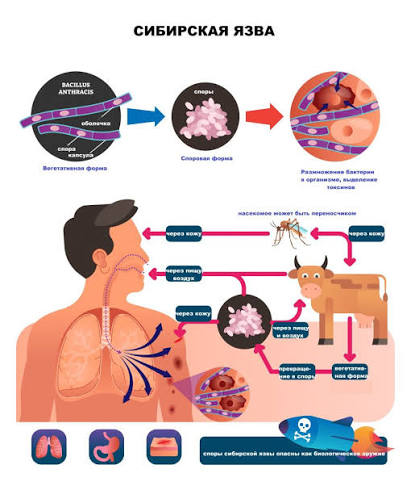
Anthrax is one of the most dangerous infectious diseases of animals and humans with a very high mortality rate.
The causative agent of anthrax is a spore–forming bacterium that is resistant to the environment. The spore forms of the microbe tolerate cold and heat very well and survive in the soil for up to 100 years or more. Boiling kills the spores of the anthrax microbe only after 45-60 minutes.
The source of the pathogen is a sick animal, excreta of sick animals (feces, urine, bloody discharge from natural openings), as well as areas of soil infected with anthrax spores and other environmental objects.
In animals, anthrax occurs in the form of an intestinal form, accompanied by bloody discharge from the anus and nose, fever, decreased appetite.
In humans, it manifests itself in the form of intestinal, pulmonary and cutaneous forms. Infection occurs when the pathogen enters through damaged skin or mucous membranes of the eyes, mouth, nose.
From the moment of infection to the manifestation of the disease, it passes from a few hours to 8 days, usually 2-3 days. At the site of the pathogen's introduction, a red spot appears, similar to an insect bite. Then a bubble is formed, filled with a bloody fluid, in place of which a black scab quickly forms.
The ways of human infection with anthrax are diverse:
- contact,
- alimentary (through food and water),
- air-dust,
But most often, infection occurs when caring for a sick animal, during forced slaughter of livestock from the carcass of fallen animals, and when eating meat products. With insufficient heat treatment, sick animals can become infected through animal raw materials (wool, down, skin, bristles, etc.).
To prevent anthrax infection, follow the following rules::
- call a veterinarian immediately if the animal is sick and anthrax is suspected.;
- do not carry out forced house slaughter of animals without the knowledge of the veterinarian;
- when caring for sick animals, strictly observe personal hygiene;
- wash your hands thoroughly after contact with animals, have special clothes for caring for sick animals.;
- make sure that the cattle in the individual farm are vaccinated against anthrax in a timely manner.;
- people who have a real risk of infection (veterinarians, employees of sheepskin factories) should not refuse preventive vaccinations.;
- If anthrax is suspected, seek medical attention immediately.
State Institution "Mendykarinskaya district territorial Inspectorate of the Ministry of Agriculture of the Republic of Kazakhstan", Borovskoye village, Altynsarina St. 83, tel.: 2-40-64, 2-42-67.