
Development of the sports industry in Kazakhstan: systemic reforms, infrastructure, mass sports and champions training
14.04.2025 13:10:40 4876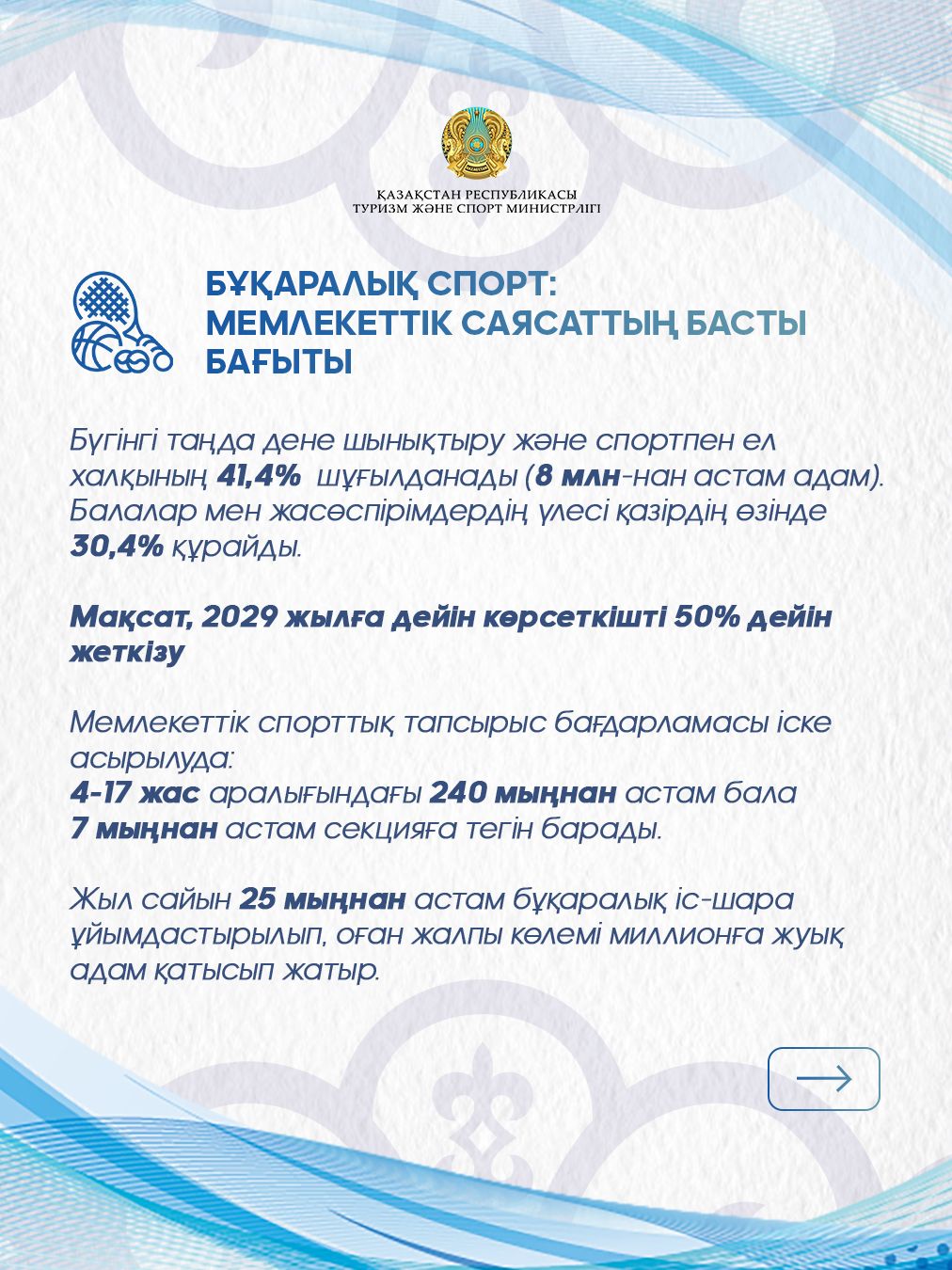
"As you know, I pay special attention to the development of mass sports. Without this, it is impossible to achieve the goal of educating healthy youth and strengthening the health of the entire nation. Recently, at a meeting with participants of the Olympic Games, I formulated key tasks and priorities in the field of sports. I believe that there is a need to update legislation in this area. The relevant amendments will give a powerful impetus to the development of mass and children's sports, provide the basis for the preparation of a new galaxy of champions. I think that the deputies should pay special attention to this important bill."
Kassym-Jomart Tokayev, President of the Republic of Kazakhstan
Consistent work is being carried out in Kazakhstan to develop the sports industry, from creating equal access to physical education to training international athletes. The priorities remain mass sports, popularization of national sports, modernization of infrastructure and support of the coaching staff.
Today, over 8 million Kazakhstanis are involved in sports and physical education, which is 41.4% of the country's population. The government has set a goal to bring this figure to 50% by 2029. Already, the proportion of students among children and adolescents exceeds 30%. The state sports order program is being widely implemented: more than 240,000 children aged 4 to 17 attend more than 7,000 sports clubs for free. More than 25,000 mass events are held annually, covering about a million people.
Special attention is paid to national sports as an important part of the cultural code. In 2024, about 670,000 people are systematically engaged in national disciplines, 16,555 clubs, 15 youth sports schools, 17 clubs and a specialized directorate are operating. The most popular are kazak kuresi, kokpar and togyzkumalak. Kazakhstan confidently confirmed its leadership at the 5th World Nomad Games in Astana, winning 112 medals, including 43 gold, 32 silver and 37 bronze medals.
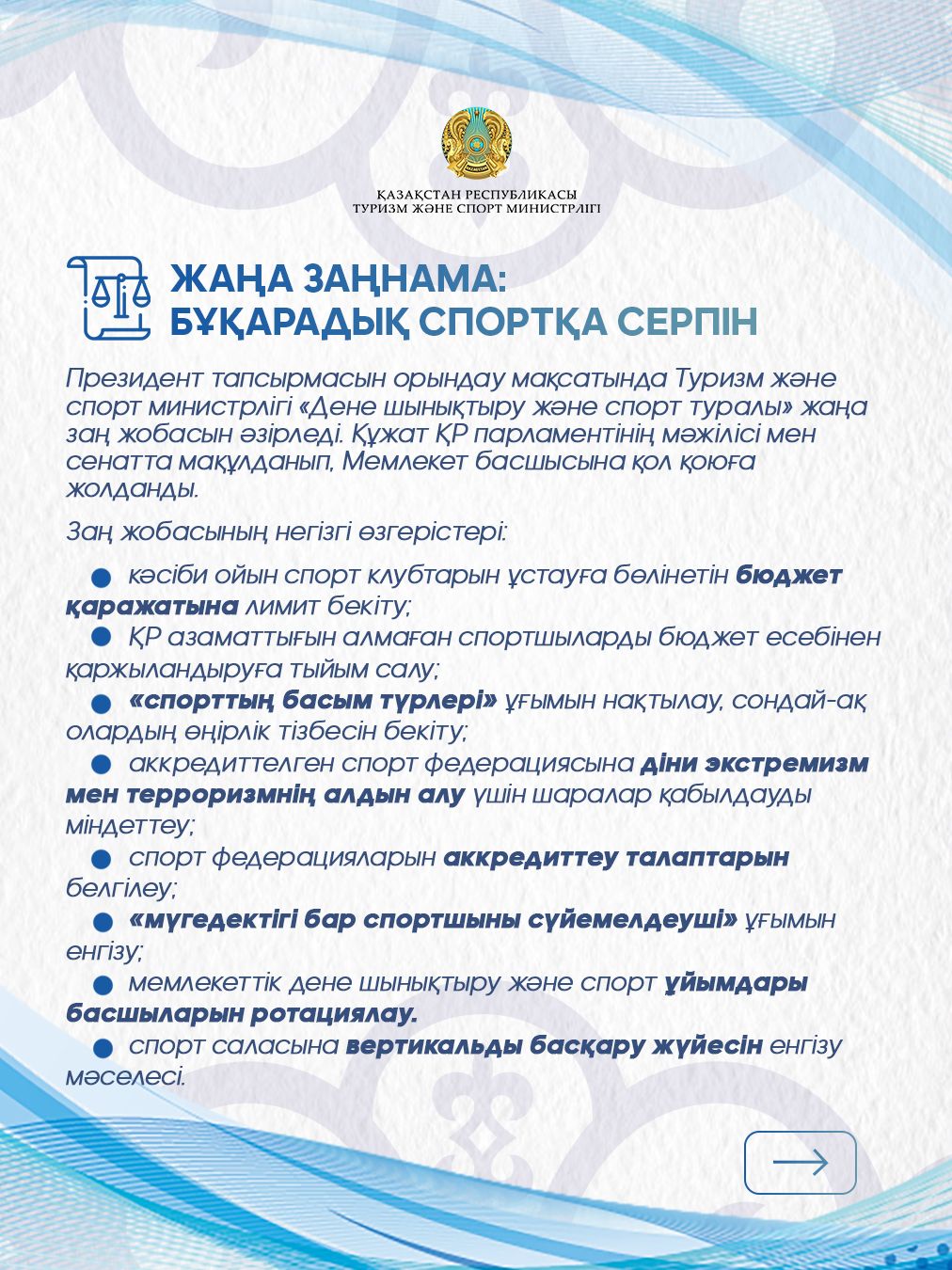
In accordance with the instructions of the Head of State, a new draft law "On Physical Culture and Sports" has been developed, which has been approved by the Mazhilis and the Senate.
The document has been sent to the President for signature. The bill provides for the introduction of systemic changes, including:
establishing clear rules for budget financing of professional clubs;
ban on state financing of foreign athletes;
clarifying the criteria for "priority sports";
new requirements for the accreditation of sports federations;
inclusion of commitments on the prevention of extremism;
expanding the concept of "athlete with a disability";
introduction of the mechanism of rotation of heads of state organizations in the field of physical culture and sports;
the introduction of a vertical management system in the field of sports.
In parallel, the transition to a vertical control system is underway. 33 schools of higher sports skills, 19 Olympic reserve training centers, and 14 boarding colleges are being transferred to the Ministry. The heads of 8 republican federations have been appointed and the heads of sports departments in 11 regions have been agreed. A KPI system is being developed to evaluate the effectiveness of akimats.
Since September 2025, a pilot project on the introduction of per capita financing of children's and youth sports schools will be launched in Akmola and Aktobe regions. In 2026, this system will be extended to the entire territory of the country. This will ensure more targeted and transparent support for young athletes and their mentors.
As part of the implementation of the Concept for the development of Physical Culture and Sports until 2029, there are more than 25,000 sports facilities in Kazakhstan. In 2024, 90 new sports facilities were commissioned across the country, including 29 in urban and 61 in rural areas. Large—scale infrastructure projects are being implemented, including the construction of a rowing canal in Turkestan, a table tennis academy in Ust-Kamenogorsk, an indoor stadium and a rehabilitation center in the East Kazakhstan region, and the third stage of a ski base in Shchuchinsk. The National University of Physical Culture and Sports is scheduled to open in 2025.
Modernization of the football infrastructure has become a separate area. Stadiums are being built and reconstructed in Kyzylorda, Uralsk, Turkestan, Zhetysu and other regions. Projects are being worked out in Astana, Shymkent, Aktau, Ust-Kamenogorsk and Semey. It is planned to build six stadiums that meet UEFA standards. Construction of children's sports grounds has begun, including in rural areas.
Resolving the personnel issue remains a key condition for the successful implementation of all initiatives. Retraining of trainers is underway, a licensing system is being implemented, and the institute of mentoring is developing. The status of trainers is equivalent to that of teaching staff, social guarantees and wage increases are provided. The second package of amendments provides for an increase in the average salary of coaches of youth sports schools by 30%.
A draft of updated Standards and requirements for awarding sports titles and ranks has been developed. 163 sports have been taken into account, the conditions for obtaining titles, including non-Olympic disciplines, have been revised, standards for confirming coaching participation have been added, and criteria for national and international tournaments have been updated.
Digitalization of the industry has become an important area. By the end of 2025, the E-sport digital platform will be implemented, including a unified register of athletes, coaches, referees and methodologists, an electronic calendar of sporting events and a register of sports infrastructure facilities. The implementation of this system will ensure transparency, control of coverage and effectiveness of all elements of sports policy.
Kazakhstan continues to achieve high results in the international arena. By the end of 2024, the national teams won 1,206 medals, of which 1,086 in Olympic and non—Olympic sports (399 gold, 341 silver and 346 bronze). 120 medals were won in para-sports: 56 in Paralympic disciplines (16 gold, 20 silver, 20 bronze) and 64 in Deaflympic and non-Paralympic (30 gold, 17 silver, 17 bronze).
The goal of all measures taken remains to create a sustainable, effective and accessible sports system capable of educating a new generation of champions and strengthening the health of the nation.
Source : https://www.gov.kz/memleket/entities/karaganda-sport/press/news/details/975508?lang=kk