
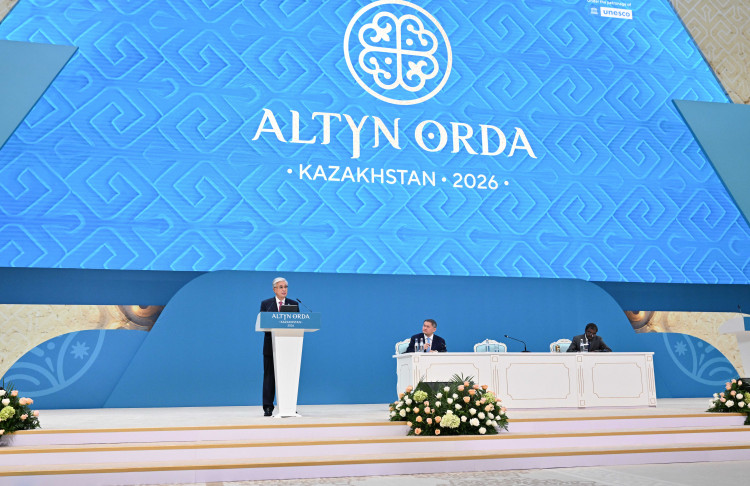
Speech by Head of State Kassym-Jomart Tokayev at the international symposium "The Golden Horde as a Model of Steppe Civilization: History, Archaeology, Culture, Identity"
22.05.2026 08:14:58 2029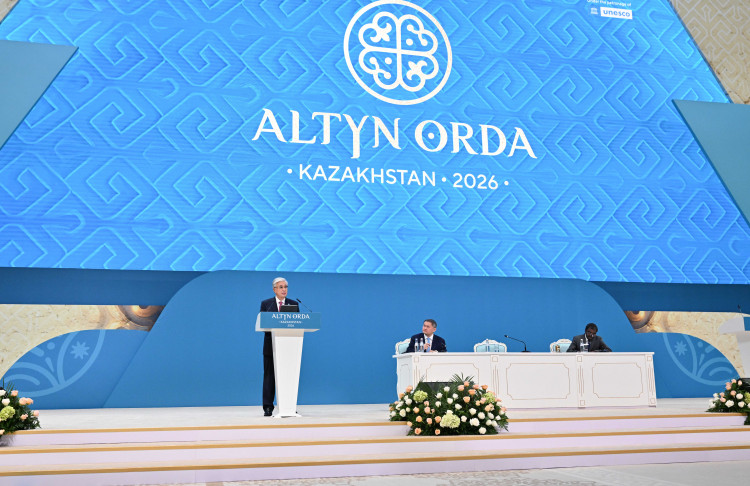
Dear participants!
I am pleased to welcome you to the international symposium dedicated to the history of the Golden Horde.
First of all, I would like to express my sincere gratitude to all the guests who have come to Astana to participate in today's event.
I would also like to thank the speakers who have just spoken – renowned scholars and representatives of reputable international organizations – for their insightful presentations.
Today, no historian questions the power of the Golden Horde – an empire that ruled the Great Steppe and occupied the vast expanses of Eurasia. This is a historical fact.
This empire, which connected West and East and significantly influenced the development of various civilizations and the formation of states, was a major political structure, which is also undeniable.
This is precisely why the history of the Golden Horde is the subject of numerous in-depth studies. This topic remains relevant today and, in my opinion, will never lose its significance.
This is one of the most important chapters in the history of our country and of all humanity.
The main goal of the symposium, which will last several days, is to strengthen ties with the global scientific community for a systematic and comprehensive analysis of this issue.
In this regard, I would like to express my deepest gratitude to the leadership of UNESCO for supporting our country's initiative.
I express my gratitude to former UNESCO Director-General Audrey Azoulay, who is attending today's forum. We highly appreciate your significant contribution to strengthening the partnership between Kazakhstan and UNESCO.
Holding this event under the auspices of such a prestigious international organization underscores the global historical significance of the Golden Horde's legacy.
Also participating in today's symposium is a delegation led by UNESCO's High Representative, Mr. Lazar Eloundou Assomo, Director of the World Heritage Centre.
Thanks to the Organization's support, our country has implemented many important initiatives. A clear result of this cooperation is the inclusion of such iconic sites as the Mausoleum of Khoja Ahmed Yasawi, the petroglyphs of Tamgaly, and several ancient settlements on the UNESCO World Heritage List.
Extensive work has also been undertaken to preserve and promote Kazakhstan's intangible cultural heritage.
For example, a significant event in 2025 was the international recognition of the unique manuscript "Genealogy of the Khans." This valuable document contains information about the country's rulers, including the Golden Horde period.
Therefore, we are interested in further expanding our partnership, which is in our common interests and is of great importance.
It is significant that this symposium brought together various research schools specializing in the history of the Golden Horde and the Great Steppe.
Here, the role of Russian scholars, who have fruitfully studied this vast topic for many years and have managed to compile a body of research providing extensive knowledge about the Golden Horde, deserves due recognition.
At the same time, the topic of the Golden Horde has transcended the borders of a single state, attracting the attention of researchers in China, Mongolia, the United States, India, Pakistan, Japan, Kyrgyzstan, Uzbekistan, Egypt, and a number of European countries. It can be said that this topic is confidently moving across the globe.
Ultimately, the chronicle of the Golden Horde is the shared history of humanity.
I am confident that today's unique symposium will give new impetus to the systematic study of world heritage. The scholars and experts present here are making a significant contribution to achieving this lofty goal.
I sincerely believe that your work will bear significant fruit that will enrich our shared history and scholarship.
Dear symposium participants!
In Kazakhstan, the history of the Golden Horde is viewed as a complex, multidimensional period in the world history. This circumstance should not be oversimplified under any circumstances, as this will inevitably lead to a linear view of this unique phenomenon of world history, which is fraught with historical errors, which, in turn, could undermine good relations between states and peoples.
Unfortunately, we are already witnessing similar cases involving different interpretations of major historical events of global significance.
In the current extremely complex and tense geopolitical situation, it is important to be able to find compelling and inspiring examples in human history of the development of world-building constructs and the creation of platforms for dialogue, without becoming fixated on the grim chronology of wars.
I understand that this is no easy task, because the entire world history, from ancient times to the present, is rich in detailed descriptions of wars and armed conflicts.
The reason for this phenomenon is quite clear: wars, with their inexhaustible potential for confrontation, were much easier to describe than the monotonous processes of creation in peaceful conditions. Incidentally, Leo Tolstoy's famous novel "War and Peace" is a phenomenal and fundamental description of war rather than peace.
But precisely now, when the global community has reached a historical "fork in the road" and faces a civilizational choice, it is critical to unite the efforts of authoritative, professional scholars to present our shared history as a factor in the unification of nations. Here, it is important to understand that historical assessment must be absolutely objective and politically neutral. The principle that "history is made only by the strong and written by the victors" is admittedly anti-scientific: since victors are not judged, they should be accorded the most honorable place in world history, where all the complimentary assessments of researchers flock. And small and medium-sized countries, especially those that suffered defeats on the battlefield in the past, will have to be content with the role of historical “backbenchers.”
Kazakhstan has begun a rather active process of reexamining outdated dogmas and stereotypes that, for the sake of political ambitions, reduce once-mighty steppe empires to the status of so-called "sub-states" and even portray nomadic peoples as wild, elemental forces that have transcended the historical context.
However, in restoring an objective historical picture, we are far from blindly idealizing the past.
History does not tolerate or forgive lies in the name of self-admiration, nor does it forgive attempts to transform a shared heritage into a typically national phenomenon.
Claiming a monopoly on the interpretation of our rich past, with its contradictions and complexities, is a dead end, leading to the degradation of science and the growth of mutual mistrust.
Meanwhile, the professional community of historians undoubtedly includes representatives of effective "soft power" and scientific diplomacy; they can build bridges where politicians can only erect walls. Their mission is especially important in these turbulent times.
For Kazakhstan, the era of the Golden Horde is a crucial part of national history, a period of civilizational evolution.
I have already stated above that the historical memory of most peoples is more vividly marked by the conquests of rulers and talented military leaders than by the monotonous work of reformers and outstanding thinkers.
Indeed, legendary military victories evoke a heightened emotional response in people compared to their responses to institutional innovations and progressive ideas, the fateful significance of which is revealed and properly appreciated long afterward.
A clear example of this is the distorted perception of the history of the Great Steppe, which, as a rule,
is still perceived as an endless series of battles and conflicts.
This one-dimensional approach significantly simplifies and distorts historical reality, squeezing the complex, multilayered existence of the Great Steppe, especially the Golden Horde, into the "Procrustean bed" of banal military chronicles.
I believe that the high level of interdisciplinary development in modern scholarship will nevertheless allow for the improvement of the objective study of the history of the Golden Horde.
Given that authoritative researchers of that period are gathered in this hall today, I would like to briefly outline my vision of the main areas of scholarly research, which, in my opinion, will help expand the prospects for a positive reinterpretation of the history of the Golden Horde.
FIRST. Study of intellectual heritage.
The phenomenon of the Golden Horde cannot be understood or comprehended without reference to the rich intellectual landscape that developed in the heart of Eurasia over more than a thousand years.
It is well known that in the Middle Ages, the Great Steppe became one of the world's centers for the generation of progressive ideas.
The flowering of intellectual thought in Central Eurasia occurred on fertile soil that absorbed the energy of the nomadic world, the Turkic-Mongol heritage, Islamic traditions, and the ideological principles of the Christian community of nations.
This was a continuous process of positive evolution of ideas. Each century added new values to the treasury of thought of the Great Steppe.
Without understanding and recognizing this profound continuity, it is difficult to objectively assess the rapid rise of the Golden Horde.
And here, of course, the rich legacy of outstanding thinkers who created scientific, philosophical, and literary masterpieces long before the founding of the Golden Horde is of great importance.
First and foremost is Abu Nasir al-Farabi, one of the unshakable pillars of world philosophy, known in history as the "Second Teacher of the World" after Aristotle.
In his treatise "On the Views of the Inhabitants of the Virtuous City," he presented a broad and compelling vision of ways to achieve the common good based on justice, knowledge, and moral perfection.
His ideas are a key reference point for understanding the subsequent political and philosophical tradition of the Turkic-Muslim world.
Undoubtedly, the figure of the great Khoja Ahmed Yasawi occupies a special place in the intellectual heritage of the Great Steppe. He laid the foundation for the formation of "Turkic Islam," which organically combines universal Muslim values and local spiritual traditions.
Essentially, it was he who proposed to all the peoples of the Great Steppe a completely new ideological doctrine, which has become the foundation of our worldview even in modern times.
Yassawi's views became an integral part of the cultural code of the Great Steppe, and his mausoleum in Turkestan is recognized as a UNESCO World Heritage Site.
The city of Turkestan itself has remained the main spiritual and political center of the region for centuries and to this day, considered the sacred capital of the Turkic world.
It is natural that the ideas of Al-Farabi, Yassawi, and other outstanding thinkers were further developed in the Golden Horde.
For example, it was during this era that a grandiose ideological synthesis of the Turkic language, Islamic literary tradition, and centuries-old steppe wisdom took place. This phenomenon was clearly evident in the literature of the Golden Horde period and became the core of the "golden age" of Turkic literature.
It's symbolic that this year marks the 800th anniversary of the legendary "Aqsaq Qulan" kyu, which essentially marked the birth of epic poetry accompanied by the main musical instrument of the Great Steppe—the dombra.
It's no coincidence that the legacy of such zhyrau storytellers as Ketbuga, Asan Qayqy, Shalkiyz, and Dospambet still lives on in the traditional art genres of our region.
The epics of that period (Er Edige, Alpamys, Qoblandy, and Er Tarqyn) celebrate the heroes and events of the shared history of the Kazakhs, Tatars, Bashkirs, Nogais, Karakalpaks, and other peoples.
This thread of intellectual and spiritual continuity proved so strong that it has passed through the centuries, embodied in the works of the great Abai.
In his concept of "Tolyk Adam," he essentially presented a universal formula for nurturing a harmonious person or a holistic nature based on the trinity of reason, will, and kindness.
Therefore, it should be noted that the intellectual heritage of the Great Steppe developed as a natural ideological substance of global significance for our region,
without exceptions or derogations.
It was a holistic philosophical and ideological "product."
The establishment of the Al-Farabi and Qoja Ahmet Yassaui Orders became a symbol of Kazakhstan's commitment to this ideological heritage.
These high state awards will be presented to those who make outstanding contributions to the development of science, education, and spirituality, including foreign scientists, political figures, and public figures.
The first recipient of the Qoja Ahmet Yassaui Order was Turkish President Recep Tayyip Erdogan, who recently paid a state visit to Kazakhstan.
Today, I proposed presenting the second order to former UNESCO Director-General Audrey Azoulay. She graciously agreed to accept it.
In this way, we emphasize the exceptional importance of intellectual work and creative interaction for the future of peoples united by a common historical destiny.
SECOND. It is necessary to carefully study the Golden Horde's system of governance.
The territory of the Ulus of Jochi at its peak exceeded 6 million square kilometers, which, incidentally, is significantly larger than the Roman Empire at its greatest expansion.
It is not without reason that some historians call the Golden Horde the Rome of the Steppes.
However, the greatness of the Golden Horde was measured not by its geographical extent, but by its institutional stability.
The Jochids ruled the states of the Great Steppe for over 600 years, which is comparable, for example, to the reigns of dynasties such as the Han or Habsburg.
This fact speaks to the legitimacy and viability of the system created by the Jochids, which ensured the harmonious coexistence of different ethnic groups and religions.
The Golden Horde developed a harmonious system of steppe and Islamic law.
The foundation of public order was a legal culture rooted in the Great Yasa of Genghis Khan and even more deeply in the traditions of the Turkic Khaganate.
The dictatorship of law was so comprehensive that the security of individuals and property was guaranteed throughout the empire. This means that order reigned in society.
Furthermore, there is precise historical evidence of the existence of developed office practices during the Golden Horde era.
The institution of the Kurultai also served as a unique example of steppe democracy.
Although the social structure of the Ulus was clear and stable, justice, rather than rigid dogma, played a dominant role in society.
In the army and bureaucracy, discipline, exemplary service, and meritocracy were paramount, opening up broad opportunities for representatives of all ethnic groups and the various groups inhabiting this vast empire.
Thus, thanks to a well-balanced domestic and foreign policy, stability was maintained in society, and the state prospered.
The Golden Horde maintained active diplomatic contacts with Mamluk Egypt, the Vatican, Byzantium, the Ottoman Empire, and European courts.
Overall, even during periods of profound crisis, such as the Great Turmoil of the 14th century, the Golden Horde's system of governance was quite stable. As is well known, this system was subsequently adopted by many Eurasian states.
THIRD. The economic model of the Golden Horde should be comprehensively studied.
It is well known that the ancient civilizations of Mesopotamia, Egypt, China, and India were largely formed through the development of river valleys.
The Great Steppe, however, created a fundamentally different type of historical development.
Five thousand years ago, in Botai, northern Kazakhstan, humans first domesticated the horse, a pivotal event that determined the course of world history.
The equestrian culture gave rise to a unique strategic thinking and a highly mobile lifestyle.
Thus, by controlling all key transport, trade, and humanitarian links across the vast expanses of Eurasia, the Golden Horde became the pinnacle of equestrian nomadic civilization.
Therefore, there is every reason to assert that it was precisely the symbiosis of nomadic and sedentary lifestyles that was the main reason for the Golden Horde's remarkable emergence onto the historical stage.
Ultimately, thanks to the synergy of a nomadic lifestyle, urban craft culture, and trade routes,
the Golden Horde developed a developed economy, cemented by a monetary and fiscal system.
According to many scholars, important discoveries are currently being made in Golden Horde numismatics.
Archaeologists have discovered dozens of previously unknown mints.
According to experts, during its heyday, the Golden Horde minted approximately 28 million silver coins.
Currently, the total number of coins from that era in public and private collections approaches one million.
It is symbolic that the name of Kazakhstan's national currency, the tenge, directly derives from the Horde word "dang," which is likely also the origin of the word "money."
This is not just a linguistic coincidence, but rather an illustration of how the Golden Horde established the standards of monetary relations in our vast region.
The empire controlled the northern branch of the Great Silk Road, transforming the steppe into a secure transit corridor.
Thousands of tons of goods passed through the territory of the Ulus of Jochi annually: silk from China, spices from India, furs from Russia, and handicrafts from Europe and the Near and Middle East.
Unlike many states of the time, the Golden Horde demonstrated a principle of strategic openness throughout its development, which was reflected even in the appearance of its cities.
During its heyday, the empire's cities were not confined within fortress walls, but developed as spaces for intensive trade and high human mobility.
This experience convincingly refutes the myth of a supposedly eternal conflict between the steppe and the city.
On the contrary, it was precisely their interaction that created one of the most flexible models of medieval statehood.
This is confirmed by the material culture of the Golden Horde cities, of which, according to scholars, there were more than a hundred.
Various archaeological excavations indicate that the cities of the Golden Horde employed advanced engineering solutions to ensure the comfort of their residents.
The high level of production and scale of the construction industry of that time were embodied in Golden Horde bricks; this sought-after building product was widely used throughout the region from the Irtysh to the Danube.
Overall, it can be said that the Golden Horde gave birth to or created a proto-global market, within which enterprising people from all corners of Eurasia freely traded and conducted business, contributing to overall progress.
The research directions I have outlined, of course, do not claim to be exhaustive.
Unlike you, I am not a scholar of ancient history.
These are merely the outlines of further scholarly research that will allow us to rethink the role
of the Golden Horde and overcome the inertia of a purely military-political perception of its history. It is important to fully uncover the civilizational matrix of the Golden Horde, with its deep intellectual and spiritual traditions, effective institutions, and developed economy.
This is necessary not only for a comprehensive scientific reconstruction of the past, but also for understanding the origins of statehood, identity, and, indeed, the shared history of the peoples of Central Eurasia.
Dear scientists and experts!
As is well known, Kazakhstan has been implementing large-scale political and economic reforms in recent years.
This is undoubtedly an extremely important and responsible step for our country.
At the same time, we clearly recognize the challenge we face: without a change in consciousness, society will not be renewed and the state will not develop. This is an axiom.
In this regard, the issue of preserving historical continuity is extremely pressing. Clearly, without it, no progress is possible. If we do not respect the past, then moving toward a brighter future will be difficult.
Therefore, as a progressive nation, we will only move forward.
The new Constitution, adopted by national referendum, clearly states that preserving the continuity of the Great Steppe with its thousand-year history is our sacred duty.
After all, in our state activities, our country is the direct heir to the Golden Horde, which made "Mangilik El" its main idea.
The legacy of the Golden Horde is boundless. We are making systematic efforts to adapt and modernize this colossal spiritual and historical heritage for the 21st century.
On my initiative, the first specialized academic institution, the Institute for the Study of the Ulus of Jochi, was established in Kazakhstan.
In the forthcoming academic history of Kazakhstan, a separate volume will be dedicated to the Golden Horde for the first time.
To popularize the historical and cultural heritage of the Ulus of Jochi, films are being made, books are being published, monuments are being erected, plays are being staged, and exhibitions are being held.
But for a real breakthrough in the comprehensive study and promotion of the historical phenomenon of the Golden Horde, we must reach a fundamentally new, global level.
Recently, at the Organization of Turkic States summit in Turkestan, I proposed creating a center dedicated to the popularization of steppe civilization.
At the same time, it is necessary to launch a large-scale publishing project involving international experts on the Golden Horde.
It is important that academic research become a reliable foundation for the implementation of various projects in the creative industry and media sphere.
In the era of globalization, total digitalization, and artificial intelligence, a new interpretation of the concept of nomadism, which is now vividly embodied in the creative potential and incredible passion of "digital nomads," is particularly relevant.
I am convinced that a comprehensive study of the traditions of steppe statehood, based on justice, openness, and cultural dialogue, will contribute to the long-term progress of all of Central Eurasia.
Today, we can already state that our region is entering a period of new renaissance and the return of its historical mission as an important civilizational and geopolitical center of the world.
The unprecedented spirit and creative energy of our peoples, including the younger generation, play a decisive role in this process. Thanks to this, we today set lofty goals and accomplish important tasks.
Source : https://www.gov.kz/memleket/entities/mfa-muscat/press/news/details/1227105?lang=ru