
European Parliament Discusses Kazakhstan-EU Cooperation on Reforms and Transport Connectivity
13.07.2026 05:06:20 1174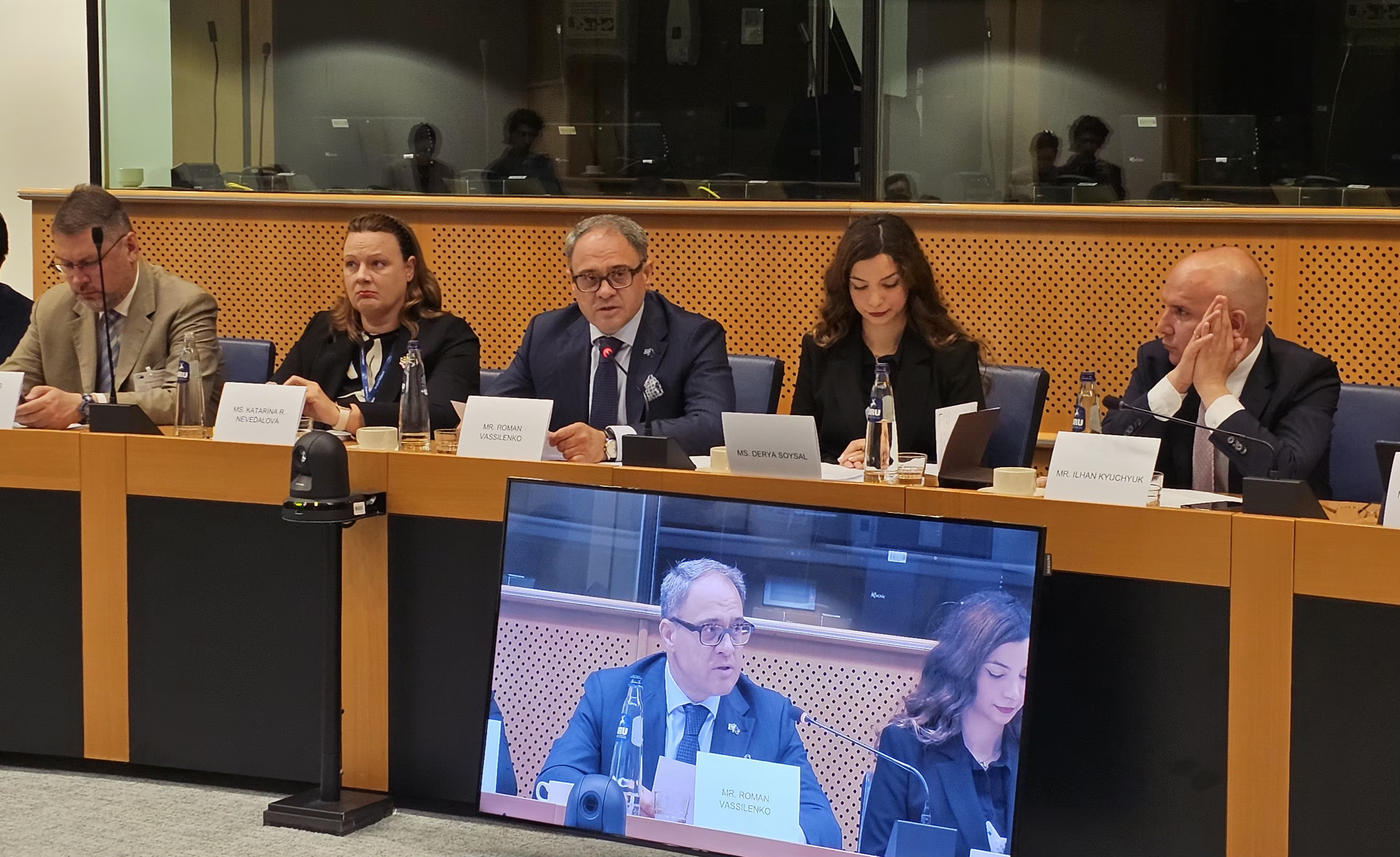
Brussels, 30 June 2026 – Roman Vassilenko, Permanent Representative of the Republic of Kazakhstan to the European Union, met with David McAllister, Chair of the European Parliament's Committee on Foreign Affairs (AFET) and a member of the European People's Party (EPP).
During the meeting, Ambassador Vassilenko highlighted that Kazakhstan's new Constitution, which enters into force on 1 July 2026, establishes a stronger foundation for effective public governance, enhances legal certainty, and reinforces Kazakhstan's reputation as a predictable and reliable partner, including in its relations with the European Union.
Mr McAllister welcomed the systemic reforms underway in Kazakhstan and praised the significant progress made in advancing the Kazakhstan–EU strategic partnership following President Kassym-Jomart Tokayev's recent official visit to Brussels.
Ambassador Vassilenko also participated in a roundtable discussion on the development of the Trans-Caspian International Transport Route (TITR), widely known as the Middle Corridor. The event was hosted at the European Parliament with the support of Ilhan Kyuchyuk, Chair of the Committee on Legal Affairs and a member of the Renew Europe Group.
The discussion brought together representatives of the EU institutions, the diplomatic corps, international organizations, and Brussels-based academic and business communities. Participants agreed that the Middle Corridor is becoming an increasingly important strategic link between Central Asia and Europe and that its further development should remain a key priority for cooperation between the two regions.
Opening the roundtable, Ambassador Vassilenko recalled that during President Tokayev's official visit to Brussels, the leaders of Kazakhstan and the European Union reaffirmed the strategic importance of the Trans-Caspian International Transport Route and welcomed closer cooperation under the EU's Global Gateway initiative. The agreements reached during the visit reflected a shared commitment to strengthening transport connectivity through the development of the Middle Corridor, building more resilient supply chains, and investing in modern transport infrastructure.
The discussion also focused on the digitalization of transport and logistics. Participants noted that the introduction of digital solutions, coupled with more efficient customs procedures, has significantly reduced cargo transit times along the Middle Corridor, making the route faster, more competitive, and increasingly attractive to international freight operators.
Ambassador Vassilenko stressed that the success of the Middle Corridor is the result of close cooperation among the countries of Central Asia, the South Caucasus, and the European Union. He emphasized that the corridor's development is not the achievement of any single country, but rather the product of coordinated regional efforts, joint investment, and shared responsibility.
"When the countries of Central Asia work together, everyone benefits," Ambassador Vassilenko said. "Regional cooperation is transforming Central Asia into a reliable transport and logistics bridge connecting Asia and Europe."
Eduards Stiprais, EU Special Representative for Central Asia, highlighted the region's growing strategic importance for the European Union, particularly in the areas of transport connectivity, energy, critical raw materials, digital infrastructure, and regional stability. Together, these factors are making Central Asia an increasingly attractive destination for European investment.
Member of the European Parliament Katarína Neveďalová welcomed the close cooperation among the Central Asian countries, including the progress achieved since the first Central Asia–European Union Summit held in Samarkand in April 2025.
"Central Asia is a strategic region for the European Union, and we need to continue strengthening our ties. By working together, we become stronger partners," she said.
Henri Vantieghem, former Belgian Ambassador to Kazakhstan, noted that awareness of Central Asia's growing strategic importance continues to increase both in Belgium and across the European Union. He described the Middle Corridor as a modern Silk Road that offers a more sustainable alternative to traditional maritime routes while creating new opportunities for regional cooperation.
"The countries of Central Asia have made impressive economic, political and social progress. Democratic reforms are advancing, and the rule of law—particularly with regard to investment—is continuing to strengthen. European businesses should look more closely at the opportunities the region has to offer," he said.
Participants concluded that the Middle Corridor is evolving into far more than a major transport route. It is increasingly serving as a strategic platform for expanding economic cooperation, strengthening the resilience of global supply chains, deepening energy cooperation, and reinforcing the partnership between Central Asia and the European Union.
Source : https://www.gov.kz/memleket/entities/mfa-brussels/press/news/details/1250986?lang=ru