
Central Election Commission Held Its First Meeting as Part of Preparations for the Elections of Deputies of the Kurultai
13.07.2026 16:25:51 1834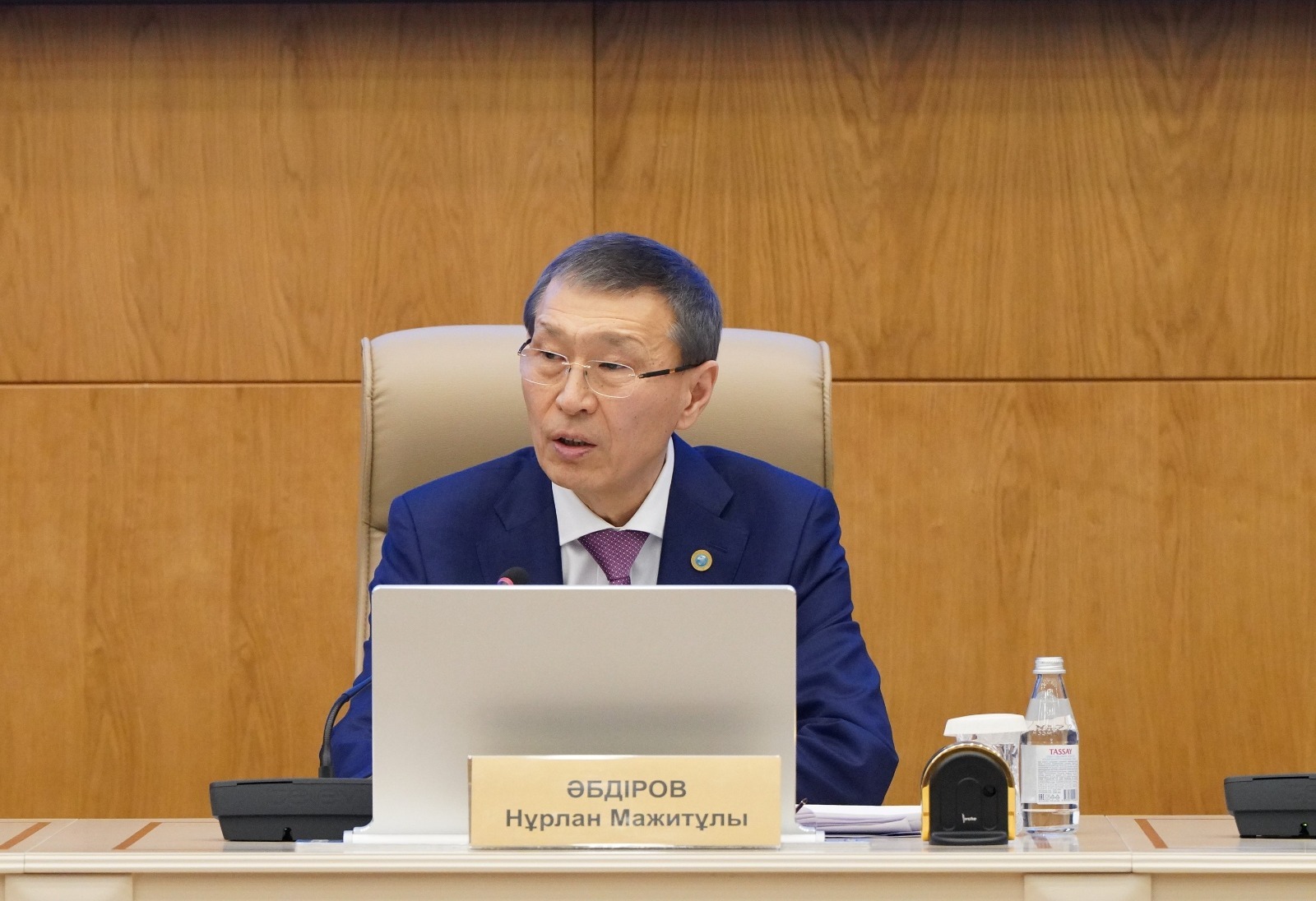
On 1 July 2026, as part of the election campaign for the elections of deputies of the Kurultai of the Republic of Kazakhstan, scheduled for 23 August 2026, the first meeting of the Central Election Commission of the Republic of Kazakhstan was held.
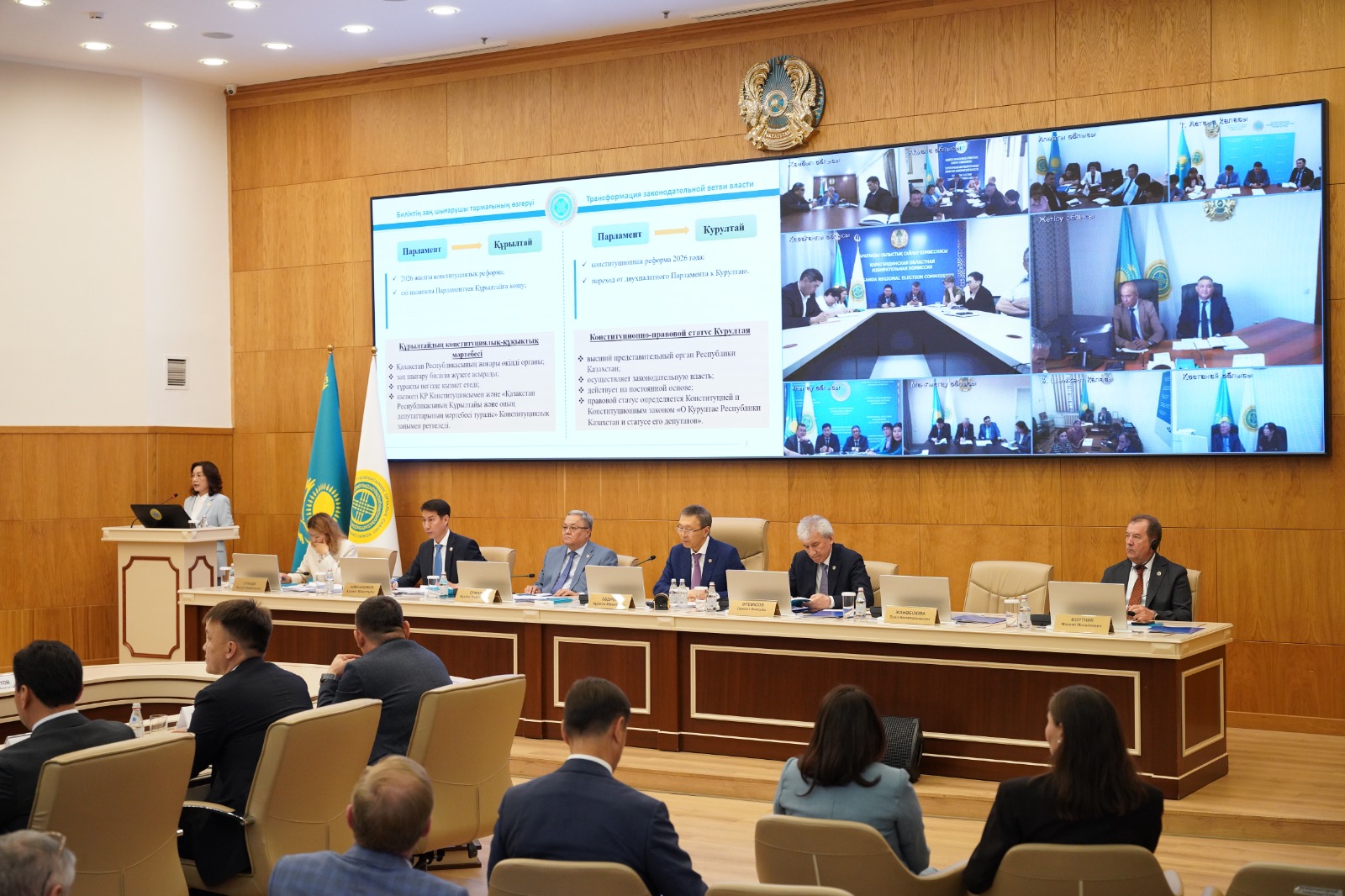
The meeting took place on the day the new Constitution of the Republic of Kazakhstan entered into force, establishing the transition to a new model of state structure. In accordance with the Fundamental Law, the Kurultai, a unicameral body, became the country’s highest representative body exercising legislative power.
The chairpersons and members of the territorial election commissions of the capital, regions and cities of republican significance, as well as heads of the offices of regional akims, joined the meeting via videoconference.
Among those invited were representatives of political parties, mass media, the Prosecutor General’s Office, the Ministries of Foreign Affairs, Justice, Internal Affairs, Finance, Culture and Information, Artificial Intelligence and Digital Development, as well as representatives of the Academy of Public Administration under the President of the Republic of Kazakhstan.
In accordance with the agenda of the meeting, the Commission considered the following issues:
- On the approval of the Calendar Plan of main activities for the preparation and conduct of the elections of deputies of the Kurultai of the Republic of Kazakhstan, scheduled for 23 August 2026;
- On establishing the forms of election documents for the elections of deputies of the Kurultai of the Republic of Kazakhstan, scheduled for 23 August 2026;
- On organizing work with voter lists for the elections of deputies of the Kurultai of the Republic of Kazakhstan, scheduled for 23 August 2026;
- On the innovations in the electoral legislation of the Republic of Kazakhstan;
- On the procedure for nominating political parties and admitting them to participate in the elections of deputies of the Kurultai of the Republic of Kazakhstan, scheduled for 23 August 2026;
- On certain issues relating to the activities of observers from foreign states, international organizations, and representatives of foreign mass media during the elections of deputies of the Kurultai of the Republic of Kazakhstan, scheduled for 23 August 2026;
- On organizing training for members of election commissions and other participants in the electoral process during the campaign for the elections of deputies of the Kurultai of the Republic of Kazakhstan, scheduled for 23 August 2026.
Opening the meeting, Nurlan Abdirov, Chairman of the Central Election Commission of the Republic of Kazakhstan, emphasized that the meeting marked the beginning of preparations for the first elections of deputies of the Kurultai, which will be held under the new Constitution of the Republic of Kazakhstan.
“For the Central Election Commission and all election commissions, this is a great responsibility. Our task is to ensure that the elections are conducted in strict compliance with the law, openly, transparently and at a high organizational level, while creating equal conditions for all participants in the electoral process,” he noted.
On the first item on the agenda, Mukhtar Yerman, Deputy Chairman of the Central Election Commission, delivered a report. He presented the Calendar Plan of main activities for the preparation and conduct of the elections of deputies of the Kurultai of the Republic of Kazakhstan, developed in accordance with the requirements of the Constitution of the Republic of Kazakhstan and the Constitutional Law of the Republic of Kazakhstan “On Elections in the Republic of Kazakhstan.”
The speaker explained the main stages of the election campaign, including the procedure for nominating and registering party lists, the timeframe for pre-election campaigning, as well as other key activities provided for in the Calendar Plan.
Following consideration of the issue, the Central Election Commission approved the Calendar Plan of main activities for the preparation and conduct of the elections of deputies of the Kurultai of the Republic of Kazakhstan - the key document defining the stages of the election campaign and the related electoral procedures.
On the second item on the agenda, Azamat Aimanakumov, a member of the Central Election Commission, presented the resolution “On Establishing the Forms of Election Documents for the Elections of Deputies of the Kurultai of the Republic of Kazakhstan.”
It was noted that, in accordance with subparagraph 6) of Article 12 of the Constitutional Law of the Republic of Kazakhstan “On Elections in the Republic of Kazakhstan,” the Central Election Commission establishes the forms of election documents.
The draft resolution approves 21 forms of election documents to be used at various stages of the election campaign. Following the adoption of the resolution, the approved forms will be posted on the official website of the Central Election Commission.
On the third item on the meeting agenda, Azamat Aimanakumov, a member of the Central Election Commission of the Republic of Kazakhstan, stated that the formation of up-to-date and reliable voter lists is one of the key organizational elements of the electoral process and is carried out in accordance with the Constitutional Law of the Republic of Kazakhstan “On Elections in the Republic of Kazakhstan” and the Rules for Compiling Voter Lists.
As of 1 July 2026, the Register of Voters includes 12,561,644 citizens permanently registered at their place of residence. A total of 10,427 polling stations will be used for the conduct of the elections, including 82 polling stations abroad in 64 countries.
Particular attention was paid to the deadlines for compiling and submitting voter lists. Local executive bodies will submit voter lists to precinct election commissions by 2 August, and they will be available for voters to review from 7 August 2026.
In addition, the members of the Commission were provided with information on the procedure for voting with absentee voting certificates. It was noted that their issuance will begin on 7 August and end on 22 August 2026 at 6:00 p.m. local time.
Following consideration of the issue, the Central Election Commission adopted the resolution “On Organizing Work with Voter Lists for the Elections of Deputies of the Kurultai of the Republic of Kazakhstan, Scheduled for 23 August 2026.”
Local executive bodies were instructed to ensure the completeness and accuracy of voter lists, the timely introduction of changes to them on the basis of submitted applications, broad public awareness-raising on the procedure for inclusion in voter lists, as well as the effective operation of call centers, digital services and online resources for checking information on citizens’ inclusion in voter lists.
During the meeting, the official address of the Central Election Commission to voters was also announced. The document provides explanations on relevant issues concerning inclusion in voter lists, verification of personal data and the exercise of the right to vote, and calls on citizens to actively participate in the first elections of deputies of the Kurultai.
The next item on the agenda was the consideration of the main amendments and additions introduced to the Constitutional Law of the Republic of Kazakhstan “On Elections in the Republic of Kazakhstan.”
Assel Zhanabilova, a member of the Central Election Commission of the Republic of Kazakhstan, spoke about the key changes in electoral legislation.
According to her, in order to implement the provisions of the new Constitution and improve electoral legislation, amendments were introduced on 11 June of this year to the Constitutional Law of the Republic of Kazakhstan “On Elections in the Republic of Kazakhstan.”
The amendments are aimed at ensuring the exercise of citizens’ constitutional rights, as well as improving the electoral process.
Specific amendments establish provisions related to the conduct of the first elections of deputies of the Kurultai.
At the same time, the fundamental principles of electoral law and the mechanisms for organizing elections have been preserved.
The Kurultai consists of 145 deputies elected in a single nationwide electoral district under a proportional electoral system. The term of office of deputies is five years.
Assel Zhanabilova paid particular attention to the amendments concerning the participation of political parties in the elections. Thus, the transitional provisions establish the procedure for paying the election fee during the first elections of deputies of the Kurultai.
Political parties that received five percent or more of the votes in the 2023 elections of deputies of Parliament are exempt from paying the election fee. Parties that received between three and five percent of the votes shall pay 50 percent of the established amount of the fee, while parties that received between one and three percent shall pay 70 percent.
In addition, political parties have been granted the right to conduct pre-election campaigning on their own online resources and accounts on online platforms.
At the same time, it is prohibited to use campaign materials that were not prepared specifically for the current election campaign, as well as to photograph, video-record, or disseminate images of a completed ballot paper on election day.
According to the CEC member, one of the key principles of electoral legislation is preserved - the financing of pre-election campaigning by political parties exclusively through election funds. At the same time, the maximum amounts of political parties’ election funds have been increased.
The new provisions expand the possibilities for establishing polling stations at organizations with continuous production operations and at sites where work is organized on a rotational basis, which will make it possible to ensure the exercise by their employees of the constitutional right to participate in elections.
The participants in the electoral process were then reminded of the key legal requirements regulating the conduct of pre-election campaigning, the activities of mass media and users of online platforms, and the conduct of public opinion polls.
“Pre-election campaigning has clearly established timeframes under the law. It begins after the completion of the registration of party lists, after 6:00 p.m. on 23 July, and ends at 12:00 a.m. on 22 August. Any calls to vote for or against a political party are permitted exclusively during this period. Campaigning before the start of the established period, as well as on the campaign silence day and on election day, is prohibited by law,” noted Lyazzat Suyindik, a member of the Central Election Commission.
At the same time, before the start of the pre-election campaigning period, the dissemination of information about the activities of a political party does not in itself constitute pre-election campaigning, provided that such materials are purely informational in nature and do not contain signs of encouraging voters to vote for or against a political party.
Special attention was paid to mass media and users of online platforms. In order to place campaign materials, they are required, no later than five days before the start of campaigning, to publish and submit to the Central Election Commission information on the cost and terms of their placement. Until this requirement is fulfilled, the publication of campaign materials is not permitted.
In accordance with the legislation of the Republic of Kazakhstan, citizens and public associations have the right to conduct pre-election campaigning that does not require financing.
It is a different matter when mass media, individuals and legal entities provide services to candidates or political parties for the conduct of pre-election campaigning on a paid basis.
In this case, such services must be paid for exclusively through election funds, with the written consent of the political party obtained.
In addition, the CEC member stated that only legal entities meeting the requirements of the Constitutional Law have the right to conduct and publish the results of public opinion polls related to elections.
On the fifth item, CEC Secretary Shavkat Utemissov informed the participants that the procedure for nominating party lists is based on the principles of openness and intra-party democracy.
“The Constitutional Law ‘On Elections’ creates equal conditions for all political parties to participate in elections. Every party that meets the established requirements has the opportunity to nominate its party list. At the same time, the nomination and registration procedure is clearly regulated: from the adoption of a decision by the party’s highest body to the verification of documents by the Central Election Commission. This approach ensures transparency and the uniform application of legislation,” Shavkat Utemissov emphasized.
Special attention in the report was paid to the requirements and restrictions applicable to candidates for deputies of the Kurultai. In particular, a person whose legal incapacity has been recognized by a court, who has a criminal record that has not been expunged or removed in the manner prescribed by law, or whose guilt in committing a corruption crime or corruption offence has been recognized by a court in the manner prescribed by law may not be a candidate for deputy of the Kurultai.
During the meeting, the procedure for registering party lists was also explained, including the requirements for their formation. The legislation establishes that women, youth and persons with disabilities must collectively account for at least 30 percent of the total number of candidates included in a party list.
Summing up his remarks, Shavkat Utemissov noted that all procedures provided for by legislation are aimed at ensuring equal conditions for the participation of political parties in elections, the transparency of the electoral process, and compliance with the constitutional principles of legality and openness.
On the sixth item on the meeting agenda, Mukhtar Yerman, Deputy Chairman of the Central Election Commission of the Republic of Kazakhstan, delivered a report.
In order to create legal and organizational conditions for the activities of international observers, he presented the resolution “On Certain Issues Relating to the Activities of Observers from Foreign States, International Organizations, and Representatives of Foreign Mass Media during the Elections of Deputies of the Kurultai of the Republic of Kazakhstan, Scheduled for 23 August 2026.”
The document defines the procedure for sending invitations to foreign states and international organizations, accrediting international observers, and issuing them certificates of the established form.
The resolution also provides for the possibility of observation by representatives of foreign mass media, provided that they are accredited by the Ministry of Foreign Affairs of the Republic of Kazakhstan. In addition, it regulates issues related to the withdrawal of accreditation in the event of a violation of the legislation of the Republic of Kazakhstan or generally recognized norms of international law.
The adoption of the resolution opens the institution of international observation for the elections of deputies of the Kurultai of the Republic of Kazakhstan.
On the final item on the agenda, Shavkat Utemissov, Secretary of the Central Election Commission, presented information on the organization of electoral training as part of preparations for the elections of deputies of the Kurultai of the Republic of Kazakhstan.
For the conduct of the elections of deputies of the Kurultai, the Central Election Commission will deploy a multi-level system of electoral training. More than 71,000 members of territorial and precinct election commissions will undergo training, as they will be responsible for ensuring that voting is conducted in accordance with the new Constitution and the updated electoral legislation.
“The first elections of deputies of the Kurultai are being held under a new constitutional model of state structure. Therefore, our key task is to ensure the uniform application of electoral legislation throughout the country. The cascade training model, unified methodology and multi-level quality control make it possible to train more than 71,000 members of election commissions within the established timeframes and ensure uniform standards for organizing the electoral process,” noted Shavkat Utemissov, Secretary of the Central Election Commission.
The training will be organized according to a cascade model in three consecutive stages. At the first stage, the Central Election Commission will train 821 members of territorial election commissions exercising their powers on a permanent professional basis in a remote format. At the same time, an online meeting will be held for commission heads on the application of electoral legislation and the organization of certain electoral procedures.
At the second stage, the trained specialists will conduct training for 908 members of territorial commissions, as well as for more than 31,000 chairpersons, deputy chairpersons and secretaries of precinct election commissions. At the final stage, the leadership of precinct commissions will train more than 38,000 members of precinct election commissions. This approach will ensure full coverage of all levels of commissions and uniform training standards within the established timeframes.
The Central Election Commission is currently finalizing the development of a unified Training and Methodological Package, which will serve as the main methodological standard for all regions. In addition, a training film will be prepared on the organization of the work of a precinct election commission on election day.
In addition to the training of commission members, training activities will be conducted at the central and regional levels for representatives of political parties, accredited public associations and non-governmental organizations, and mass media. Participants will be briefed on the legal framework and practical issues related to the preparation and conduct of elections.
Monitoring of the organization of training in the regions will be carried out as part of on-site seminars and meetings with the participation of members of the Central Election Commission and staff of its Office. An integral part of the programme is remote testing for all categories of election commission members, which will make it possible to assess not only their knowledge of legislation, but also their readiness to apply it in practice when conducting electoral procedures. Upon successful completion of the testing, participants will be issued an electronic certificate.
Concluding the meeting, Nurlan Abdirov noted that the coordinated, professional and responsible work of election commissions at all levels is the foundation for the high-quality organization of the election campaign. He emphasized that strict compliance with electoral legislation remains the main requirement for all participants in the electoral process, and that the Central Election Commission will exercise continuous control over compliance with the legislation at all stages of the preparation and conduct of the elections.
Source : https://www.gov.kz/memleket/entities/election/press/news/details/1252163?lang=ru