Address by President of Kazakhstan Kassym-Jomart Tokayev at the Regional Ecological Summit 2026
23.04.2026 08:19:26 2877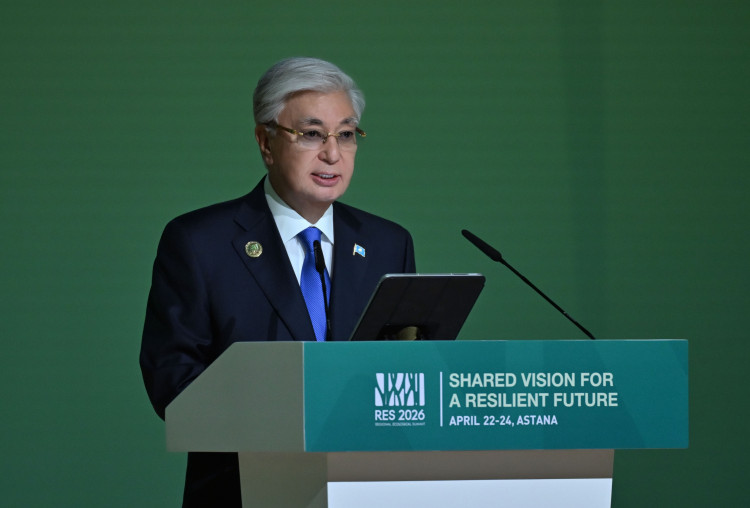
Dear Heads of State and Government,
Distinguished participants,
Ladies and gentlemen!
It is a great honour and privilege for me to welcome you all at the Regional Ecological Summit and to have here Heads of State of Central Asian countries and Caucasus.
Thank you, my dear colleagues, your attendance at this Forum held in cooperation with the United Nations gives an added value to this extremely important event.
Indeed, today, on Earth Day, we gather in Astana to reaffirm our shared responsibility to protect our planet.
It means that the states of our region clearly understand the urgency and extreme significance of having shared vision for a resilient future.
Ecology today is not limited to climate alone.
It is the very foundation of human livelihood.
It is about clean air and safe water, healthy soils and secure food systems.
It is about stability of communities and dignity of future generations.
It is also about clarity of thought, harmony of our societies and their happiness.
In broad sense, ecology is a way of living responsibly on our shared planet.
Therefore, our today’s Summit is timely and necessary.
Once again, I sincerely thank the leaders of brotherly states: President of Uzbekistan Shavkat Mirziyoyev, President of Kyrgyz Republic Sadyr Japarov; President of Tajikistan Emomali Rahmon, President of Turkmenistan Serdar Berdimuhamedov; President of Mongolia Ukhnaagiin Khürelsükh, who is also paying a state visit to Kazakhstan; President of Armenia Vahagn Khachaturyan, who is celebrating his birthday today; President of Georgia Mikheil Kavelashvili and high representatives of Russia, Azerbaijan, Belarus, Serbia, Pakistan and many other countries for their participation in this Summit.
I welcome the heads and representatives of the United Nations agencies, Environmental Conventions, financial institutions, NGOs, as well as our international partners, experts, scholars, academic community.
I also extend my sincere gratitude to organizers, volunteers, technical and logistical team and all those who worked tirelessly behind the scenes to make this Summit happen.
Dear Participants,
We meet here at a time of growing uncertainties and unpredictabilities.
Needless to elaborate how deeply and harmfully they affect global and regional stability and life’s quality of millions of people.
They undermine development efforts and divert resources away from solving urgent environmental challenges.
In this context, the role of the international community does really matter.
The United Nations, created eighty years ago, remains indispensable as the only universal platform for dialogue.
Yet, since then, the world has changed drastically and fundamentally.
The artificial intelligence has gained the upper hand in the mindsets of people around the world and their daily lives.
Many words are being said about the sanctity of the UN Charter, which remains a cornerstone of international law.
However, the UN Charter is not of Haute Cuisine and cannot serve as a cherry-picking platform.
Rather, UN Charter must be accepted and perceived as the single, comprehensive document and recognized as such with all its provisions.
Therefore, there is a strong need to ensure that UN and other major international institutions fully comply with the realities of the current world, which has entered an era of transformation of such a nature and scale that make it totally unprecedented and therefore unpredictable.
We should avoid selective applying of the principles of UN Charter to the international military conflicts.
At the same time, our trust in multilateral institutions should be kept unwavering, although they unfortunately lack credibility in addressing major international issues.
From my perspective, selective approaches cannot be tolerated either on ecological matters.
In many cases, environmental agendas are drafted and shaped without considering to the full extent the development needs of different regions and countries, especially of emerging states that are still building up their economic capacities.
Meanwhile, developed nations reached their current environmental standards through long periods of the industrialization.
Therefore, the global transition to cleaner models must be fair, balanced and stimulating.
Our common approach should be well-grounded, pragmatic, thoroughly considered to allow countries to move forward sustainably without compromising their opportunities for economic growth and progress.
Environmental cooperation must serve as a reliable instrument of unity and should not divide us.
It should be based on partnership, trust and shared responsibility – with no naming, no shaming and no blaming.
As partners we must work pragmatically and responsibly in support of peace and sustainable development.
Dear participants,
Nature can exist without geopolitics, and the latter cannot exist without nature.
Our countries share ecosystems.
We share rivers, landscapes and climate risks.
And most importantly, we share responsibility.
Central Asia and neighbouring regions face common ecological challenges. Among them are as follows:
- water scarcity and its poor management;
- desertification;
- glacier retreat;
- air pollution;
- biodiversity’s vulnerability.
I intentionally name all major problems and challenges and uncover their essence because I strongly believe that this precisely how we can collectively achieve positive results in addressing them.
The time for indicating successes is over, the time for making solutions has come.
Kazakhstan places special importance to ecological responsibility on the highest juridical level.
Our new Constitution clearly reflects environmental protection as a fundamental priority of state policy and public responsibility.
It confirms that ecological safety and prosperity are not a technical issue. It is a real value that must be embedded in our national DNA and our long-term vision of progress.
To be clear, Kazakhstan is implementing policies aimed at:
- transitioning to cleaner energy;
- protecting biodiversity;
- restoring degraded lands;
- modernizing water management systems;
- launching water saving policy;
- and, definitely, strengthening regional environmental cooperation.
We acknowledge that no country can succeed alone, major emphasis must be put on joint efforts on the regional and global levels.
We are pursuing this agenda through practical action, new technologies and long-term investment in resilience.
Central priority is just and fair energy transition.
Renewables now provide over 7 percent of Kazakhstan’s electricity and are expected to exceed 15 percent by 2030.
While maintaining strong oil and gas capacity, my country remains committed to sustainable energy objectives.
As the world’s leading uranium exporter, providing about 40 percent of global supply, we also support carbon-free electricity generation.
We are advancing our first nuclear power plant project, while modernizing coal-based power generation using clean coal technologies.
Therefore, emissions from major energy facilities are expected to decline by nearly 35 percent.
Water security is a matter of extreme importance for Kazakhstan as well as for the whole Central Asia. Our future depends on managing this vital resource wisely and fairly.
The Aral Sea remains a stark reminder of the consequences of unsustainable policies, but also of what determined, science-based action can achieve.
So far, we restored about 36 percent of the Northern Aral Sea, improving water quality, fish stocks and enhancing living conditions.
This afternoon, together with my colleagues, at the high-level meeting of the International Fund for Saving the Aral Sea, Kazakhstan will conclude its three-year chairmanship in the Organization.
Another pressing concern for my country is the Caspian Sea. Its protection is essential for ecological balance, biodiversity and regional sustainability.
Kazakhstan has therefore initiated an Interstate program to prevent further degradation of the Caspian Sea and established Scientific Research Institute of the Caspian Sea to advance regional scientific cooperation.
We call on all international stakeholders to support these efforts to safeguard this unique natural treasure.
Therefore, any use of military arms in the Caspian region must be excluded and banned.
Alongside our regional efforts, global water cooperation remains a key priority.
Last December in Ashgabat city I proposed to establish International Water Organization as an agency of United Nations.
This initiative is particularly timely, as the UN is currently reviewing thousands of mandates, offering an opportunity to strengthen coherence and effectiveness in global governance.
I am pleased to note that this Summit will host the first round of international consultations on this proposal.
Biodiversity conservation also remains a central pillar of our environmental policy.
Sustained efforts have delivered tangible results: the saiga population has rebounded.
Snow leopard numbers in Kazakhstan have more than doubled to around 190 animals.
In collaboration with international partners, we are also reintroducing and restoring other rare species, including falcons, the Turan tiger and Przewalski’s horse.
Large-scale reforestation is a core priority of Kazakhstan’s ecological agenda.
Over the past five years, we have planted more than 1.5 billion trees across more than one million hectares, including saxaul trees planting alongside with Uzbek experts on the dried Aral Sea bed to slow down its desertification.
Kazakhstan invites all partners to join the International Fund for Rare Species and Biodiversity Conservation – a platform for cross-border cooperation, research and effective ecosystem protection.
Besides, we have launched the nationwide movement “Таза Қазақстан” or “Clean Kazakhstan,” a broad public campaign promoting environmental awareness and civic responsibility.
This movement brings together nearly a million volunteers, who I would rather say, are true patriots of Kazakhstan, whose selfless service show how much they care about their country and its future.
In this spirit, we welcome and fully support the UN’s designation of 2026 as the International Year of Volunteers for Sustainable Development.
And in our new Constitution the Volunteer’s movement has gained appropriate status and now it is the duty of State to embrace volunteers.
This year has been announced the Year of Digitalization and Artificial Intelligence.
It is evident that handling successfully ecological matter is impossible without AI.Artificial intelligence will create new opportunities for protecting natural resources and improving environmental governance. Hence, we are ready to support the creation of a Regional Digital Ecosystem.
Distinguished guests,
This Summit reminds us that protecting our planet is a shared responsibility of all humanity.
It is about a future of the humankind and of our younger generation.
It is not only an environmental task, it is a highly moral duty.It is an economic necessity. And it is a strategic priority for peace and stability.
In this spirit, our shared vision for a resilient future must include several key principles:
- RESPONSIBILITY toward our citizens and future generations.
- COOPERATION across borders and sectors.
- FAIRNESS in access to resources, technologies and opportunities.
- PRACTICAL STEPS that bring out visible improvements.
- And finally, SOLIDARITY between nations regardless of size or level of development.
The adoption of the Astana Declaration on Ecological Solidarity in Central Asia and a number of substantive agreements reached on the margins of the Summit reflect our commitment to these principles and mark an important step toward stronger regional ecological partnership.
I am confident that our deliberations today will produce meaningful results and lead to concrete joint initiatives, transforming our shared vision for a resilient future into practical action that benefits our peoples.
I wish you all productive discussions.
Thank you.
Ақпарат көзі : https://www.gov.kz/memleket/entities/mfa-ljubljana/press/news/details/1206579?lang=kk