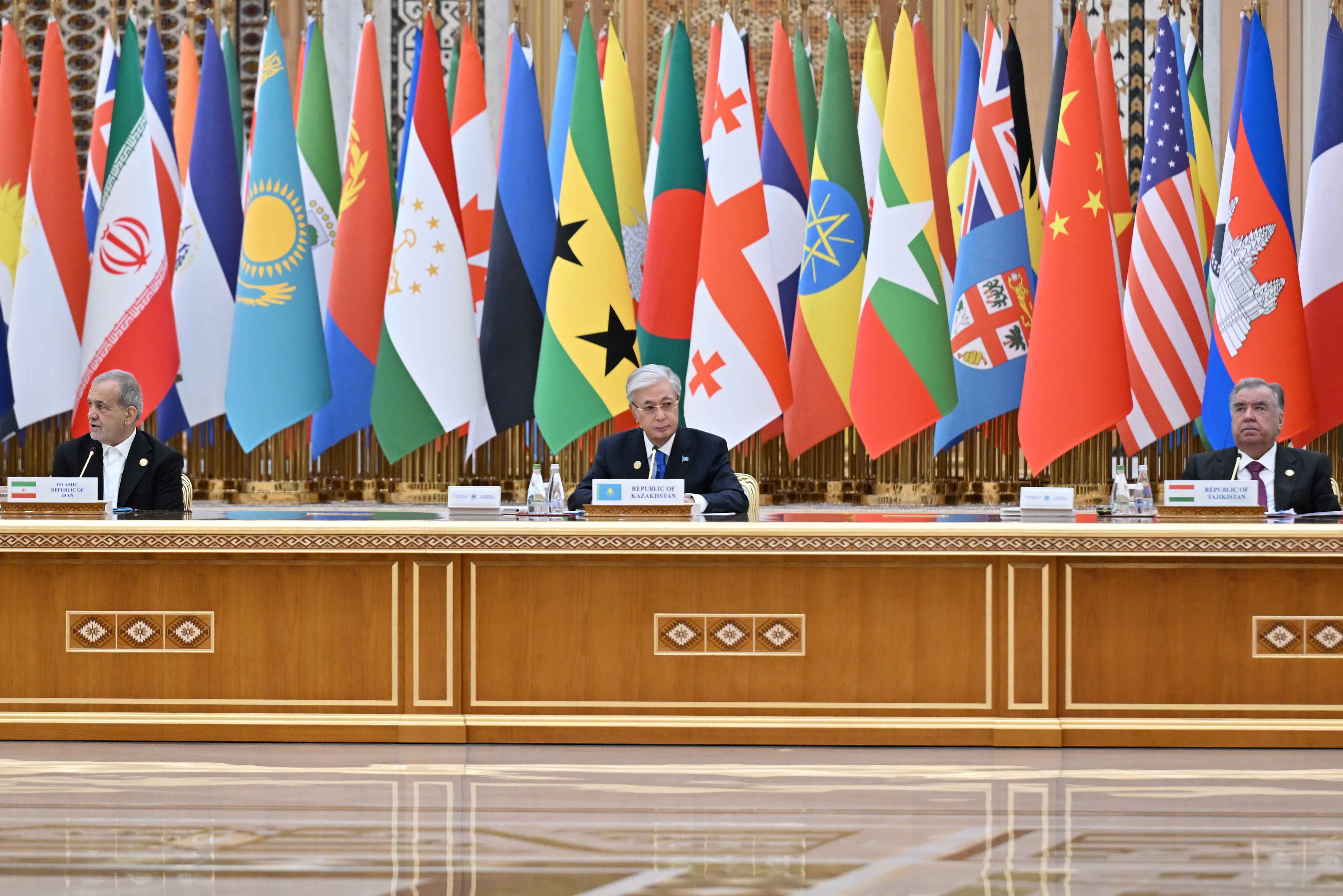

The Head of State highlighted the particular significance of Ashgabat's initiative to proclaim the International Year of Peace and Trust, which was supported by the United Nations General Assembly. The President stated that Kazakhstan had joined this important resolution because peace and trust are fundamental elements of Kazakhstan's foreign policy strategy.
"Despite the successes in resolving certain conflicts, the overall situation in the world remains extremely tense. There is a deficit of such critically important factors as mutual trust, tolerance, and the understanding of the importance of peace and cooperation for sustainable development. It is also with great regret that we must note the erosion of international law, its substitution with certain rules, and, of course, the decline in the authority and effectiveness of multilateral institutions, particularly the United Nations. Without restoring the strategic balance and building a just world order, international stability and security may remain merely a figure of speech or a good wish in negotiations and resolutions of multilateral forums. Therefore, Kazakhstan advocates for the reform of the United Nations, including the expansion of the Security Council and strengthening the role of the General Assembly. Within the framework of the 80th session of the General Assembly, I proposed the creation of a 'group of like-minded countries' to prepare specific proposals for reforming the UN system," said Kassym-Jomart Tokayev.
The President of Kazakhstan emphasized the importance of major powers demonstrating political will and calling on UN member states to engage in a large-scale dialogue. Kassym-Jomart Tokayev also mentioned that Kazakhstan supports the initiative put forward today by the President of Turkmenistan regarding the establishment of a United Nations University for Peace and Neutrality.
"It is now clear that a just and sustainable world order will become a reality only when narratives of inevitable global confrontation, and even nuclear war, are rejected. Instead of militaristic rhetoric, the language of peace, trust, and cooperation must prevail. In this regard, Kazakhstan welcomes the intensification of the negotiation process on the Ukrainian conflict. Following the meeting between the Presidents of Russia and the United States in Anchorage, the main provisions of the peace pact are actively being discussed, which indicates the emergence of an opportunity to achieve the long-awaited peace," noted the Head of State.

Kassym-Jomart Tokayev then expressed his support for the resolution of conflicts in other regions.
"We welcome the signing of agreements concerning the Middle East situation. Kazakhstan's decision to join the Abraham Accords is driven by the desire to contribute to the stabilization of the situation in this region. At the same time, Kazakhstan advocates for the creation of a sovereign Palestinian state as a key factor in resolving this truly protracted military-political crisis. In our view, the signing of the Joint Declaration on Peace by Azerbaijan and Armenia is of historical significance, as it opens up broad prospects for multifaceted cooperation both within the region and beyond. We hope for the swift conclusion of a comprehensive peace treaty that guarantees stability in the South Caucasus," he said.
On the issue of ensuring regional security, the President of Kazakhstan emphasized the necessity of continuing support for Afghanistan.
"An important platform for coordinating cooperation in this regard is the United Nations Regional Center for Sustainable Development Goals for Central Asian countries and Afghanistan, established in Almaty. The Conference on Interaction and Confidence-Building Measures in Asia plays an active role in strengthening stability and security, and this forum has proven its political relevance. We thank our friends for supporting the activities of this forum, including transforming the CICA into a full-fledged international institution," he noted.

As Kassym-Jomart Tokayev noted, Kazakhstan places special emphasis on strengthening interfaith, interethnic, and intercultural dialogue. He reminded that Kazakhstan has been regularly holding congresses of world and traditional religious leaders for more than twenty years.
"At the recent 8th Congress in Astana, Kazakhstan presented an initiative called the 'Movement for Peace.' This is essentially a call to end military violence and seek peaceful solutions in the spirit of collective responsibility for future generations. Kazakhstan will actively participate in the activities of the Shanghai Cooperation Organization (SCO) – an authoritative and successful Eurasian organization with a multifaceted constructive agenda, including issues of security and confidence-building measures. The key condition for global progress and stability is sustainable socio-economic development. The world economy, due to rising geopolitical tensions, international sanctions, disruptions in trade supply chains, technological competition, and many other factors, is facing the most serious challenges. The global economy is slowing down. Fortunately, Central Asia is being bypassed by stagnation, and all countries in the region are demonstrating relatively confident growth. For example, Kazakhstan's economic growth this year will exceed 6%, and the GDP will surpass 300 billion dollars. On a per capita basis, this is more than 15 thousand dollars," he said.
The President observed that the countries of Central Asia are actively enhancing their transit and transport potential, aimed at strengthening connectivity between the East and West, North and South. He shared that Kazakhstan is giving due importance to the development of the Trans-Caspian International Transport Route, modernizing its railway, port, and road infrastructure with the goal of creating a "seamless" transport system. The Head of State emphasized Kazakhstan's active participation in developing a Comprehensive Strategy for the Development of the Transport System in Central Asia.
According to the Head of State, ensuring water security requires particular attention.
"In the face of the growing water shortage, its conservation and rational use have already become a strategic, indeed vital priority for our country and, I believe, for other states in the region. The issues of transboundary water use, as well as the ecological state of the Aral and Caspian Seas, require urgent solutions and measures. In our view, through joint efforts based on mutual compromises, the effectiveness of the International Fund for Saving the Aral Sea could be enhanced. This would be facilitated by inviting Russia to become an observer member of the Fund. As for the Caspian, with the current rates of shallowing, this dangerous process could become irreversible, which would inevitably trigger a chain reaction of ecological, socio-economic, and even political consequences. Kazakhstan has proposed the development of a special Intergovernmental Program aimed at preventing the destruction of the ecosystem and the shallowing of the Caspian Sea. We call on the global community to support our efforts to preserve this unique water body," said the President.

Kassym-Jomart Tokayev believes that the development of global water diplomacy requires close interstate coordination.
"There is no specialized structure within the UN that focuses solely on water issues. Therefore, Kazakhstan proposes the creation of an International Water Organization that could consolidate all existing mandates from various UN organizations. An optimal option might be to transform the interagency mechanism UN-Water into a fully specialized agency or organization within the UN. The implementation of this initiative fully aligns with the UN's sustainable development goals and, of course, serves the interests of the entire international community. In April next year, Astana will host the Regional Environmental Summit, where Kazakhstan intends to initiate international consultations on the creation of a global water organization. I am confident that, with the shared political will, critically important water-related issues will begin to be addressed systematically, rather than fragmented, as is the case now," emphasized the Head of State.
In conclusion, Kassym-Jomart Tokayev expressed confidence that the Ashgabat Forum would contribute to strengthening the constructive partnership of the interested states and give a strong boost to international efforts to build a just world order based on mutual trust.
The forum also featured speeches by the President of Turkmenistan, Serdar Berdymukhamedov, the President of Russia, Vladimir Putin, the President of Turkey, Recep Tayyip Erdoğan, the President of Iran, Masoud Pezeshkian, the President of Armenia, Vahagn Khachaturyan, the President of Iraq, Abdul Latif Rashid, the President of Kyrgyzstan, Sadyr Japarov, the President of São Tomé and Príncipe, Carlos Manuel Vila Nova, the President of Tajikistan, Emomali Rahmon, the President of Uzbekistan, Shavkat Mirziyoyev, the Prime Minister of Azerbaijan, Ali Asadov, the Prime Minister of Georgia, Irakli Kobakhidze, the Prime Minister of Pakistan, Shehbaz Sharif, the Prime Minister of Myanmar, Nyo Soe, and the Prime Minister of Eswatini, Russell Dlamini.


