Enbekshi QazaQ

News

Online - meeting with the parent community on inclusive education 21.05.2026
15 мая 2026 года отделом образования Осакаровского района проведена очередная онлайн - встреча с родительской общественностью по вопросам инклюзивного образования. На встрече приняли участие более 25 родителей. В ходе встречи рассмотрен актуальный вопрос на сегодняшний день «Профориентационная работа с детьми с особыми образовательными потребностями». На встрече выступили заместитель директора по профессиональному обучению Нуринского многопрофильного колледжа имени Болата Абдикаримова – Зейникенов М.С., заместитель директора по учебной работе Колледжа-школы-интерната Осакаровского района – Резван В.А.На все интересующие вопросы были даны полные и развернутые ответы.В заключении родительская общественность района выразили благодарность за предоставленную информациюSource : https://www.gov.kz/memleket/entities/edu-osakarovka/press/news/details/1224688?lang=ru
New akim of Tenge village, Zhanaozen city elected 21.05.2026
New akim of Tenge village, Zhanaozen city electedZhanaozen City Election Commission on registration of the elected akim of the village of Tenge, Zhanaozen, Mangystau regionIn accordance with subparagraph 9) of Article 14, Article 45, paragraph 1 of Article 113-11 of the Constitutional Law of the Republic of Kazakhstan "On Elections in the Republic of Kazakhstan", the Zhanaozen City Election Commission, based on decision No. 11 dated May 20, 2026, registered Ermukhanov Amandyk Keldibayevich as akim of the village of Tenge in Zhanaozen, Mangystau region.Ermukhanov Amandyk Keldibayevich was born in 1987, works in the state institution "Office of the Maslikhat of Zhanaozen" as chief of staff, lives in the city of Zhanaozen.Zhanaozen City Election CommissionSource : https://www.gov.kz/memleket/entities/akimat-goroda-zhanaozen/press/news/details/1224691?lang=ru
How funds were used under the National Fund for Children program as of May 1, 2026 21.05.2026
      From February 1, 2024, to May 1, 2026, 297,895 applications totaling over $53.09 million were processed. Funds were transferred to authorized operators for subsequent crediting to applicants' bank accounts.Of the total number of completed applications, 187,597 applications, totaling approximately $33.39 million, were for housing improvements, and 110,298 applications, totaling $19.70 million, were for education expenses.As a reminder, recipients of targeted savings (TS) may use the entire amount or a portion of it. Unused funds remain in the targeted savings account (TSA).The most popular method for improving housing conditions was replenishing housing construction savings for further accumulation (183,436 applications completed, totaling approximately $32.72 million). Funds were also used as down payments for mortgage loans to purchase housing (1,425 applications, totaling $232,770), and for the purpose of acquiring housing through civil law transactions (final settlement), totaling 989 applications, totaling $156,590.The largest amount of funds under the TS for education was allocated to pay for educational services at educational institutions located in the Republic of Kazakhstan, either in installments (for each academic period or academic year) or in full (for the entire term of study) (101,899 applications, totaling $18.51 million, were completed). The following services were also in high demand: replenishing an educational savings deposit under an educational savings deposit agreement (5,796 applications completed, totaling approximately $801,290), and paying for educational services at foreign educational institutions in installments (for each academic period or academic year) or in full (for the entire term of study) (2,075 applications completed, totaling $308,590).Detailed information on TS payments for improving housing conditions and/or paying for education, broken down by authorized operators and regions, is available on the enpf.kz website.As a reminder, Kazakhstani children received a further payment of $130.71 per child based on the results of 2025, $129.38 per child in 2024, and $100.52 per child in 2023.Children under 18 receive annual payments from the National Fund as targeted benefits. According to the law, the amounts accrued to young Kazakhstani children remain part of the National Fund's assets and continue to be invested. Through continued investment, each child's targeted benefit amount increases annually through the investment income received.As a result, the total amount of all accumulated target requirements (including the annually accrued investment income) for a child participating in the program:- three years, amounted to $370.56;- two years, amounted to $263.93;- one year, amounted to $130.71.Parents and other legal representatives can check the participation of a child under 18 in the program using the child's IIN on the website kids.enpf.kz, in their personal account on the eGov.kz e-government portal, as well as in the eGov Mobile mobile apps and those of some second-tier banks.If information about target benefits accrued to children for the 2025 reporting year is not displayed, you must update your documents in your mobile apps by following this path:in the eGov Mobile app: "Digital Documents" - "Family" - "Update Document List" - "Accruals from the National Fund";in second-tier bank mobile apps, such as Kaspi.kz: "Gosuslugi" - "All Documents" - "Update Document List" - "Accruals from the National Fund."The absence of information on the accrual of target benefits for children who have reached or will reach 18 years of age this year in the legal representative's personal account is due to the fact that target benefits have acquired the status of TS, and therefore access to information about them is provided directly to the TS recipient (a citizen who has reached or will reach 18 years of age in 2026). These individuals must independently obtain information about their TS through their personal account on the UAPF or e-government websites. Upon reaching 18 years of age, they can contact an authorized operator to open a US dollar bank account and submit an online application for TS payment to improve their housing conditions and/or pay for education.Currently, the authorized operators are:Otbasy Bank JSC (for housing and education),Halyk Bank JSC (for education),Bank CenterCredit JSC (for education).Statistics on minor children eligible for targeted loans and adult recipients of the TS, as well as on the use of the TS for housing and/or education, can be found on the enpf.kz website.You can review the program terms, get instructions, and get answers to your questions on the website kids.enpf.kz. You can also view video comments and instructions on the topic on the БЖЗҚЕНПФ YouTube channel:video commentary by the Chairman of the Executive Board of UAPF JSC Zh.B. Kurmanov:https://www.youtube.com/watch?app=desktop&v=30CdPWl6dv0 video commentary by the Managing Director of UAPF JSC M.T.Sharipov:https://www.youtube.com/watch?v=APg2vATmMk0video commentary "Question and Answer" on the "National Fund for Children" program:https://www.youtube.com/watch?v=4cKr1VCAvUkhttps://www.youtube.com/watch?v=mrV0y37Gjnkinstructions for the "National Fund for Children" website:https://www.youtube.com/watch?v=VgP3dmMwAHchttps://www.youtube.com/watch?v=jyC2c-HgqpQinstructions for the implementation of the "National Fund for Children" program:https://www.youtube.com/watch?v=bqeT41rWecAhttps://www.youtube.com/watch?v=pNBSS1VHdWUSource : https://www.gov.kz/memleket/entities/abay-kurchatov/press/news/details/1228901?lang=ru
New akim of Rakhat village, Zhanaozen city elected 21.05.2026
New akim of Rakhat village, Zhanaozen city electedMessage from the Zhanaozen City Election Commission on the registration of the elected akim of the village of Rakhat in Zhanaozen, Mangystau regionIn accordance with subparagraph 9) of Article 14, paragraph 1 of Article 113-11 of the Constitutional Law of the Republic of Kazakhstan "On Elections in the Republic of Kazakhstan", the Zhanaozen City Election Commission, based on decision No. 10 dated May 20, 2026, registered Kazbek Amanzholuly Tabanbayev as akim of the village of Rakhat in Zhanaozen, Mangystau region.Tabanbayev Kazbek Amanzholuly was born in 1994, works in the state institution "Office of Akim of the village of Rakhat" as deputy akim of the village, lives in the village of Rakhat in the city of Zhanaozen.Zhanaozen City Election CommissionSource : https://www.gov.kz/memleket/entities/akimat-goroda-zhanaozen/press/news/details/1224698?lang=ru
Happy Anniversary! 21.05.2026
Комитет State Revenues of the Ministry of Finance of the Republic of Kazakhstan congratulates Ms. Kuralaі Zhyyndinova, Chief Expert of the Contact Center Division of the Department of Public Services, on her 50th anniversary!Kuralai Aigakyzy has been working in the system of state revenue authorities since 2003. She began her career in the territorial state revenue bodies of the East Kazakhstan Region and later in Astana, serving in the departments of information processing, tax registration of legal entities, reception and processing of information on legal entities and individual entrepreneurs, audit of legal entities, taxpayer registration, desk control, and administration of indirect taxes.Throughout her career, Kuralai Zhyyndinova has established herself as a competent and highly professional employee. She possesses such qualities as determination, integrity, the ability to make balanced decisions, and teamwork skills, and is one of the leading operators of the Contact Center.She is a true professional in her field, a responsible and proactive employee who enjoys the respect of her colleagues.On this remarkable юбилей day, we wish her abundant energy, strength, and enthusiasm!Source : https://www.gov.kz/memleket/entities/kgd/press/news/details/1224720?lang=ru
A delegation of the National Archive of the Republic of Kazakhstan, led by Director Sagila Nurlanova, paid a working visit to Estonia 21.05.2026
Tallinn 12–15 May 2026 - A delegation of the National Archive of the Republic of Kazakhstan, led by Director Sagila Nurlanova, paid a working visit to Estonia.As part of the programme organised by the Embassy, a meeting was held in Tartu with the Director of the National Archives of Estonia, Priit Pirsko, who presented the institution’s key areas of activity, modern archival practices, digitalisation projects, and methods for ensuring the long‑term preservation of documents. A significant outcome of the discussions was the signing of a Memorandum of Cooperation between the National Archives of Estonia and the National Archive of the Republic of Kazakhstan, confirming the intention of both sides to strengthen professional collaboration, exchange expertise, and implement joint initiatives. The delegation also visited the Estonian National Museum, where it became acquainted with approaches to cultural heritage preservation, research activities, and the organisation of archival and museum processes.In Tallinn, the delegation held a series of working meetings, including a visit to the Tallinn branch of the National Archives of Estonia, where it examined the institution’s structure, services, and operational processes, as well as contemporary methods for managing collections and digital resources. A meeting also took place at the National Library of Estonia with its Director General, Martin Eõvel. Discussions focused on best practices in library science, digital transformation, the introduction of innovative services, and the processes of digitisation and management of electronic collections.The visit contributed to the strengthening of professional ties and opened new opportunities for cooperation in the fields of archival and library work, digitalisation, knowledge exchange, and the implementation of joint projects.Source : https://www.gov.kz/memleket/entities/mfa-tallin/press/news/details/1224755?lang=ru
Coordination Between Kazakhstan and Slovenia within the Framework of Multilateral Diplomacy 21.05.2026
Ljubljana, 15 May 2026 – The Ambassador of Kazakhstan to Slovenia, Altay Abibullayev, held a meeting with the Director-General of the Directorate for Multilateral Cooperation of the Ministry of Foreign and European Affairs of Slovenia, Ambassador Božena Forštanarič Boroje.The parties exchanged views on issues of multilateral cooperation and interaction on international platforms, shared assessments of the current situation within the UN system, discussed the need to strengthen its institutions, and underlined the importance of coordinated approaches to global challenges. The meeting also addressed matters related to mutual support for candidacies in UN bodies and other international structures, as well as prospects for further coordination in the upcoming election cycles. The Ambassador of Kazakhstan provided a detailed briefing on the outcomes of the Regional Environmental Summit held in Astana, as well as on the initiative of the Head of State, Kassym-Jomart Tokayev, to establish, under the auspices of the United Nations, a specialized international water organization as part of the UN‑80 reform process.Both sides reaffirmed their commitment to the principles of multilateralism, emphasized the importance of international law, and expressed readiness to continue dialogue on the reform of the UN system. Special attention was given to the humanitarian agenda and the search for sustainable solutions in regions requiring international support. Following the consultations, the diplomats reached a principled understanding on further strengthening cooperation within international organizations, confirming their shared interest in advancing mutually beneficial partnership.Source : https://www.gov.kz/memleket/entities/mfa-ljubljana/press/news/details/1224758?lang=ru
Мемлекет басшысы Қасым-Жомарт Тоқаевтың Түркі мемлекеттері ұйымының бейресми саммитінде сөйлеген сөзі 21.05.2026
Құрметті мемлекеттер басшылары!Қадірлі саммитке қатысушылар!Баршаңызды Түркі әлемінің рухани астанасы – Түркістанда қарсы алып, Өздеріңізбен жүздесіп отырғаныма қуаныштымын.Менің шақыруымды қабыл алып, алқалы жиынға келгендеріңіз үшін Сіздерге шынайы ризашылығымды білдіремін.Түркістан – атажұртымыздың мызғымас темірқазығы. Екі дүние есігі, ер түріктің бесігі атанған шежірелі шаһар. Көне қала қашанда түбі бір түркі жұртының қасиетті қара шаңырағы саналған.Түркістан төріндегі Әзірет Сұлтан кесенесі – рухани тұтастық пен тарихи сабақтастық символы. Қожа Ахмет Ясауи бауырлас елдердің дүниетанымын кеңейтуге зор үлес қосты. Адамзатқа ортақ құндылықтарды барынша дәріптеді. Халықты жақсылыққа, жасампаздыққа, адалдыққа шақырды.Ғұлама ойшыл ислам дінін түркі жұртының таным-түсінігімен ұштастыра білді. Аса құнды еңбектер жазып, мол мұра қалдырды.Ясауидің тағылымды ойлары мен хикметтері – түркі халықтарының баға жетпес байлығы. Ұлы бабамыз дәріптеген құндылықтар әлі де өзектілігін жоғалтқан жоқ. Сондықтан біз Ясауидің гуманистік идеяларына баса мән беріп отырмыз.Қазір елімізде «Адал азамат», «Әділетті Қазақстан», «Таза Қазақстан» және басқа да бірегей бастамалар табысты жүзеге асырылып жатыр.Басты мақсатымыз – ұлт сапасын барынша жетілдіріп, мемлекеттігімізді нығайта түсу. Түптеп келгенде, осы ауқымды жұмыстың негізі Ясауи ілімінен бастау алады.Бүгінгі жиында Өздеріңізге тағы да атап өткім келеді: мен биыл Ұлыстың ұлы күнінде осы киелі Түркістан жерінде «Qoja Ahmet Yasaui» орденін тағайындау туралы шешім қабылдадым. Осыған орай тиісті Заң қабылданды, арнайы Жарлыққа қол қойдым.Бұл күллі түркі дүниесі үшін мән-мағынасы айрықша марапат деп айтуға болады. Сол себепті кеше алғашқы мәртебелі награданы аса құрметті Президент Режеп Тайип Ердоғанға салтанатты түрде табыстадым.Осылайша, біз түркі руханиятының темірқазығы – Ясауи тұлғасын дәріптей отырып, халықтарымыздың арасындағы мызғымас бауырластық тамырын нығайта береміз деп сенемін.Бүгінде Түркістан – көне мен келешекті тоғыстырған шырайлы шаһар. Аймақтың экономикалық әлеуеті жыл өткен сайын артып келеді. Былтыр облыстың экономикасы 9,3 пайызға өсті, оның көлемі 10 миллиард доллардан асты.  Аймаққа 3,5 миллиард доллар инвестиция тартылды.Алқалы жиынды осында өткізудің мақсаты – атажұртта бауырлас елдердің көшбасшыларымен жүздесу, қайта түлеген Түркістанды төрткүл дүниеге таныту.Біз киелі орданың тарихы қандай терең болса, болашағы да сондай жарқын боларына нық сеніммен қараймыз.Осы мүмкіндікті пайдаланып, бүгін Түркістанда Өзбекстанның қолдауымен жаңа зәулім мешіт ашылғанын үлкен ризашылықпен атап өткім келеді. Ерекше тарту жасағаны үшін Өзбекстан Президенті, аса қадірлі Шавкат Миромонұлы Мирзиёевке және өзбек халқына алғысымды білдіремін.Елдеріміздің руханиятындағы осы мешіттің орны ерекше болмақ. Бұл – қазақ-өзбек халықтары ынтымағының тарихи символы.Менің пікірімше, бұл мешітке «Миромон ата» аты берілсе, өте орынды болар еді. Қос халқымыз бұл шешімді қолдайтынына еш күмән жоқ. Себебі осы қасиетті нысан біздің арамыздағы мәңгі достыққа қызмет етеріне сенімдіміз.Құрметті достар!Біз халықаралық геосаяси ахуал аса күрделі және құбылмалы дәуірді бастан өткерудеміз. Әлемдік және аймақтық деңгейдегі бәсеке күшейіп барады.Қарулы қақтығыстар, соғыстар толастар емес. Мұның бәрі әлем экономикасына кері әсер етіп жатқанын бәріміз көріп отырмыз. Таяу Шығыстағы жағдайдың салдарын көршілес аймақ елдері де сезіне бастады.Осындай алмағайып кезеңде түркі мемлекеттерінің ауызбіршілікте болуы – өте маңызды.Себебі халықтарымызға ортақ сан ғасырлық шежіреміз бар.Қазіргі таңда түркі елдері заман талабын ескеріп, экономика және инвестиция саласындағы ықпалдастықты нығайтуы керек, ортақ мүдде жолында күш жұмылдыруға тиіс деп санаймын.Осы орайда, бүгінгі саммиттің «Жасанды интеллект және цифрлық даму» мәселесіне арналып отырғаны өте маңызды.Құрметті жиынға қатысушылар!Қадірлі достар!Қазір бүкіл әлем бұрын-соңды болмаған өзгерістермен бетпе-бет келді. Жаңа сын-қатерлер пайда болды. Дүние жүзінде технологиялық бәсеке күшейді, яғни, инновациялық тұрғыдан озық ел болу мақсаты алдыңғы қатарға шықты.Технологиялық даму кез келген мемлекеттегі тұрақтылық пен қауіпсіздік факторына айналды. Бұл – цифрлық трансформацияға дер кезінде бет бұрған елдер көш соңында қалмайды деген сөз. Сондықтан Түркі кеңесіне мүше мемлекеттер технологиялық жаңғыру үдерісінен тыс қалмауы үшін бірлесе жұмыс істеуі керек деп санаймыз. Жасанды интеллект пен цифрландыру үдерісі түркі әлемінің дамуына жол ашуға тиіс.Қазақстан цифрлық ел болуды көздеп отыр. Бұл – еліміздің алдында тұрған стратегиялық мақсат. Осы жыл Қазақстанда «Цифрландыру және жасанды интеллект жылы» деп жарияланды. Астанада Alem.ai жасанды интеллект орталығы ашылды. Сондай-ақ біз екі суперкомпьютерді іске қостық. Келесі қадам – «Деректерді өңдеу орталықтарының алқабын» құру. Бұл жоба аймақ елдеріне жетекші технологиялық компаниялар мен жаһандық цифрлық капиталды тартуға зор мүмкіндік бермек.Біз Қазақстанды аймақтық хаб ретінде дамыту үшін көші-қон үдерісін оңтайландыра бастадық. Шетелден келген кәсіпкерлерге, инвесторларға, білікті мамандарға арналған «Алтын визаны» енгіздік. Мұндай виза алған адамдар мемлекеттік және қаржылық қызметтерге Қазақстан азаматтарымен тең дәрежеде қол жеткізе алады.Сонымен қатар елімізде Цифрлық кодекс қабылданды, Жасанды интеллект туралы заң күшіне енді. Біз білім саласындағы цифрлық инфрақұрылымды дамыту және озық технологияны меңгерген педагогтерді даярлау мәселесіне, білім беру жүйесін әр оқушының қабілетіне сай бейімдеу, олардың дербес деректерін қорғау ісіне ерекше мән беріп отырмыз. Осы мақсатпен мен жақында Жасанды интеллектіні орта білім беру жүйесіне енгізу туралы Жарлыққа қол қойдым. Бұл да Қазақстанның болашағы үшін жасалған өте маңызды қадам деп айтуға болады. Алдағы уақытта еліміздің цифрлық даму бағдарын айқындайтын Digital Qazaqstan стратегиясы бекітіледі.Таяуда Алматы қаласында Тұрақты дамуға ықпал ететін цифрлық шешімдер орталығы ашылды. Бұл бастама Біріккен Ұлттар Ұйымының аймақтық экономикалық және әлеуметтік комиссиясының қолдауымен жүзеге асырылады. Қазақстанға тілектестік танытып, осы жобаның тең авторлары ретінде бұл жұмысқа мол үлес қосқандарыңыз үшін Сіздерге алғыс айтамын.Сонымен қатар наурыз айында Түркі кеңесі сарапшыларының қатысуымен Шымкент қаласында «Жасанды интеллект және цифрлық даму» халықаралық конференциясы өтті. Бұл іс-шара елдеріміздің осы саладағы ынтымақтастығы мен мүдделестігін айқын көрсетті.Мен былтыр Габалада өткен басқосу кезінде цифрлық даму және киберқауіпсіздік мәселесіне қатысты бірқатар бастама көтердім. Атап айтқанда, Түркі мемлекеттері ұйымының Цифрлық мониторинг және Цифрлық инновациялар орталықтарын құруды ұсындым. Бұл орталықтар Ұйымға мүше мемлекеттердің өсіп-өркендеуіне цифрлық тұрғыдан тың мүмкіндіктер береді. Бұдан бөлек, сол алқалы жиында Киберқауіпсіздік жөніндегі кеңес құру қажет екенін айттым.Мұндай Кеңес елдеріміздің цифрлық әлеміндегі осал тұстарды анықтап, инфрақұрылымға төнетін қауіптің алдын алуға ықпал етеді. Осы құрылым арқылы Ұйымға мүше елдердің тиісті органдары жедел ақпарат алмаса отырып, жұмыс істей алады.Қазақстан бұл бастамалар бойынша тиісті тұжырымдамаларды әзірлеп, Ұйымға мүше мемлекеттерге келісу үшін жолдады. Аталған нақты шаралардың бәрі де елдеріміздің ортақ мүддесіне сай келеді, сондықтан, осы бағытта тиімді және белсенді әрекет етеміз деп ойлаймын.Құрметті мемлекеттер басшылары!Мен бүгін бірқатар ұсынысты ортаға салғым келеді.Біріншіден, сауда-экономика саласы бойынша ұйымға мүше елдер арасында электрондық құжаттар мен цифрлық қолтаңбаны өзара тануға қатысты жұмысты бірлесе жүргізген жөн.Екінші мәселе: Ғарыш саласы – түркі мемлекеттерінің бәсекеге қабілетін арттыруға ықпал ететін негізгі фактордың бірі.Бұл бағытты жүйелі түрде дамыту үшін елдеріміздің ғылыми, технологиялық және қаржылық әлеуеті жеткілікті.Әсіресе, спутник байланысы, навигация және мониторинг саласында бірлескен жобаларды жүзеге асырып, ықпалдастығымызды кеңейте түсу қажет.Сол арқылы технологиялық дербестігімізді нығайтып, инновациялық әлеуетімізді арттыруға мүмкіндік туады. Мысалы, «CubeSat-12U» ғылыми спутнигін іске қосудың маңыздылығын атап өтуге болады.Үшіншіден, білім-ғылым саласына қажетті мамандар даярлайтын оқу орталықтары мен ғылыми мекемелер керек. Өзара тәжірибе алмасу, бірлесіп кадрлар даярлау және озық технологияларды енгізу өте маңызды. Сондықтан Түркі елдерінің жасанды интеллект орталықтарының желісін құруды ұсынамын.Біз Қазақстанда жаңа форматтағы технологиялық оқу орны – Жасанды интеллект университетін ашуды жоспарлап отырмыз.Жоғары оқу орнында түркі мемлекеттерінің азаматтарын оқыту үшін арнайы гранттар бөлуге дайынбыз.Бағдарламалау, жасанды интеллект және озық цифрлық технология салалары бойынша Түркі елдерінің жастары арасында жыл сайын ғылыми-технологиялық олимпиада ұйымдастырған жөн деп санаймыз.Бұл бастамаларды жүзеге асыру үшін Түркі инвестициялық қоры тарапынан қаржылай көмек көрсетуге болар еді.Биыл Қор нақты жобалар бойынша жұмыс істеу тәсіліне көшті. Жарғылық капиталы 600 миллион долларға жетті. Оны ұлғайтуға болады. Бұл – айрықша мәні бар стратегиялық ресурс.Сол себепті Қор барлық стартапқа қолдау көрсетіп, инфрақұрылымдық жобаларды іске асыруға белсене атсалысады деп сенеміз. Қор толыққанды қызмет көрсетуге тиіс. Мүше мемлекеттерді осы міндетті жедел жүзеге асыруға шақырамын.Төртінші мәселе. Қазір әрбір елде IT-жобаларға арналған технопарктер бар. Мен Түркі кеңесіне мүше мемлекеттердің IT хабтарының бірлескен орталығын ашуды ұсынамын. Орталыққа «Turkic ai» атауын беріп, оны Alem.ai орталығында орналастыруға болады. Бірлескен хаб ортақ мүдделерімізді ілгерілетуге ықпал етері сөзсіз.Бесіншіден, жасанды интеллект пен озық технология дәуірінде рухани және мәдени құндылықтарды назардан тыс қалдырмау қажет. Түркі өркениетінің мол мұрасын сақтау және оны зерделеу – тарихи жадыны жаңғырту мәселесі ғана емес. Бұл – біздің бірегей болмысымызды, бірлігімізді және ынтымақтастығымызды көрсететін маңызды фактор.Осы орайда мен Түркі өркениетінің мұрасын сақтау жөніндегі конвенция жобасын пысықтау туралы ұсынысты қолдауға шақырамын. Бұл құжат түркі халықтарының тарихи-мәдени мұрасын сақтау және дәріптеу ісіне құқықтық негіз болады. Сондай-ақ ЮНЕСКО-ның осы саладағы қызмет аясын кеңейте түсуге ықпал етеді.Алтыншы мәселе. Жасанды интеллект негізінде түркі халықтарының тарихы мен мәдениетіне қатысты материалдарды жинақтайтын арнайы цифрлық платформа құру жөніндегі жұмысты жандандыру қажет.Бұл жоба көптілді форматта жасалуға тиіс. Сонда кез келген адам онлайн режимде түркі өркениетінің мол мұрасымен танысып, оны зерделей алады. Қазақстан бұл бастамалар бойынша жан-жақты цифрлық шешімдер ұсынуға дайын.Жетінші міндет. Түркі мемлекеттерінің тарихи және мәдени мұрасын сақтау және оны болашақ ұрпаққа аманат етіп қалдыру – баршамызға ортақ міндет, парыз деп айтуға болады.Сол себепті мен Түркістан қаласының руханиятымыздағы рөлін ескеріп, осында Түркі өркениеті орталығын құру туралы шешім қабылдадым.Бұл орталық бауырлас елдердің бірлесіп ғылыми зерттеу жүргізуіне, мәдени жобаларды және білім беру бағдарламаларын іске асыруына жағдай жасайды. Сондай-ақ гуманитарлық ықпалдастығымызды нығайта түседі.Орталықтың қызметін тиімді ұйымдастыру үшін Ясауи атындағы Халықаралық қазақ-түрік университетінің ғылыми-академиялық әлеуетін пайдаланған жөн деп санаймын.Бұл университетке қажетті қаржылай және басқа да жәрдем көрсетіледі.Бәріміз де жаңа ғана Түркі өркениеті орталығының іргетасын қалау рәсіміне куә болдық. Осы бастамаға көрсеткен қолдауларыңыз үшін Сіздерге алғысымыз зор.Бұған қоса, біз Астанада Дала өркениетін дәріптеуге арналған арнайы орталық құруды жоспарлап отырмыз. Онда дала халықтарының тарихы мен мәдениеті кеңінен насихатталмақ. Ұйымға мүше мемлекеттерді және барлық бауырларымызды осы жобаны қолдауға және оған белсенді қатысуға шақырамын.Келесі маңызды мәселе. Технологиялық даму және гуманитарлық ықпалдастық дәуірінде түркі тілдеріне ортақ терминологиялық негіз қалыптастыру қажет.Жақында Түркі Академиясы ағылшын, орыс және түркі тілдерінде сегіз томдық терминологиялық сөздікті жарыққа шығарды. Бұл жұмыс терминдерді бір ізге келтіруге және ортақ ғылым кеңістігін нығайтуға ықпал етпек.Осы орайда Кеңеске мүше елдердің тиісті мекемелерінің өкілдері, ғылыми сарапшылары кіретін Мемлекетаралық терминологиялық комиссия құруды ұсынамын.Құрметті әріптестер!Қазақстан Түркі мемлекеттері ұйымын жан-жақты дамытуға мүдделі. Бүгінде біздің Ұйымға халықаралық қауымдастық сенім білдіріп отыр. Абырой-беделіміз де артып келеді.Осы орайда Қазақстан Ресейдің «Алтай – түркі өркениетінің бесігі» жобасына оң көзқарасын білдірді. Бұған қоса, біз «Алтай сұхбат алаңы (диалогі)» форумын құру жөніндегі ұсынысымызды жарияладық.Еліміз Түркияның ынтымақтастық аясын кеңейтуге бағытталған «Түркі мемлекеттері ұйымы +» форматын құру бастамасын қолдады. Осы форматқа қосылуға ниет білдірген мемлекеттер мен ұйымдарға қатысты нақты өлшемдер болу қажет деп санаймын. Ең бастысы, жаңа форматтағы жұмыс Ұйымның мақсат-міндеттеріне сай болып, оған кері әсерін тигізбеуі керек.Мысалы, соңғы кезде Ұйымымызды әскери альянс ретінде сипаттайтын ой-пікірлер айтылып жүр. Олардың теріс пейілі бізге анық, мақсаттары – елдестіру емес екені де белгілі. Қазақстан ондай ұстанымды жоққа шығару керек деп санайды. Біз үшін түркі әлемінің бірлігін нығайту аса маңызды, кезек күттірмейтін басымдық. Түркі мемлекеттері ұйымы – геосаяси жоба емес, әскери ұйым да емес. Бұл – бауырлас елдердің сауда-экономикалық, жоғары технологиялық, цифрлық және мәдени-гуманитарлық ынтымақтастығын нығайтатын бірегей алаң.Мұндай ұстаным еліміз үшін – маңызды басымдық, себебі, бұл ұлттық мүдде тұрғысынан да тиімді екені анық. «Алтау ала болса, ауыздағы кетеді, төртеу түгел болса, төбедегі келеді» деген аталы сөз – бәрімізге ортақ. Түркі әлемі әрдайым тату болып, алға қойған мақсатынан ауытқымай, бірлесе дами беруі керек. Сондықтан бүгінгі басқосу тамыры бір, тарихы ортақ елдеріміздің ауызбіршілігін арттыра түсері сөзсіз.Аса құрметті президенттер!Қадірлі жиынға қатысушылар!Бауырластық пен достық негізінде құрылған Ұйымының қызметі жыл өткен сайын жанданып келеді.Бүгінде Түркі мемлекеттері ұйымы ортақ бастамалар көтеріліп, өзара қолдау табатын теңдессіз сұхбат алаңы ретінде қалыптасты. Мен осы тұста баршаңызға тағы да шынайы ризашылығымды білдіремін.Бұл басқосуда қабылданған шешімдер Түркі елдерін одан әрі қарқынды дамытуға ықпал етеріне кәміл сенемін.Түбі бір түркі жұртының бірлігі нығайып, берекесі арта берсін! Осымен бейресми саммит отырысын жабық деп жариялаймын.Баршаңызға көп рақмет!Справочно:«Алтай – колыбель тюркской цивилизации» как важный элемент культурно-гуманитарного сближения в рамках ОТГ Организация тюркских государств – уникальная региональная организация, призванная расширять торгово-экономические и культурно-гуманитарные связи стран участниц объединения. Сегодня членами ОТГ являются: Казахстан, Азербайджан, Кыргызстан, Турция и Узбекистан.Казахстан является одним из основателей и локомотивов тюркской интеграции. Наша страна стояла у истоков создания ОТГ и последовательно продвигает углубление политического диалога и институционального развития организации.Наша страна активно выдвигает инициативы по укреплению многостороннего сотрудничества, включая принятие долгосрочных стратегических документов, таких как «Перспективы тюркского мира - 2040».Важным направлением также является продвижение инициативы «Трансалтайский диалог», выдвинутой Президентом Республики Казахстан в ходе Саммита ШОС в городе Тяньцзинь в 2025 году. Данная инициатива нацелена на эффективное раскрытие потенциала уникального евразийского «алтайского» региона, объединяющего Казахстан, Россию, Китай и Монголию и обладающего значительными территориальными, демографическими и экономическими ресурсами.Президент Касым-Жомарт Токаев поддерживает российскую концепцию «Алтай – колыбель тюркской цивилизации».На ІІ Международной научно-практической конференции «Алтай – прародина тюрков. К истории зарождения тюркской цивилизации», Глава государства отметил, что Алтай, издревле почитаемый как сакральная колыбель тюркского этноса, в нынешнее время органично объединил на своих просторах Казахстан, Россию, Китай и Монголию. Соответственно, данный диалог нацелен на эффективное задействование потенциала уникального по территории, численности населения и экономической мощи евразийского «алтайского» региона. Предлагаемый формат не является альтернативой действующим механизмам взаимодействия, а, напротив, направлен на усиление евразийской взаимосвязанности и органично дополняет существующие интеграционные форматы.Казахстан последовательно выступает за формирование современного, открытого и конкурентоспособного тюркского пространства, ориентированного на совместное движение по пути технологического прогресса, цифровизации, инновационного развития и внедрения искусственного интеллектаВ этом контексте особое значение придается интеграции тюркских стран в глобальные экономические и технологические процессы, развитию человеческого капитала, образования и научной кооперации.Казахстан рассматривает политическое взаимодействие в рамках ОТГ прежде всего как основу для укрепления торгово-экономического и культурно-гуманитарного сотрудничества, а также взаимного доверия между братскими тюркскими народами, а не как инструмент формирования военно-политического альянса. При этом, вопросы взаимодействия в сфере безопасности и военного сотрудничества реализуются государствами ОТГ преимущественно на двусторонней основе с учетом национальных интересов и внешнеполитических приоритетов каждой страны.Тем самым Казахстан последовательно способствует трансформации тюркского мира в пространство прогресса, инноваций и открытого международного сотрудничества, выводя его за рамки исключительно культурно-исторической повестки. Особое внимание при этом уделяется вопросам технологического развития, цифровизации и внедрения искусственного интеллекта, что полностью соответствует тематике Неформального саммита ОТГ в Туркестане. Такой подход позволяет гармонично сочетать богатое историческое наследие тюркских народов с современными глобальными трендами и ценностями открытого мира.Source : https://www.gov.kz/memleket/entities/mfa-ljubljana/press/news/details/1224776?lang=ru
International Symposium on the Legacy of the Golden Horde Opens in Astana with the Participation of the President of the Republic of Kazakhstan 21.05.2026
On May 19 the opening ceremony of the International Symposium “The Golden Horde as a Model of Steppe Civilization: History, Archaeology, Culture, and Identity” was held in Astana with the participation of the President of the Republic of Kazakhstan, Kassym-Jomart Tokayev.The large-scale international forum, taking place on May 19–20 under the auspices of UNESCO, has brought together leading domestic and international scholars, experts, and representatives of the global academic community to comprehensively examine the historical legacy of the Ulus of Jochi and its role in shaping civilizational processes across Central Eurasia.The symposium aims to position the Republic of Kazakhstan as a leading international center for the study of Golden Horde heritage, while also demonstrating the country’s academic potential in the field of Central Eurasian civilization studies through a comprehensive interdisciplinary analysis of the political, economic, cultural, and spiritual legacy of the Ulus of Jochi and its significance for contemporary integration processes in Eurasia.As part of the symposium, a thematic exhibition dedicated to the Golden Horde heritage as a model of steppe civilization has also been presented. The exhibition features archaeological, written, and cultural artifacts.The exhibition is structured around key thematic sections, including statehood and governance, steppe fashion and clothing, military affairs, interaction between steppe and urban civilizations, culture, science, and art. Particular attention is given to an interactive map featuring 70 archaeological and architectural monuments, 17 of which are presented with detailed descriptions, aerial photographs, and 3D visualizations.Among the central exhibits is the manuscript scroll “Shezhire of the Khans,” containing genealogical information about rulers and historical figures of the era. Other exhibits include the Catalan Atlas, genealogical trees of khans, coins, written sources, and everyday household items. The written heritage section includes three decrees, four diplomatic letters, and 21 manuscripts presented in original, facsimile, and digital formats.The exhibition is based on materials from significant archaeological sites in Kazakhstan, including the ancient cities of Saraishyk, Syganak, Barshynkent, and other historically important sites located within the country. The exhibition is intended to promote the historical and cultural heritage of the Golden Horde and expand scholarly interest in its study.The plenary session was moderated by Sayasat Nurbek, Minister of Science and Higher Education of the Republic of Kazakhstan. Representatives of the UNESCO Secretariat, diplomatic missions of CIS, SCO, CSTO, and OTS member states, as well as ambassadors from Russia, China, Türkiye, Iran, Mongolia, Ukraine, Hungary, Bulgaria, the United States, the United Kingdom, Germany, France, and several other countries attended the opening ceremony.The forum brought together more than 300 scholars and experts, including 120 international researchers from over 20 countries. Participants include medieval historians, archaeologists, Orientalists, Turkologists, Mongolists, numismatists, epigraphy specialists, political scientists, cultural scholars, art historians, diplomats, and representatives of international organizations.Speaking at the plenary session, Sayasat Nurbek emphasized that the International Symposium dedicated to the legacy of the Golden Horde holds strategic importance for the development of historical science and the reinterpretation of historical memory.“Today, we are discussing not only the past, but also the foundations for understanding statehood, identity, and Kazakhstan’s place in the history of Eurasia. In the context of the modern reassessment of history, the Golden Horde acquires particular significance as a crucial stage in the formation of the political and cultural traditions of the Great Steppe,” the Minister stated.According to him, the Golden Horde represented a unique model of Eurasian integration that facilitated interaction between East and West, enabling the exchange of ideas, technologies, and cultural practices, while its history reflects the synthesis of steppe and sedentary civilizations.“For Kazakhstan, studying the Golden Horde is not merely an academic task. It is a matter of historical continuity. Kazakhstan considers itself one of the heirs of the Ulus of Jochi, where the foundations of statehood and ethnogenesis were formed and later continued in the Kazakh Khanate,” Sayasat Nurbek noted.Welcoming remarks were also delivered by Ernesto Ottone, Assistant Director-General for Culture of UNESCO and Director of the UNESCO World Heritage Centre Eloundou Assomo Lazar, State Secretary of the Kyrgyz Republic Arslan Koichiev, Minister of Culture of the Republic of Tatarstan Irada Ayupova, President of the La France s’engage Foundation Audrey Azoulay, President of the Mongolian Academy of Sciences Sodnomsambuu Demberel, President of the Academy of Sciences of the Republic of Uzbekistan Shavkat Ayupov, and Head of the M.A. Usmanov Center for Golden Horde and Tatar Khanates Studies at the Sh. Marjani Institute of History of the Academy of Sciences of the Republic of Tatarstan Ilnur Mirgaleev.During the symposium, particular attention is being paid to the ethnopolitical history of the Golden Horde, the contemporary relevance of its legacy, prospects for further research, material and spiritual cultural heritage, written and oral sources, as well as civilizational interactions along the Great Silk Road.The forum program also includes specialized academic panels dedicated to interdisciplinary studies of the historical and cultural heritage of the Golden Horde, archaeological discoveries, and issues related to the formation of historical memory and identity.One of the key outcomes of the international forum was the adoption of the Astana Declaration on the Heritage of the Golden Horde, aimed at promoting international scientific cooperation, consolidating research initiatives, and strengthening collaboration among research centers and expert communities from different countries.The cultural program of the symposium includes the concert “Uly Dala Murasy” (“Heritage of the Great Steppe”), reflecting the richness of the historical and cultural legacy of the Great Steppe and the continuity of the spiritual traditions of the Eurasian space.Hosting the International Symposium in Kazakhstan contributes to further strengthening the country’s international reputation as one of the leading centers for the study of the history and heritage of Central Asia, expanding academic dialogue, and promoting objective research into historical processes that played a significant role in shaping Eurasian civilization.Source : https://www.gov.kz/memleket/entities/mfa-tbilisi/press/news/details/1225619?lang=ru
III International Children’s Togyzqumalaq Tournament Held in Vilnius 21.05.2026
Vilnius, May 19–20, 2026 – Under the auspices of the Embassy of the Republic of Kazakhstan in the Republic of Lithuania, the Lithuanian and Latvian Togyzqumalaq Federations, and Vilnius Santaros Gymnasium, a masterclass and the Third International Children’s Togyzqumalaq Tournament were held in the Lithuanian capital. Togyzqumalaq is a traditional Kazakh intellectual game inscribed on UNESCO’s Representative List of the Intangible Cultural Heritage of Humanity.On May 19, Latvian school students conducted a masterclass at Santaros Gymnasium, where Lithuanian students had the opportunity to learn the basics and distinctive features of the game. The main tournament took place on May 20 at the Embassy of Kazakhstan in Lithuania.The tournament has been organized annually since 2024 and aims to promote Kazakhstan’s national intellectual heritage, foster intercultural dialogue, and strengthen educational and humanitarian ties between Kazakhstan and the Baltic States.More than 30 school students from Lithuania and Latvia took part in the competition, demonstrating a high level of preparation, strategic thinking, and interest in Kazakh culture.The winners and participants of the tournament were awarded diplomas from the Kazakhstan Togyzqumalaq Federation and commemorative prizes.The growing interest in togyzqumalaq across Europe is becoming a hallmark of cultural, humanitarian, and youth cooperation between Kazakhstan, Lithuania, and Latvia.The Embassy expresses its gratitude to President of the Latvian Togyzqumalaq Federation L. Azimova, President of the Lithuanian Togyzqumalaq Federation A. Zhandaris, as well as the administration of Santaros Gymnasium for their continued contribution to organizing the tournament and promoting the Kazakh intellectual game in the Baltic States.Source : https://www.gov.kz/memleket/entities/mfa-vilnius/press/news/details/1224801?lang=ru
- 21.05.2026
Source : https://www.gov.kz/memleket/entities/almobl/press/news/details/1224804?lang=ru
Constitutional Reforms in Kazakhstan Discussed at the Italian Senate 21.05.2026
Rome, May 20, 2026 – A meeting took place between Ambassador Yerbolat Sembayev and Antonio Trevisi, a member of the Italian Senate representing the “Forza Italia” party, during which the parties discussed bilateral political, trade-economic, and interparliamentary cooperation.In particular, Ambassador Sembayev briefed Senator Trevisi on the ongoing political and economic reforms in Kazakhstan and outlined the results of the referendum on the draft of the new Constitution of the Republic of Kazakhstan. The parties also discussed preparations for a major event dedicated to Kazakhstan’s constitutional reforms, scheduled to take place at the Italian Parliament in early June this year.During the talks, the Ambassador also informed Senator Trevisi about Kazakhstan’s ongoing economic reforms, measures aimed at improving the investment climate, and the implementation of investment projects. Particular attention was given to issues related to industrial cooperation, production localisation, equipment supplies, and the expansion of contacts between the business communities of the two countries.For his part, Senator Antonio Trevisi positively assessed the political reforms taking place in Kazakhstan and noted the importance of strengthening bilateral relations.Source : https://www.gov.kz/memleket/entities/mfa-roma/press/news/details/1224840?lang=ru
Mutual Commitment to Cooperation on Critical Raw Materials confirmed at Meeting in Brussels 21.05.2026
Brussels, 20 May 2026 – On the sidelines of the EIT (European Institute of Innovation and Technology) Raw Materials Summit, Ambassador of the Republic of Kazakhstan to the European Union Roman Vassilenko held a meeting today with Mr. Valère Moutarlier, Deputy Director-General of the European Commission’s Directorate-General for Internal Market, Industry, Entrepreneurship and SMEs (DG GROW).They discussed prospects for deepening the strategic partnership between Kazakhstan and the European Union in the areas of critical raw materials, industrial cooperation and sustainable supply chains in line with the relevant Memorandum of Understanding signed in 2022. Mr. Moutarlier highlighted the importance for the EU of cooperation with Kazakhstan as a reliable and constructive partner possessing significant potential in the field of mineral resources. Both sides reaffirmed their interest in further developing mutually beneficial business cooperation between Kazakhstan and the European Union based on mutual respect and trust.The interlocutors emphasized the importance of accelerating the practical implementation of joint initiatives, enhancing coordination mechanisms, and creating favourable conditions for private sector’s participation and investment. They also discussed preparations for upcoming joint events at various levels.Following the meeting, the parties agreed to continue working contacts and joint efforts aimed at expanding industrial partnership, developing high value-added projects, and strengthening investment cooperation within the framework of the Global Gateway initiative.Source : https://www.gov.kz/memleket/entities/mfa-brussels/press/news/details/1224847?lang=ru
Kazakhstan and the UAE Strengthen Cooperation in Aviation and Investment 21.05.2026
Abu Dhabi, May 20, 2026 – Ambassador of Kazakhstan to the United Arab Emirates, Rauan Zhumabek, held a meeting with His Highness Sheikh Ahmed bin Saeed Al Maktoum, Chairman and Chief Executive of Emirates Group, President of the Dubai Civil Aviation Authority, and Chairman of Dubai Holding and Dubai Airports.During the meeting, the parties discussed the current state and future prospects for the development of cooperation between Kazakhstan and the UAE, including collaboration in the fields of aviation, transport, logistics, tourism, investment, and infrastructure development.The interlocutors noted that bilateral relations continue to demonstrate a high level of strategic partnership and are developing dynamically owing to the active political dialogue and regular high-level engagements between the two countries. The parties underscored the importance of continuing joint efforts aimed at expanding trade, economic, and investment cooperation.The Kazakh diplomat particularly highlighted the significant contribution of Sheikh Ahmed bin Saeed Al Maktoum to the transformation of Dubai into one of the world’s leading aviation, transport, and business hubs. Under his leadership, Emirates Group has become one of the global leaders in the aviation industry, while Dubai International Airport has evolved into the world’s largest international aviation hub.The parties also exchanged views on further strengthening business ties and expanding cooperation between Kazakh and Emirati companies.At the conclusion of the meeting, both sides reaffirmed their mutual interest in maintaining a constructive dialogue and further advancing the mutually beneficial partnership between Kazakhstan and the UAE.Background: Emirates Group is one of the world’s largest aviation groups and the UAE’s flagship carrier headquartered in Dubai. The Group includes Emirates Airline, which operates flights to more than 140 destinations worldwide and plays a central role in positioning Dubai as a global aviation and logistics hub.Dubai International Airport (DXB) retained its status as the world’s busiest airport for international passenger traffic in 2025, handling a record 95.2 million passengers.Dubai Holding is one of Dubai’s largest diversified state-owned investment conglomerates, with an extensive portfolio of companies and projects spanning real estate, tourism, hospitality, telecommunications, finance, technology, logistics, and other strategic sectors. Source : https://www.gov.kz/memleket/entities/mfa-abudhabi/press/news/details/1224851?lang=ru
From the Great Steppe to “Kazakh-boo”: Brussels Hosts Discussion on Growing European Interest in Kazakhstan 21.05.2026
Brussels, May 20, 2026 — In the heart of the European capital, a traditional Kazakh yurt was turned into a venue for travel, discovery, and authentic stories about modern Kazakhstan. It hosted the second edition of the Shanyraq Dialogues series entitled: “The Silk Road Without Stereotypes: Real Travel Stories from Kazakhstan.”Organized by the Embassy of the Republic of Kazakhstan in Belgium, the event brought together representatives of EU institutions, European media, the tourism industry, bloggers, cultural figures, and friends of Kazakhstan.Opening the discussion, Ambassador of Kazakhstan to Belgium Roman Vassilenko noted that Kazakhstan today is becoming not only an important bridge between Europe and Asia, but also a new destination for travelers seeking authentic experiences, vast landscapes, and genuine human connections.“Today, Europe is increasingly discovering Kazakhstan not only as a modern state and a bridge between East and West, but also as the successor to the great civilization of the Golden Horde, which played a significant role in the history of Eurasia. Just yesterday, President Kassym-Jomart Tokayev particularly emphasized this historical continuity in his address at an international symposium in Astana.”The discussion was moderated by Antonio Buscardini, Founder and Editor-in-Chief of Travel Tomorrow and President of The Press Club Brussels Europe.“After the era of mass tourism, more and more people are looking for destinations where travel still feels authentic. Kazakhstan is increasingly appearing in the European digital space through travel videos, gastronomy, music, and the aesthetics of nomadic culture. Some social media users, especially young Europeans, even jokingly refer to this growing interest as ‘Kazakh-boo,’” he noted.The evening’s main speakers were travelers, journalists, and media project creators who had explored Kazakhstan firsthand.Sven Hoyaux, Editor-in-Chief of Porschist magazine, spoke about his travels across different regions of the country and the preparation of a special issue dedicated to Kazakhstan. His presentation was accompanied by video footage of steppe landscapes, mountain routes, and modern cities.Particular attention was drawn to the story of Belgian traveler Claude Brouir, who crossed Kazakhstan by bicycle. He admitted being impressed by the country’s scale, the openness of its people, and how easy it is to connect with people there.“I was amazed by people’s hospitality. Very often strangers invited me for tea, helped me on the road, or simply wanted to talk. In Europe, this happens less and less,” he said.The audience also showed strong interest in behind-the-scenes stories from the filming of the popular TV show Pékin Express in Kazakhstan, shared by producer Inga Chumakova. The show remains one of the best-known travel formats on French-speaking television. According to the project participants, the combination of modern cities, natural landscapes, and the warmth of the people became the main discovery for the European film crew.During the discussion, participants also highlighted the recent international symposium in Astana dedicated to the legacy of the Golden Horde, noting the growing interest in the history of the Great Steppe as an important part of Kazakhstan’s cultural and historical identity.Participants emphasized that such initiatives contribute to strengthening interest in Kazakhstan across Europe and help present the country more broadly as a modern tourist, cultural, and intellectual destination.Shanyraq Dialogues is a discussion platform aimed at promoting mutual understanding and strengthening ties between Kazakhstan and Europe. It serves as a venue to discuss contemporary developments, key ideas, and promising areas of cooperation in the political, economic, cultural, and public spheres. The platform encourages the exchange of views, experience, and initiatives, fostering lasting and meaningful dialogue between Kazakhstan and its European partners.Source : https://www.gov.kz/memleket/entities/mfa-brussels/press/news/details/1224852?lang=ru
Kazakhstan’s Agricultural Exports to China Rise by 82.4% 21.05.2026
Vice Minister of Agriculture of Kazakhstan, Yermek Kenzhekhanuly, held a meeting with Liu Huanxin, Head of China’s National Food and Strategic Reserves Administration (NAFRA).During the talks, the parties discussed the current state and future prospects of bilateral cooperation, the expansion of agricultural trade, the implementation of investment projects, and the strengthening of food security.Yermek Kenzhekhanuly emphasized that China remains one of Kazakhstan’s key strategic partners in the agricultural sector.At the end of 2025, bilateral agricultural trade between the two countries increased by 36.8% and reached USD 1.97 billion. In January–March 2026, the figure grew by 61.7%, reaching USD 697 million.Kazakhstan’s agricultural exports to China increased by 35.3% in 2025, totaling USD 1.43 billion. The main export items included animal feed, vegetable oils, flax and sunflower seeds, and rapeseed oil. During the first three months of the current year, exports rose by 82.4%, reaching USD 550 million.Currently, Kazakhstan and China have signed protocols covering the export of 34 types of agricultural products, including 21 categories of crop products and 13 categories of livestock products. A total of 3,601 enterprises have been included in the register of companies authorized to export to China.For his part, Liu Huanxin highlighted the strong potential for agricultural cooperation between the two countries and confirmed China’s interest in stable supplies of high-quality products.“Your country is an important partner for China in ensuring food security and developing sustainable agricultural supply chains. We are ready to further strengthen practical cooperation, expand trade, and support joint projects in grain trade, logistics, and processing,” the head of NAFRA emphasized.Particular attention during the meeting was given to the prospects of concluding long-term contracts for the supply of grain and oilseed crops, creating logistics hubs and dry ports, as well as exchanging technologies for the storage and processing of agricultural products.Another topic of discussion was the development of digital tools for grain trading. The Kazakh side expressed interest in studying China’s experience in implementing a digital grain trading platform.Following the meeting, the parties agreed to establish a joint Chinese-Kazakh grain trading platform. The project is being implemented in accordance with the China–Central Asia Action Plan under the Belt and Road Initiative (BRI).The platform will be created on the basis of China’s existing National Internet Grain Trading Platform and will allow businesses from both countries to conduct transactions through competitive bidding and direct negotiations.The platform’s main product range will focus on soybeans and other oilseed crops.In addition, a Memorandum of Understanding was signed between the Ministry of Agriculture of Kazakhstan and NAFRA, along with a cooperation agreement between Food Contract Corporation JSC and the Grain Trade Coordination Center under NAFRA.Source : https://www.gov.kz/memleket/entities/moa/press/news/details/1224873?lang=ru
The new MAT methodology is aimed at ensuring the adequacy of future funded pensions. 21.05.2026
 In Kazakhstan, to ensure the adequacy of future pensions for citizens and bring the pension system in line with international standards, changes are planned to the Methodology for Calculating Minimum Adequacy Thresholds (MAT).The purpose of revising the MAT calculation method (Methodology) is to increase the requirements for the minimum amount of pension savings necessary to ensure the adequacy of future funded pensions and to gradually increase the labor income replacement rate (IRR) of contributors through pension benefits at retirement age (taking into account minimum international standards). Why was there a need for change?According to the current Methodology, the MAT amounts are set annually based on calculations taking into account approved socio-economic indicators, projected calculations of future pension contributions depending on the minimum wage and investment returns. However, the current Methodology has a number of shortcomings:high dependence on long-term macroeconomic forecasts, resulting in annual volatility in MAT amounts;no guarantee that the contributor will actually pay future pension contributions;deminished amounts of future pension benefits. According to the current Methodology for determining MAT, it is assumed that if a portion of pension savings is withdrawn, the contributor will continue to regularly make compulsory pension contributions (CPCs) until retirement. In this case, the future funded pension will be approximately 50,000 tenge, which corresponds to the current subsistence minimum (SM). However, in practice, contributions may be received irregularly or not at all. In this case, the current MAT amounts will not provide the expected minimum payments, and the amount of future pension benefits will be lower than the SM. Moreover, even with regular contributions and ensuring the accumulation volume at the level of the current MAT amounts, the funded pension at the level of about 50 thousand tenge will amount to less than 15% of the current median salary[1]. What does the new Methodology propose?The proposed new Methodology for Determining the MAT aims to provide citizens with a higher and more predictable level of pension benefits. According to the new approach, after withdrawing savings above the MAT, the future funded pension will be equal to at least 40% of the median salary (according to the Bureau of National Statistics of the Agency for Strategic Planning and Reforms of the Republic of Kazakhstan, in the fourth quarter of 2025, it was 339,912 tenge).Moreover, in the proposed Methodology, threshold values ​​will no longer depend on future contributions or annual projected changes in many macroeconomic indicators. MAT values ​​will be determined based on long-term factors, including demographic tables of Kazakhstan's population, regularly updated by the United Nations (UN), taking into account national statistics. Accordingly, future pension amounts will be predictable for citizens and will gradually approach the target indicators of OECD countries.The MAT amount, as currently, will depend on the contributor's age: the closer a person is to retirement age, the higher the MAT level must be to secure a future pension.The classic formula for calculating the present value of a future pension benefit will be used to determine the MAT. In other words, the new formula determines the minimum savings amount, i.e., the MAT amount that must already be in the contributor's individual pension savings account (IPSA) to ensure the target pension. Furthermore, the impact of inflation and investment returns is taken into account when calculating future payments, meaning future benefits will grow in real terms, taking inflation into account.Thus, the new Methodology for Determining MAT increases the requirements for the minimum amount of pension savings required to provide a future funded pension, ensuring an adequate replacement rate for a contributor's labor income through pension benefits. Furthermore, this Methodology will bring the MAT calculation system closer to international pension standards and reduce the risk of insufficient pension savings at retirement. International Standards and Global ExperienceAs a reminder, according to Convention 102 of the International Labour Organization (ILO), the minimum acceptable level of pension provision is IRR of at least 40%. In European Union (EU) countries, the average minimum pension is approximately 60% of the minimum wage. In Organisation for Economic Co-operation and Development (OECD) countries, the average minimum wage is approximately 50% of the median wage.International experience shows that the option of early withdrawal of pension savings has been used in a number of countries as an anti-crisis measure in strictly limited amounts in exceptional situations related to economic upheaval and the need to support the population, including during the COVID-19 pandemic.It should be emphasized, however, that pension savings are primarily intended to provide income for citizens in old age. Therefore, regular withdrawal of pension funds before retirement can lead to a critical decline in the amount of savings and, consequently, to a reduction in the amount of future pension benefits. In the long term, this increases the risk of insufficient retirement income in old age.Therefore, the option of using a portion of pension savings for alternative purposes remains, but approaches to determining the amount of funds available for withdrawal are being refined, taking into account the need to ensure citizens have an adequate and stable level of pension benefits in the future. The calculation of the MAT under the new Methodology in Kazakhstan will be adapted to real conditions and aims to bring it closer to the pension provision practices of advanced countries. The updated methodology will allow for the determination of the minimum level of pension savings required to be retained in the Individual Pension Savings Account (IPSA), so that, if a portion of the savings is withdrawn, the future funded pension will not be lower than the target indicators and will provide a stable pension income for citizens at retirement age. [1]The median salary is an indicator that divides all salaries into two equal parts: 50% of employees receive less than this amount, and 50% receive more. Source : https://www.gov.kz/memleket/entities/kostanai-rudnyi-kalasy-akimat/press/news/details/1228761?lang=ru
POWER OUTAGE NOTICE 19.05.2026
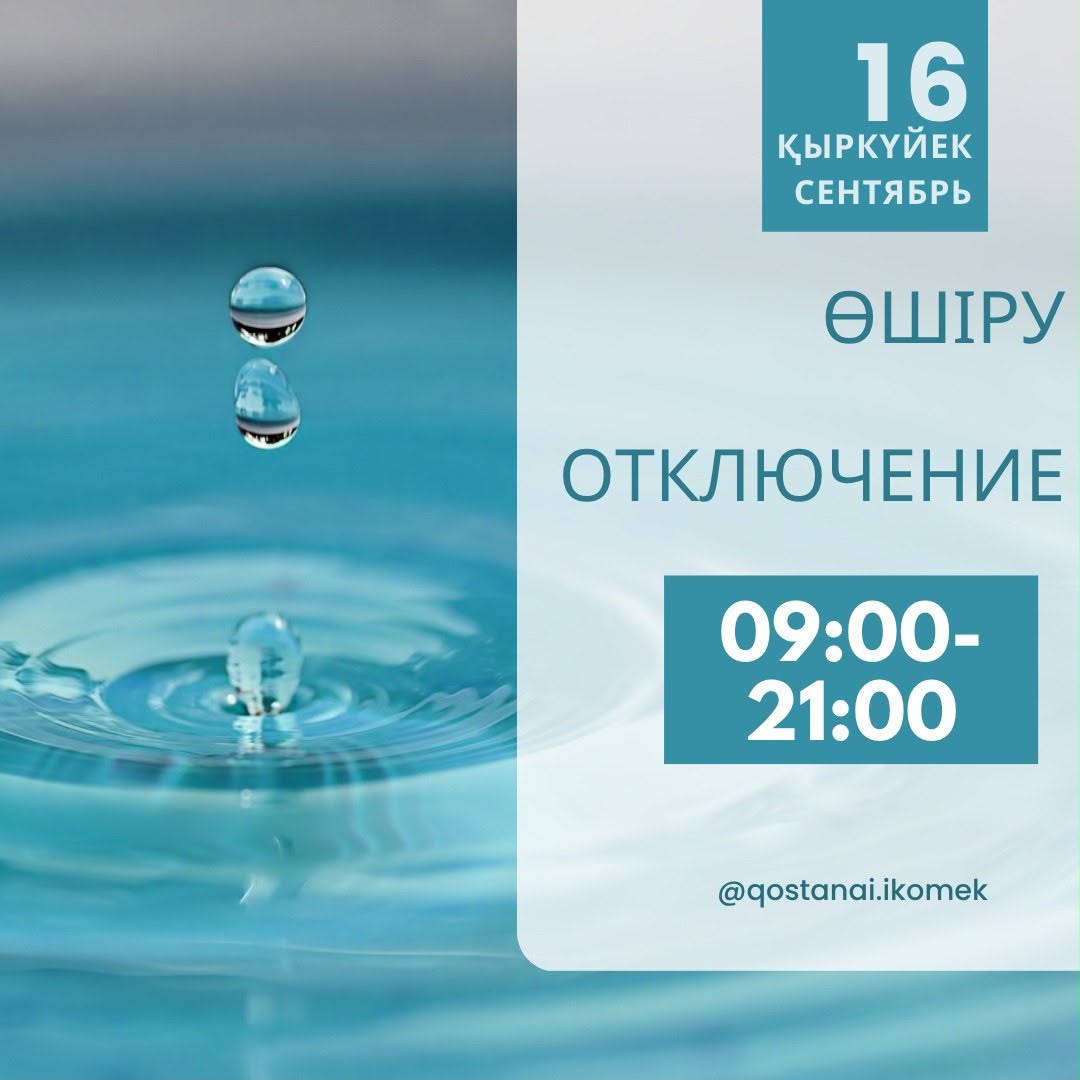
Due to repair works on overhead power lines, temporary power outages are scheduled.“Fedorov” Transformer SubstationOutage period:May 18–22, 2026Time: 10:00 AM – 6:00 PMPrivate residential sector:Doshchanov St.: 83–180, 180a, 99/1–99/11, 101a, 176/1–176/10Borodin St.: 24–45Shayakhmetov St.: 24–37, 35/1–35/14Zhuravleva St.: 98–138, 123/1–123/12Letunov St.: 11–36RP-9Outage period:May 18–22, 2026Time: 09:00 AM – 6:00 PMFacilities:Old church — 212 Altynsarin St.Stores:“Partner”“Na Kryuchke”“Promtovary”Service station — 56 Shipin St.Private residential sector:Altynsarin St.: 182–228Shipin St.: 50–61, 61aKassymkanov St.: 144–199, 152aRabochaya St.: 61–74, 61aProletarskaya St.: 74–84Traffic lights temporarily отключены:Nazarbayev Ave. — Altynsarin St. intersectionResidents are kindly asked to take the necessary precautions in advance and treat the temporary inconvenience with understanding.Source : https://www.gov.kz/memleket/entities/kostanai-kalasy-akimat/press/news/details/1223373?lang=kk
Press release about the organization of the summer language camp outside the school 19.05.2026
According to the plan of the KSU "East Kazakhstan Regional Scientific and Methodological Center for Informatization and Development of Education 'Örken'" of the Education Department of the East Kazakhstan Region, from June 1 of this year, school-based language camps for 4,255 students will begin operating in 340 general education organizations in the region.The goal of the camp is to develop students' language skills (listening, speaking, reading, and writing), expand vocabulary in three languages, and develop the ability to freely express their thoughts.In 121 schools with 2,155 students, activities will be organized to adapt children to the Kazakh-language environment; in 140 schools with 1,740 children — to the Russian-language environment; and in 18 lyceums and gymnasiums, 300 children will be adapted to the English-language environment.Dates: June 1–12, 2026Participants: students in grades 2–5.Source : https://www.gov.kz/memleket/entities/vko-bilim/press/news/details/1223374?lang=kk
Members of the Kuwaiti Royal Family Express Interest in Investing in Kazakhstan’s Agricultural and Real Estate Sectors 19.05.2026
Al-Kuwait, May 18, 2026 – The Ambassador of the Republic of Kazakhstan to the State of Kuwait Yerzhan Yelekeyev held a meeting with Sheikha Ohoud Salem Al-Ali Al-Sabah, during which the parties discussed prospects for the development of trade, economic and investment cooperation between Kazakhstan and Kuwait.During the meeting, the parties discussed opportunities for cooperation in the fields of agriculture and the agro-industrial complex. It was emphasized that Kazakhstan is one of the world’s major grain exporters, supplying agricultural products to more than 80 countries worldwide. The Ambassador of Kazakhstan also noted that the country continues to strengthen its position in the global oilseed market, having recently entered the world’s top 10 exporters of sunflower oil.Particular attention was paid to food security issues. The Ambassador noted that Kazakhstan possesses significant potential to contribute to ensuring food security not only for the State of Kuwait, but also for the region as a whole, including through the supply of environmentally friendly and high-quality agricultural products.In this context, the parties, together with representatives of “Al Deira” company, discussed in detail the prospects for supplying Kazakh meat products to the Kuwaiti market, including beef and lamb exports. The Kuwaiti side expressed interest in establishing cooperation with leading Kazakh producers and suppliers of meat products.Following the meeting, an agreement was reached to organize a visit of Kuwaiti representatives to Kazakhstan in the summer of 2026 in order to further explore opportunities for cooperation, hold meetings with enterprises, and discuss prospects for importing Kazakh meat products.The parties also exchanged views on cooperation in the fields of real estate and investment, including the participation of “Al Ahd Al Mushtarak” company in the implementation of investment and infrastructure projects in Kazakhstan, including the “Alatau City” accelerated development project. The Kazakh side presented information on the project’s potential, its special legal status and opportunities available for foreign investors.At the conclusion of the meeting, the interlocutors confirmed their mutual interest in further expanding bilateral trade and economic cooperation and developing direct contacts between the business communities of Kazakhstan and Kuwait.“Al Deira”company operates in the field of food distribution in the State of Kuwait, supplying retail chains, restaurants, hotels and other HoReCa sector facilities. The company is considered one of the notable players in Kuwait’s food distribution market and is currently exploring opportunities to expand imports of meat products from the Republic of Kazakhstan. Founded in 2001, “Al Ahd Al Mushtarak” company operates in the fields of construction, real estate, facility management and interior design in the State of Kuwait. The companies are part of the family business structure of Sheikha Ohoud Salem Al-Ali Al-Sabah. Sheikha Ohoud Al-Salem Al-Ali Al-Sabah is a Kuwaiti public figure and entrepreneur, founder of a number of companies and initiatives in the fields of real estate, asset management, youth development and entrepreneurship support. Under her leadership, projects in the real estate sector are being implemented, along with initiatives aimed at supporting young talents and the development of creative industries in the State of Kuwait.Source : https://www.gov.kz/memleket/entities/mfa-kuveyt/press/news/details/1223339?lang=kk